
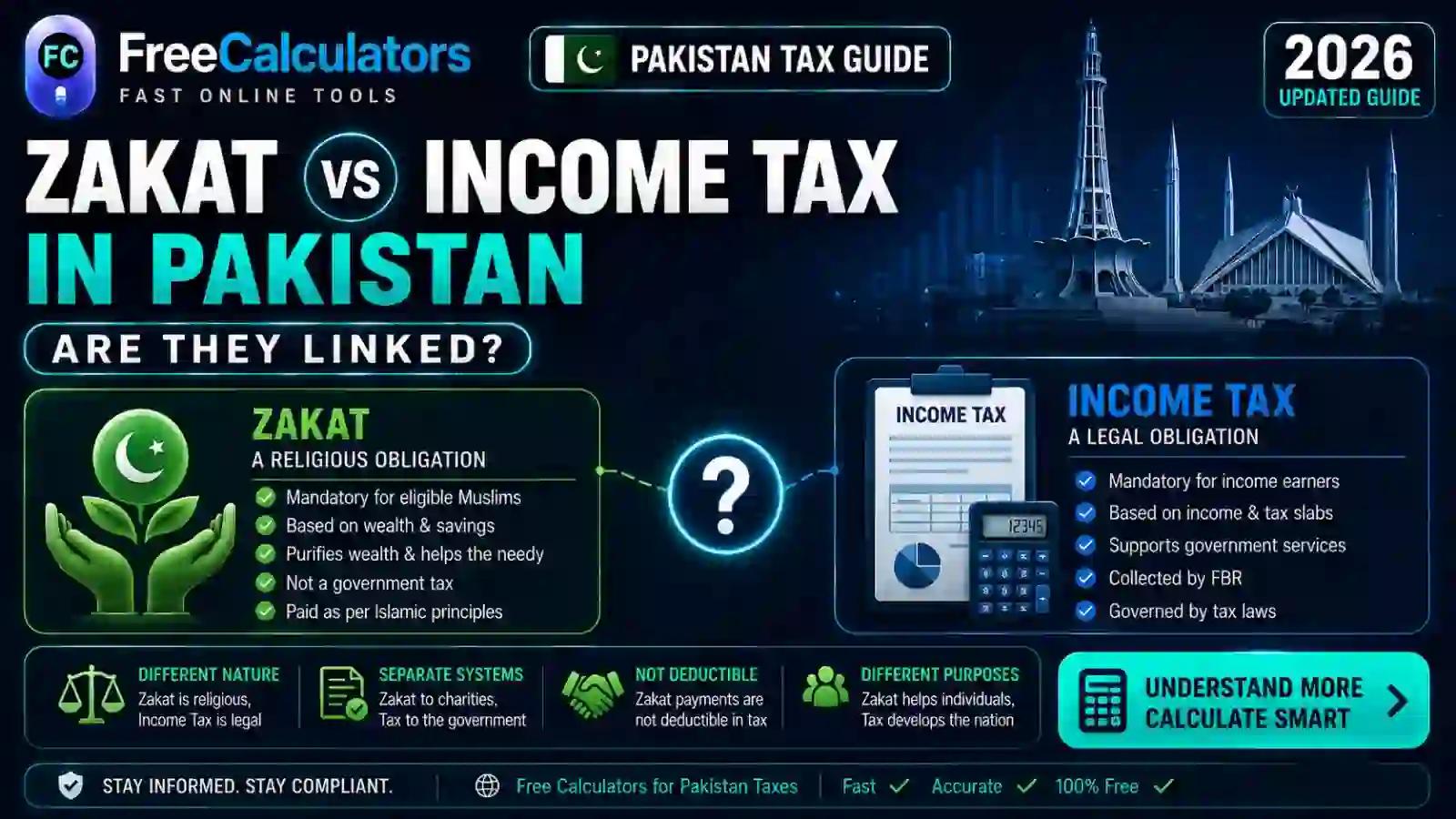
Zakat and income tax in Pakistan are two entirely separate obligations — one religious, one legal — and paying one does not exempt you from the other. Zakat is a fixed 2.5% religious levy on qualifying savings and assets, collected mostly through automatic bank deduction under the Zakat and Ushr Ordinance, 1980, while income tax is a progressive, government-mandated levy on earnings, filed annually through the FBR. The confusion between the two is understandable, since both are deducted from money you've already earned — but they answer to different authorities, follow different rules, and in most cases, aren't linked at all. This guide breaks down exactly how each works, where they overlap, and what to do if you're being deducted for both.
What Is Zakat, Exactly?
Zakat is one of the Five Pillars of Islam — a religious obligation requiring eligible Muslims to give 2.5% of their qualifying wealth to those in need, once that wealth has been held for a full lunar year and exceeds a minimum threshold called the Nisab.
In Pakistan specifically, Zakat isn't left entirely to individual discretion the way it is in many other countries. According to < cite index="46-1">the Zakat Council system, Pakistan introduced compulsory collection and distribution of Zakat and Ushr in 1980 through an ordinance decreed by General Muhammad Zia-ul-Haq, mandating a 2.5% annual deduction from personal bank accounts on the first day of Ramadan, with the revenue used for poverty relief.</cite> This makes Pakistan one of the few countries where Zakat collection is partly institutionalized through the banking system rather than left purely to personal responsibility.
The Nisab threshold — the minimum wealth level that triggers Zakat liability — is pegged to the value of gold or silver. Since metal prices fluctuate constantly, the exact Nisab in rupees changes year to year, which is why checking a current calculator rather than relying on an old figure matters.
What Is Income Tax, and How Is It Different?
Income tax is a completely separate matter — a statutory, government-imposed levy on earnings, collected by the Federal Board of Revenue (FBR) under Pakistan's income tax laws. It applies to everyone earning above the taxable threshold, regardless of religion, and is calculated using progressive slabs, meaning higher income brackets are taxed at higher rates.
< cite index="54-1">Taxation in Pakistan is managed by the FBR, which operates under the Ministry of Finance and is responsible for formulating tax policies, collecting federal taxes, and ensuring compliance with tax laws, while also overseeing departments dealing with income tax, sales tax, and customs.</cite> Filing happens annually through the FBR's IRIS portal, and your final liability depends on your income bracket, filer status, and any applicable deductions or credits.
Here's the core distinction in plain terms:
| Feature | Zakat | Income Tax |
|---|---|---|
| Basis | Religious obligation (Islamic law) | Legal/statutory obligation |
| Applies to | Muslims meeting the Nisab threshold | All eligible earners, regardless of religion |
| Rate | Fixed 2.5% | Progressive slabs (0% to 35%+ depending on income) |
| Collected by | Banks (automatic deduction) or private payment to Zakat committees | Federal Board of Revenue (FBR) |
| Timing | Deducted once a year, typically on 1st Ramadan | Filed annually, tax year runs July to June |
| Deductible from the other? | No automatic offset in most cases | No automatic offset in most cases |
Are Zakat and Income Tax Actually Linked?
Here's the direct answer: no, not in the sense most people assume. Paying Zakat does not reduce your income tax liability, and paying income tax does not exempt you from Zakat. They are calculated independently, collected by entirely different systems, and serve different purposes — one is worship-based charity, the other is state revenue for public services.
That said, there's a practical overlap worth understanding. Since Zakat is deducted automatically from savings accounts, and income tax is often withheld directly from salaries or bank transactions, many salaried Pakistanis feel like they're being taxed twice around the same period — especially since both processes can involve bank-level deductions. But structurally, these are two unrelated deduction systems running in parallel, not one feeding into the other.
There is no standard provision under Pakistani tax law allowing Zakat payments to be claimed as a direct deduction against your income tax liability, the way some countries allow charitable donations to reduce taxable income. If you're looking for exact deduction eligibility for your specific case, running your numbers through an income tax calculator gives you clarity on your actual tax liability separate from any Zakat obligation.
How Zakat Deduction Actually Works in Pakistan
Understanding the mechanics helps explain why so many people get confused about whether Zakat "counts" toward tax.
- Automatic deduction on 1st Ramadan: Banks deduct 2.5% of eligible savings account balances automatically on the first day of Ramadan each year, as required under the Zakat and Ushr Ordinance.
- Applies mainly to Sunni account holders: The compulsory deduction system historically applies to Sunni Muslims; Shia Muslims and others who follow different Zakat jurisprudence can file a declaration to be exempted from the automatic bank deduction.
- Not all accounts are Zakatable: Current accounts, foreign currency accounts, and certain other account types are typically excluded from automatic deduction — only qualifying savings-type accounts are affected.
- Collected funds go to provincial Zakat authorities, such as the Zakat and Ushr Department in each province, which then distributes funds to eligible recipients through local Zakat committees.
If you'd rather calculate your own Zakat liability manually rather than relying solely on the bank's automatic deduction — useful if you hold gold, business assets, or savings across multiple accounts — a dedicated Zakat calculation approach covering all your assets gives a more accurate figure than the bank deduction alone, since banks only see what's in that specific account.
How to Avoid or Get Exempted From Automatic Zakat Deduction
This is one of the most searched practical questions on this topic, so it's worth addressing directly.
- File a declaration form (commonly known as CZ-50) with your bank if you follow Fiqh-e-Jafria (Shia jurisprudence) or otherwise qualify for exemption under the ordinance — this must typically be submitted before the Zakat deduction date each year.
- Move funds to a non-Zakatable account type before 1st Ramadan if the account doesn't need to sit in a Zakatable savings account year-round.
- Keep documentation of Zakat already paid privately if you prefer to calculate and distribute your own Zakat rather than have the bank deduct and forward it through the provincial system — some account holders choose this route for more direct control over where their Zakat goes.
- Understand this is separate from tax exemption paperwork. Zakat exemption declarations only affect the bank's automatic religious deduction — they have zero bearing on your FBR income tax filing status or liability.
Understanding the Nisab Threshold
The Nisab is the minimum amount of wealth a Muslim must hold before Zakat becomes obligatory, and it's calculated using either the gold or silver standard.
< cite index="43-1">Nisab is based on the value of 87.48 grams of gold or 612.36 grams of silver, and since the value of these metals fluctuates, the Nisab threshold changes accordingly.</cite> Most scholars and Zakat authorities recommend using the silver standard, since it results in a lower threshold — meaning more people who genuinely have surplus wealth end up contributing, which aligns more closely with Zakat's redistributive purpose.
Because gold and silver prices shift constantly — and have moved significantly in recent years — the exact Nisab value in Pakistani rupees needs to be checked close to the date you're calculating, rather than relied on from a prior year's figure.
Understanding Pakistan's Income Tax Slab System
Unlike Zakat's flat 2.5% rate, Pakistan's income tax operates on a progressive slab system — the more you earn, the higher the marginal rate applied to income within each bracket.
A few structural points worth understanding:
- Salaried individuals are taxed under one slab structure, while non-salaried individuals and Associations of Persons (AOPs) — business owners, freelancers, professionals — fall under a different, often steeper slab structure.
- Filer vs. non-filer status matters significantly. Registered tax filers on the FBR's Active Taxpayer List generally face lower withholding tax rates on banking transactions, vehicle purchases, and property transfers compared to non-filers.
- The tax year in Pakistan runs from July 1 to June 30, and slabs are typically revised through the annual Finance Act, meaning rates and thresholds can shift year to year based on the federal budget.
- A surcharge can apply to higher earners. Budget measures in recent years have added additional surcharges on salaried individuals crossing certain high-income thresholds, on top of the standard slab rate.
Because these figures are revised annually and vary based on your exact income and filer status, the most reliable way to know your actual liability is to run your numbers through a current FBR tax calculator or salary tax calculator rather than relying on a fixed number that may be outdated by the time you read it.
Zakat vs. Ushr: A Related but Different Obligation
Since both fall under the same 1980 ordinance, it's worth briefly clarifying how Ushr differs from Zakat, since the two are often mentioned together.
Ushr is the agricultural equivalent of Zakat — a levy on crop produce rather than savings or cash wealth, historically set at a rate that varies based on how the land was irrigated (naturally rain-fed land typically carries a different rate than land irrigated through artificial means). Like Zakat, Ushr collection in Pakistan is administered through the provincial Zakat and Ushr departments rather than the FBR, reinforcing that both remain entirely outside the income tax system.
Why the Confusion Between Zakat and Tax Persists
A few practical reasons explain why so many Pakistanis assume there's more overlap than there actually is:
- Both involve automatic bank deductions. Zakat is deducted directly from savings accounts, and various withholding taxes are deducted from banking transactions — this proximity makes them feel like part of the same system, even though they're administered completely separately.
- Both are calculated as a percentage of money you already hold or earn, which creates an intuitive (but incorrect) assumption that they should offset each other.
- Government involvement in Zakat collection — since it's collected via a state ordinance rather than purely voluntary charity — makes it feel more "tax-like" than it would in countries where Zakat is entirely self-administered.
- Timing coincidence: Zakat deduction on 1st Ramadan sometimes falls close to tax filing season concerns, reinforcing the sense that they're connected financial events even though the calendars are unrelated.
Understanding that these are structurally independent systems — one rooted in religious law and voluntary community welfare, the other in federal fiscal policy — clears up most of the confusion once you see the mechanics side by side.
Practical Scenarios: How This Plays Out for Different People
Salaried employees: Income tax is withheld directly from your salary by your employer and reported to the FBR. Zakat, separately, gets deducted from your savings account balance (if applicable) on 1st Ramadan. Neither affects the other's calculation.
Business owners: You'll calculate Zakat on qualifying business assets — inventory, cash reserves, receivables — separately from your business income tax return, which follows the non-salaried/AOP slab structure and involves its own set of deductions and expense claims.
Overseas Pakistanis: If you hold a Pakistani bank account with savings that qualify under Zakat rules, the automatic deduction can still apply. Meanwhile, your income tax obligation depends heavily on your residency status and where your income is earned — these are governed by different residency tests entirely.
Freelancers: Freelance income is generally subject to income tax under FBR rules once it crosses the taxable threshold, filed as business or professional income. Zakat liability, separately, depends on your savings and asset holdings at year-end, not your freelance earnings directly.
Frequently Asked Questions
Is Zakat linked to income tax in Pakistan? No. They are two separate obligations — Zakat is a religious levy governed by the Zakat and Ushr Ordinance, 1980, while income tax is a statutory levy governed by FBR tax law. Paying one does not reduce or exempt you from the other.
Do I pay Zakat and income tax separately? Yes. Zakat is typically deducted automatically from qualifying bank accounts on 1st Ramadan, while income tax is either withheld from your salary throughout the year or calculated and paid when you file your annual return with the FBR.
Can Zakat be adjusted against income tax liability? No, there is no standard provision under Pakistani tax law that allows Zakat payments to be deducted from or offset against your income tax liability. The two systems calculate and collect independently.
Why is Zakat automatically deducted in Pakistan? Because the Zakat and Ushr Ordinance, 1980 established a compulsory collection system requiring banks to deduct 2.5% from eligible savings accounts on the first day of Ramadan each year, with proceeds distributed through provincial Zakat authorities to those in need.
Is Zakat mandatory by law in Pakistan? Automatic bank deduction is mandatory for eligible Sunni account holders under the ordinance, though individuals who follow different jurisprudence (such as Shia Muslims) can file for exemption from the bank-level deduction and manage their own Zakat payments independently.
How much is income tax compared to Zakat in Pakistan? Zakat is a fixed 2.5% of qualifying wealth above the Nisab threshold. Income tax is progressive, meaning the rate increases with income — ranging from 0% for those below the taxable threshold up to a top marginal rate well above Zakat's flat rate for high earners.
Can non-Muslims be exempted from Zakat deduction in Pakistan? Yes. Automatic Zakat deduction applies specifically to Muslim account holders under the ordinance's framework; non-Muslims are not subject to this particular deduction, though they remain fully subject to income tax like any other earner.
Final Takeaway
Zakat and income tax in Pakistan run on entirely separate tracks — one is a fixed religious obligation rooted in the Zakat and Ushr Ordinance, 1980, and the other is a progressive statutory tax administered by the FBR, and neither offsets or reduces the other under current law. If you're trying to plan around both, the most useful next step is treating them as two completely independent calculations: check your Zakat liability against the current Nisab for your savings and assets, and separately run your income through an income tax calculator or FBR tax calculator to know exactly where you stand with the government. Getting clarity on both — rather than assuming one covers the other — is the only way to make sure you're meeting your religious obligation and your legal one, in full, without over- or under-paying either.