
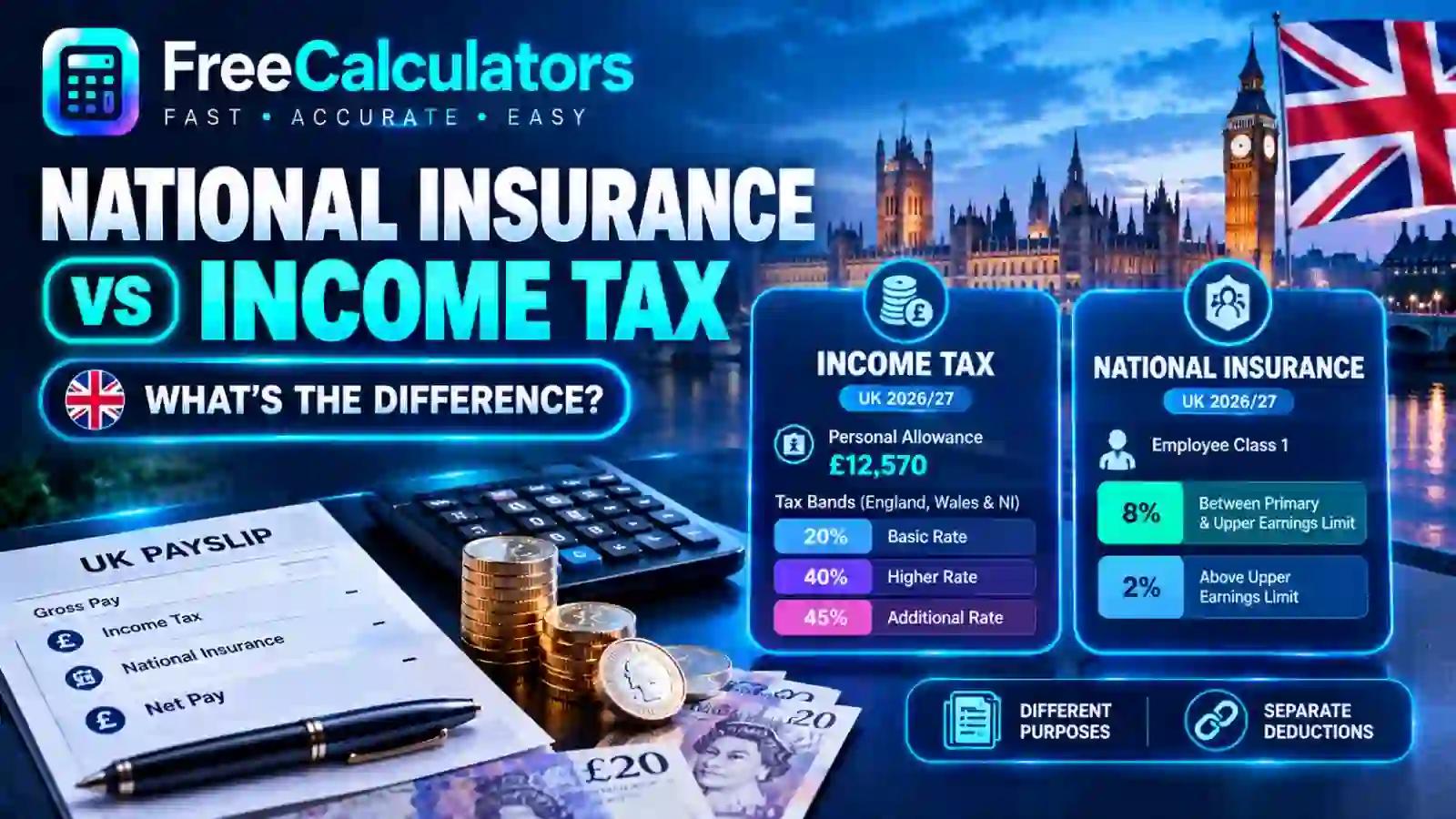
Look at any UK payslip and you'll usually see two separate deductions eating into your gross pay: Income Tax and National Insurance. They often get lumped together as "the tax I pay," but they're actually two distinct systems with different purposes, different thresholds, and different rules for who pays what. Understanding the difference matters — especially if you're self-employed, planning around a pay rise, or trying to figure out exactly why your take-home pay looks the way it does.
This guide breaks down exactly how Income Tax and National Insurance work in the UK for the 2026/27 tax year, what each one funds, and how they interact on a real payslip.
What Is Income Tax?
Income Tax is a direct tax on your earnings, collected by HM Revenue & Customs (HMRC). It funds general government spending — everything from the NHS and education to defence and infrastructure — rather than any single specific benefit.
For most employees, Income Tax is deducted automatically through PAYE (Pay As You Earn) before you're paid. According to GOV.UK's official Income Tax rates page, the standard Personal Allowance for 2026/27 is £12,570 — the amount you can earn before paying any Income Tax at all.
For England, Wales, and Northern Ireland, the 2026/27 Income Tax bands are:
| Band | Taxable Income | Rate |
|---|---|---|
| Personal Allowance | Up to £12,570 | 0% |
| Basic rate | £12,571 to £50,270 | 20% |
| Higher rate | £50,271 to £125,140 | 40% |
| Additional rate | Over £125,140 | 45% |
One detail that trips people up: the Personal Allowance doesn't stay fixed for everyone. Once your adjusted net income passes £100,000, the allowance shrinks by £1 for every £2 you earn above that threshold, disappearing entirely once you hit £125,140. This creates an effective marginal tax rate of 60% in that income band — a detail that catches many higher earners off guard.
What Is National Insurance?
National Insurance (NI) is a separate contribution system, also collected through PAYE, but with a completely different purpose. Rather than funding general spending, NI contributions build your entitlement to specific state benefits — most importantly the State Pension, but also things like Statutory Sick Pay, Maternity Allowance, and contribution-based Jobseeker's Allowance.
This is the single biggest conceptual difference between the two: Income Tax is a general tax; National Insurance is closer to a contribution-based insurance scheme that unlocks specific entitlements.
For 2026/27, employee Class 1 National Insurance works like this:
| Earnings | Weekly Equivalent | NI Rate |
|---|---|---|
| Below Primary Threshold | Up to £242 | 0% |
| Primary Threshold to Upper Earnings Limit | £242 to £967 | 8% |
| Above Upper Earnings Limit | Over £967 | 2% |
In annual terms, that's a Primary Threshold of £12,570 (the same figure as the Income Tax Personal Allowance, which is why the two often get confused) and an Upper Earnings Limit of £50,270.
Income Tax vs National Insurance: Side-by-Side
| Feature | Income Tax | National Insurance |
|---|---|---|
| Purpose | Funds general government spending | Funds State Pension and specific contributory benefits |
| Collected by | HMRC via PAYE or Self Assessment | HMRC via PAYE or Self Assessment |
| 2026/27 threshold | £12,570 (Personal Allowance) | £12,570 (Primary Threshold) |
| Main rate | 20% / 40% / 45% depending on band | 8% up to £50,270, then 2% |
| Calculated | Cumulatively across the tax year | Per pay period (weekly/monthly), not cumulative |
| Paid by pensioners on employment income | Yes, if still working | No — NI stops once you reach State Pension age |
| Builds entitlement to | Nothing specific | State Pension, certain benefits |
That last row surprises a lot of people: once you reach State Pension age, you stop paying National Insurance entirely, even if you keep working — but you continue paying Income Tax on any income above your Personal Allowance for as long as you're earning.
Why Are They Calculated So Differently?
Income Tax is cumulative. HMRC looks at your total earnings across the tax year and applies your Personal Allowance and tax bands to that running total, which is why your tax code adjusts your deductions gradually.
National Insurance, on the other hand, is calculated per pay period — weekly or monthly, depending on how you're paid — rather than as a running annual total. This matters in practice: if your earnings fluctuate month to month (say, from irregular overtime or bonuses), you might pay NI in a high-earning month but nothing in a quieter one, even if your average monthly earnings across the year would otherwise sit below the threshold.
Employer National Insurance: The Deduction You Don't See
Here's something that doesn't show up on your payslip but affects the wider economy: employers also pay Class 1 National Insurance on top of what they pay you. For 2026/27, the employer rate is 15% on earnings above the £5,000 Secondary Threshold, with no upper limit — meaning employers keep paying that 15% on every pound above the threshold, no matter how high the salary goes.
This is why the true cost of employing someone is always higher than their gross salary, and it's a cost businesses factor into hiring decisions and salary negotiations.
National Insurance for the Self-Employed
If you're self-employed, the NI picture changes. Since April 2024, mandatory Class 2 contributions were abolished for self-employed people with profits above the Small Profits Threshold — these are now treated as paid automatically, protecting your State Pension record without a separate payment. Below that threshold, Class 2 becomes voluntary if you want to keep building qualifying years.
Class 4 National Insurance is the one self-employed people actually pay as a percentage of profits, calculated through Self Assessment rather than PAYE. If you're weighing up sole trader status against running a limited company, it's worth comparing this against our Self-Employment Tax Guide and running the numbers through the Pakistan Withholding Tax Calculator or US Self-Employment Tax Calculator if you're comparing structures across jurisdictions.
Scotland: A Genuine Exception
National Insurance rates and thresholds are the same UK-wide, including in Scotland — they're set by Westminster, not the Scottish Parliament. Income Tax is different: Scotland sets its own rates and bands for non-savings, non-dividend income.
For 2026/27, Scottish Income Tax bands are:
| Band | Taxable Income | Rate |
|---|---|---|
| Personal Allowance | Up to £12,570 | 0% |
| Starter rate | £12,571 to £16,537 | 19% |
| Basic rate | £16,538 to £29,526 | 20% |
| Intermediate rate | £29,527 to £43,662 | 21% |
| Higher rate | £43,663 to £75,000 | 42% |
| Advanced rate | £75,001 to £125,140 | 45% |
| Top rate | Over £125,140 | 48% |
This means a Scottish taxpayer earning £45,000 pays a noticeably different Income Tax bill than someone earning the same salary in England, Wales, or Northern Ireland — even though both pay identical National Insurance, since NI doesn't have a Scottish variant.
Does National Insurance Really Count Toward Your Pension?
Yes — and this is arguably the most practical reason to actually understand NI rather than treating it as "extra tax." According to GOV.UK's guidance on the new State Pension, you generally need at least 10 qualifying years on your National Insurance record to receive any new State Pension at all, and typically 35 qualifying years for the full amount.
A "qualifying year" doesn't necessarily mean you paid NI that year — earning between the Lower Earnings Limit and the Primary Threshold still counts as a qualifying year even though no NI is actually deducted at that income level. This is why people with gaps in their employment (career breaks, part-time work, time abroad) sometimes discover they're short of qualifying years and choose to pay voluntary Class 3 contributions to fill the gap.
A Practical Example
Let's say you earn £45,000 a year as an employee in England.
Income Tax:
- First £12,570 — tax-free
- £12,571 to £45,000 (£32,430) taxed at 20% = £6,486
National Insurance:
- First £12,570 — no NI
- £12,571 to £45,000 (£32,430) at 8% = £2,594.40
Total combined deduction: roughly £9,080 before any pension contributions or student loan deductions are factored in — which is why two people with identical gross salaries can have quite different take-home pay once other deductions are added.
Common Questions
Is National Insurance just another form of Income Tax?
No. They're calculated differently, serve different purposes, and stop at different points — NI stops at State Pension age, Income Tax doesn't.
Do I pay National Insurance and Income Tax on the same income?
Generally yes, if you're an employee earning above both thresholds. Since both the Personal Allowance and Primary Threshold sit at £12,570 for 2026/27, most working-age earners start paying both taxes at the same point.
Do pensioners pay National Insurance?
No. Once you reach State Pension age, NI stops on employment income, even if you continue working. Income Tax, however, still applies to earnings above your Personal Allowance.
Does paying more Income Tax increase my State Pension?
No. Only National Insurance contributions count toward your State Pension entitlement — Income Tax has no bearing on it whatsoever.
Which is deducted first from my payslip, tax or NI?
Both are calculated independently and deducted in the same pay run; neither reduces the other's calculation base.
Can I check how much tax and NI I've paid?
Yes, through your Personal Tax Account on GOV.UK, or via your payslip and P60, which show cumulative Income Tax and NI contributions for the tax year.
Bringing It Together
Income Tax and National Insurance often get mentally filed under the same heading — "money that disappears from my payslip" — but they're built for different jobs. Income Tax funds the country broadly; National Insurance builds your personal entitlement to specific benefits, most importantly your State Pension.
Knowing the difference matters most in a few real situations: deciding whether to fill NI gaps with voluntary contributions, understanding why your pay changes once you hit State Pension age, or comparing employee versus self-employed tax treatment before making a career decision. If you want to see exactly how these two deductions apply to your own salary, run your numbers through the UK National Insurance Calculator — it's the fastest way to see the actual pounds-and-pence impact rather than working through the bands by hand.