
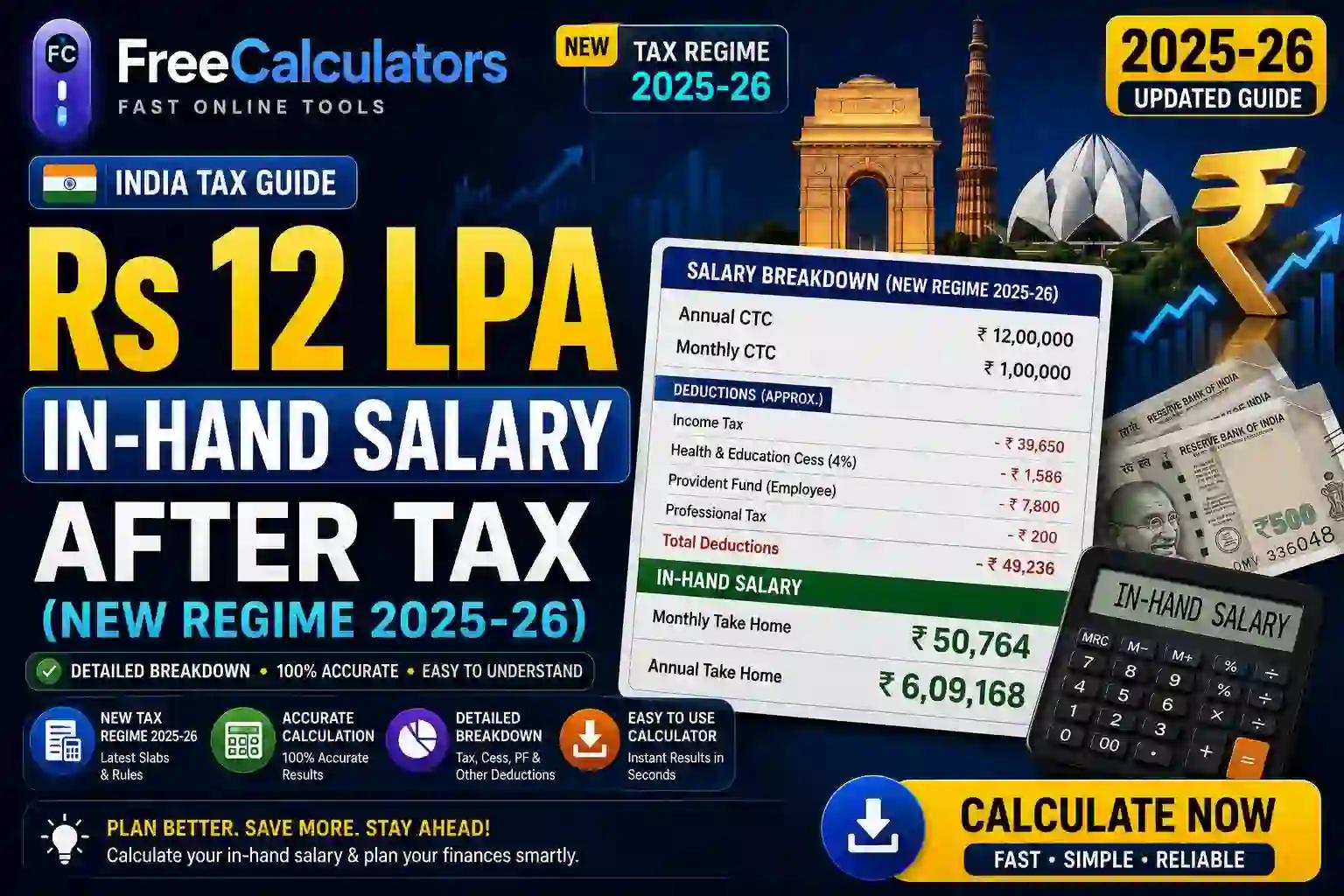
If your offer letter says ₹12 LPA, the number that actually lands in your bank account every month is smaller — and figuring out exactly how much smaller trips up almost everyone, including people who've been working for years. Between employer PF contributions, gratuity, professional tax, and the way tax slabs actually apply, the gap between "CTC" and "in-hand" can be confusing.
under the new tax regime for FY 2025-26, a ₹12 LPA salary is largely or fully tax-free once you account for the ₹75,000 standard deduction and the Section 87A rebate, which zeroes out tax for anyone with taxable income up to ₹12 lakh. For a typical salary structure, the monthly in-hand salary usually falls somewhere between ₹85,000 and ₹95,000, depending on how your company structures PF, gratuity, and allowances. This article breaks down exactly how that number is calculated, so you're not just taking someone's word for it.
CTC vs Gross Salary vs Net (In-Hand) Salary
Before the math makes sense, these three terms need to be separated — companies often use them interchangeably in casual conversation, which is exactly why offer letters confuse people.
- CTC (Cost to Company) is the total amount your employer spends on you annually. It includes your salary, employer's PF contribution, gratuity, and any other benefits like insurance premiums.
- Gross Salary is what's left after subtracting the employer's contributions (PF and gratuity) from CTC. This is the figure your tax is actually calculated on.
- Net Salary (In-Hand) is gross salary minus your own PF contribution, professional tax, TDS, and any other employee-side deductions. This is what actually hits your bank account.
A ₹12 LPA CTC is never a ₹12 LPA gross salary — the employer's PF contribution and gratuity are carved out first, which is a detail a lot of people miss when they compare offers.
Salary Breakdown: ₹12 LPA CTC to In-Hand (Illustrative)
Every company structures salaries differently, so treat this as a realistic working example rather than a universal figure. This assumes a fairly standard structure where basic pay is 40% of CTC — a common but not fixed ratio.
The critical line here is the tax payable: ₹0. Because taxable income after the standard deduction stays under ₹12 lakh, the Section 87A rebate wipes out the entire calculated tax liability. Your only real deductions are PF and professional tax — no income tax at all.
If you want to run this against your own actual salary slip rather than an illustrative structure, FreeCalculaters' income tax calculator lets you plug in your exact basic, HRA, and other components for a precise number.
New Tax Regime Slabs for FY 2025-26 (AY 2026-27)
Budget 2025 reshaped these slabs significantly, and they're the reason a 12 LPA salary now pays little to no tax compared to a few years ago.
On paper, someone with exactly ₹12,00,000 taxable income owes ₹60,000 in tax (nil on the first ₹4L, 5% on the next ₹4L = ₹20,000, 10% on the next ₹4L = ₹40,000). But Section 87A grants a rebate of up to ₹60,000 for anyone whose taxable income doesn't cross ₹12 lakh — which cancels that liability entirely. That's why the final tax comes out to zero, not because the slabs themselves are zero-rated.
For salaried employees specifically, the ₹75,000 standard deduction pushes the effective tax-free ceiling even higher — up to ₹12.75 lakh of gross salary, since the deduction brings taxable income back down to the ₹12 lakh threshold where the rebate still applies.
You can see the full slab structure with worked examples across different income levels in our detailed FY 2025-26 income tax slabs guide.
Step-by-Step: How the ₹12 LPA Calculation Actually Works
Step 1 — Start with CTC. Your CTC is ₹12,00,000. This is not what you're taxed on.
Step 2 — Subtract employer contributions. Employer PF (typically 12% of basic) and gratuity (4.81% of basic) come out first. These aren't paid to you and aren't taxed as your income.
Step 3 — Arrive at gross salary. This is what's left — roughly ₹11.0–11.3 lakh depending on your basic pay ratio.
Step 4 — Apply the standard deduction. Every salaried employee gets a flat ₹75,000 deduction under the new regime, no proof or investment required.
Step 5 — Calculate tax on the remaining taxable income. Apply the slab rates above.
Step 6 — Apply the Section 87A rebate. If taxable income is at or below ₹12 lakh, the rebate cancels the tax completely.
Step 7 — Subtract employee-side deductions. Your own PF contribution and professional tax (if applicable in your state) come out of gross salary regardless of your tax liability — these aren't income tax, they're separate deductions.
Step 8 — What's left is your in-hand salary, paid out monthly.
This is the exact logic our old vs new tax regime comparison tool runs in the background, so you can see it applied to your own numbers instantly.
Old Regime vs New Regime for a ₹12 LPA Salary
This is where the new regime clearly wins for most people at this income level — unless you're claiming substantial deductions.
If you're not claiming HRA (because you live with family or own your home) and haven't maxed out Section 80C investments, the new regime is almost always the better choice at ₹12 LPA — the zero-tax outcome alone makes the decision easy.
That said, if you pay significant rent in a metro city and can claim HRA, or you've got a home loan and full 80C utilisation, it's worth actually running both scenarios rather than assuming. Our old vs new regime breakdown walks through exactly when the old regime still wins, and this guide on Section 80C deductions covers what's still available if you do go with the old regime.
Monthly In-Hand Salary for ₹12 LPA
Based on the illustrative breakdown above, here's roughly what you can expect month to month:
- Gross monthly salary: ~₹93,276
- Employee PF deduction: ~₹4,800
- Professional tax: ~₹200 (varies by state)
- Monthly in-hand salary: approximately ₹88,000–₹90,000
This range shifts depending on your company's specific structure. A company that keeps basic pay lower (say, 30% of CTC instead of 40%) will have a smaller PF deduction and a slightly higher in-hand figure. Conversely, a higher basic pushes more of your CTC into gratuity and PF, both of which reduce take-home even though they don't get taxed immediately.
Factors That Change Your Actual In-Hand Salary
A generic "12 LPA = X in-hand" number can be misleading because real salary structures vary quite a bit. Here's what actually moves the needle:
- Basic salary ratio. Higher basic means higher PF (both employer and employee side), which reduces monthly in-hand even though it builds retirement savings.
- Variable pay or bonus components. If part of your CTC is a performance bonus, your fixed monthly in-hand will be lower than the average CTC/12 suggests, since bonuses are typically paid annually or quarterly.
- State of employment. Professional tax rules differ — Karnataka, Maharashtra, and West Bengal levy it, while several other states don't. It's a small amount (usually ₹200–₹300/month) but it does affect the final number.
- Employer PF policy. Some companies calculate PF on ₹15,000 basic (the statutory minimum wage ceiling) rather than actual basic salary, which changes your deduction significantly.
- Additional benefits. Meal cards, LTA, or other reimbursement components can shift how much of your CTC actually counts as "cash in hand" each month versus being routed through non-cash benefits.
How to Structure Your ₹12 LPA Salary for a Better In-Hand Number
If you're negotiating an offer or discussing restructuring with HR, a few practical levers exist:
- Ask about the basic-to-CTC ratio. A lower basic (within reasonable limits) reduces mandatory PF and gratuity outflow, increasing your monthly cash.
- Check if bonus/variable pay is guaranteed or performance-linked. Guaranteed components are more predictable for monthly budgeting.
- Understand your state's professional tax slab so there are no surprises on your payslip.
- If you're eligible for HRA and pay significant rent, compare whether the old regime, with HRA exemption included, actually beats the new regime's flat rebate — don't assume the new regime always wins.
- Use a calculator with your exact numbers rather than relying on generic online estimates, since even a 5% shift in basic salary can change your monthly in-hand by a few thousand rupees.
For a full walkthrough of how salaried professionals in India should approach this calculation each year, see our guide on calculating income tax for salaried employees.
Frequently Asked Questions
Is ₹12 LPA tax-free under the new regime? Largely, yes. If your taxable income after the ₹75,000 standard deduction stays at or below ₹12 lakh, the Section 87A rebate brings your income tax down to zero. You'll still have PF and professional tax deductions, but no income tax.
What is the monthly in-hand salary for ₹12 LPA? For a typical salary structure, expect roughly ₹88,000–₹90,000 per month after PF and professional tax deductions, assuming no income tax liability under the new regime.
How much PF is deducted from a ₹12 LPA salary? Employee PF is usually 12% of basic salary. If basic is 40% of CTC (₹4.8 lakh annually), PF deduction comes to about ₹4,800 per month, matched by an equal employer contribution that doesn't reduce your gross salary directly.
Is the new regime or old regime better for a ₹12 LPA salary? For most people without significant HRA or 80C claims, the new regime is better since it delivers zero tax up to ₹12.75 lakh gross salary. If you have a home loan, high rent, and full 80C investments, it's worth calculating both before deciding.
Why does my CTC of ₹12 LPA not match ₹1 lakh per month exactly? Because CTC includes employer PF contribution and gratuity, which aren't paid to you monthly. Your actual gross salary is closer to ₹11–11.3 lakh, and your net in-hand after deductions is lower still.
Does professional tax apply to everyone earning ₹12 LPA? No — it depends on the state you work in. States like Maharashtra, Karnataka, and West Bengal levy professional tax (typically ₹200–₹300/month), while others don't charge it at all.
The Bottom Line
A ₹12 LPA salary in FY 2025-26 puts you in a genuinely favorable tax position — for most salaried employees, the combination of the ₹75,000 standard deduction and the ₹60,000 Section 87A rebate means you'll pay little to no income tax at all. What actually determines your monthly in-hand number is less about tax and more about how your company structures basic pay, PF, and gratuity.
The safest way to know your real number isn't a generic online estimate — it's running your exact CTC breakup through a calculator. Try the FreeCalculaters income tax and take-home salary calculator with your actual basic salary, allowances, and state to get a precise, personalized figure rather than an approximation.
For official confirmation on current slab rates and rebate provisions, you can always cross-check against the Income Tax Department's official portal.