
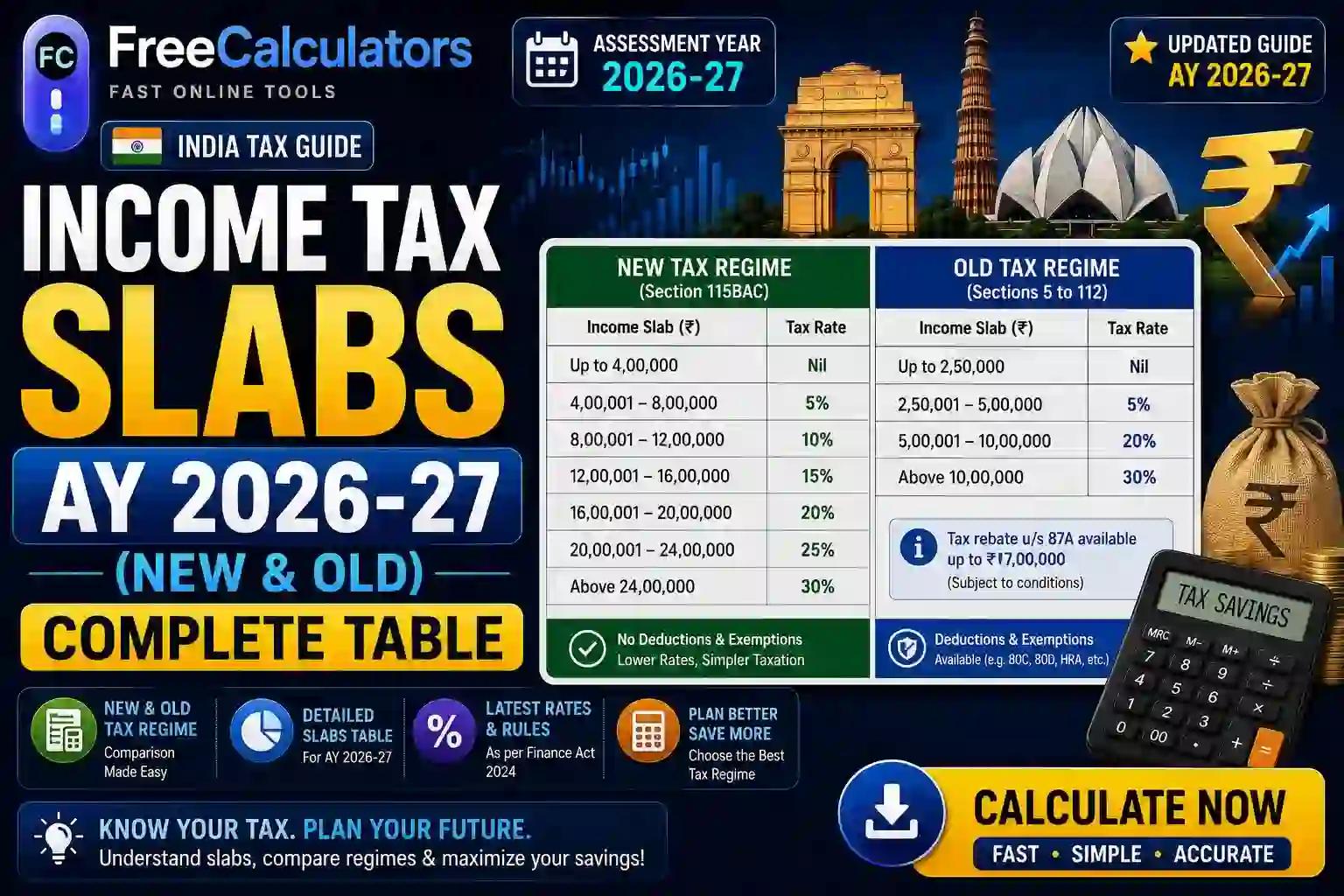
If you're trying to figure out how much tax you'll owe for Assessment Year 2026-27, the short answer is this: under the new tax regime, income up to ₹12 lakh is effectively tax-free thanks to the Section 87A rebate, and the slabs beyond that range from 5% to 30% across seven brackets. The old regime still exists as an alternative, with its familiar 5%/20%/30% structure and a much lower ₹5 lakh rebate threshold, but it comes with access to deductions like HRA and Section 80C that the new regime doesn't allow. Which one actually saves you more money depends entirely on how many deductions you can claim — and that's exactly what this guide breaks down, slab by slab, with real numbers.
What "AY 2026-27" Actually Means
Before diving into the tables, it's worth clearing up a mix-up that trips up a lot of taxpayers every year. AY 2026-27 (Assessment Year) refers to the year in which you file your return and get assessed — but the income you're reporting was actually earned in FY 2025-26 (April 2025 to March 2026), the Financial Year that just ended. So when someone searches "income tax slab AY 2026-27," they're really asking about the tax rules that applied to their FY 2025-26 income. This article uses both terms interchangeably where relevant, since that's how most people search and how the tax department itself labels the return forms.
New Tax Regime Slabs for AY 2026-27 (FY 2025-26)
The new regime under Section 115BAC is the default option for every taxpayer unless you actively choose the old regime while filing. Budget 2025 reworked these slabs substantially compared to earlier years, widening the brackets and raising the rebate ceiling.
Key features that come attached to these slabs:
- Standard deduction: ₹75,000 for salaried employees and pensioners.
- Basic exemption limit: ₹4,00,000 for everyone, regardless of age. Unlike the old regime, the new regime doesn't give senior citizens a higher exemption threshold.
- Section 87A rebate: Up to ₹60,000, applicable when taxable income doesn't exceed ₹12,00,000. This brings tax down to zero for anyone within that limit.
- Health and Education Cess: 4% on the calculated tax, after the rebate is applied.
- Surcharge: Applies above ₹50 lakh, capped at a maximum rate of 25% (down from 37% under the old structure) for the highest income brackets.
Because of the standard deduction, a salaried person can actually earn up to ₹12,75,000 gross and still land at zero tax — the deduction brings taxable income exactly to the ₹12 lakh threshold where the rebate kicks in.
Old Tax Regime Slabs for AY 2026-27
The old regime hasn't changed this year — its rates and exemption limits remain what they've been for several assessment years now. It's still relevant for people who claim substantial deductions.
Age-based exemption limits under the old regime, which the new regime doesn't offer:
Other components of the old regime:
- Standard deduction: ₹50,000 for salaried employees.
- Section 87A rebate: Up to ₹12,500, applicable only when taxable income doesn't exceed ₹5,00,000.
- Deductions allowed: HRA exemption, Section 80C (up to ₹1.5 lakh), Section 80D health insurance premiums, home loan interest under Section 24(b), LTA, and several others that the new regime removes entirely.
New Regime vs Old Regime: Side-by-Side Comparison
Worked Example: Tax on ₹15 Lakh Income Under Both Regimes
Numbers make this easier to grasp than percentages alone. Here's how a ₹15,00,000 salary plays out under each regime, assuming no additional deductions beyond the standard deduction in the old regime scenario.
Under the New Regime:
- Gross income: ₹15,00,000
- Less standard deduction: ₹75,000
- Taxable income: ₹14,25,000
- Tax calculation: Nil on first ₹4L, 5% on next ₹4L (₹20,000), 10% on next ₹4L (₹40,000), 15% on remaining ₹2.25L (₹33,750)
- Tax before cess: ₹93,750
- Cess (4%): ₹3,750
- Total tax payable: ₹97,500
Under the Old Regime (no HRA/80C claimed):
- Gross income: ₹15,00,000
- Less standard deduction: ₹50,000
- Taxable income: ₹14,50,000
- Tax calculation: Nil on first ₹2.5L, 5% on next ₹2.5L (₹12,500), 20% on next ₹5L (₹1,00,000), 30% on remaining ₹4.5L (₹1,35,000)
- Tax before cess: ₹2,47,500
- Cess (4%): ₹9,900
- Total tax payable: ₹2,57,400
At this income level, without any deductions, the new regime saves roughly ₹1,59,900. But that gap narrows — and can even flip — if the taxpayer claims a home loan interest deduction, full 80C investments, and HRA. Someone with ₹4 lakh in combined old-regime deductions on the same ₹15 lakh income would bring their old-regime taxable income down to around ₹10.5 lakh, cutting that tax bill significantly and making the comparison much closer.
This is exactly why a blanket "new regime is always better" claim doesn't hold up — the right answer depends on your actual deduction profile, not just your income bracket. You can run your own numbers against both regimes using the old vs new tax regime calculator, which handles this comparison automatically.
How Marginal Relief Works Near the ₹12 Lakh Threshold
One detail that confuses a lot of people: what happens if your taxable income is just slightly above ₹12 lakh, say ₹12,10,000? Without marginal relief, you'd lose the entire ₹60,000 rebate and owe tax on the full amount — a steep cliff for earning just ₹10,000 more.
Marginal relief prevents this. It caps your tax liability at the amount by which your income exceeds ₹12 lakh, so you're never worse off for crossing the threshold by a small margin. For someone with ₹12,10,000 taxable income, the tax payable is limited to roughly ₹10,000 rather than the full slab-calculated amount — the relief tapers off gradually as income rises further above ₹12 lakh, until it phases out completely around ₹12.75 lakh.
Which Regime Should You Actually Choose?
This decision comes down to a fairly simple test: add up what you'd actually claim under the old regime — HRA if you pay rent, Section 80C investments (PF, ELSS, life insurance), Section 80D health insurance premiums, and home loan interest if applicable.
- If your total eligible deductions are below roughly ₹4–4.5 lakh, the new regime almost always comes out ahead, especially at income levels under ₹15-16 lakh.
- If you have a home loan, pay significant rent in a metro city, and max out 80C, the old regime can still win, sometimes by a wide margin.
- If you're not sure, the only reliable way to know is to calculate both scenarios with your actual numbers rather than going by income bracket alone.
Salaried employees can switch between regimes every year when filing their return. Business owners and professionals with income from a business or profession have a one-time switch option back to the old regime, so that choice deserves more careful thought. For a deeper breakdown of exactly when each regime wins, see our full old vs new tax regime comparison, and if you're weighing specific 80C instruments, our guide on Section 80C deductions walks through what still qualifies.
Surcharge Rates for Higher Income Brackets
Beyond the basic slabs, a surcharge applies once income crosses certain thresholds — this is calculated on the tax amount itself, not on total income.
The new regime capped the maximum surcharge at 25%, compared to 37% previously under the old regime for the highest bracket — a meaningful change for very high earners, since it effectively lowered their peak marginal rate.
Frequently Asked Questions
What are the income tax slabs for AY 2026-27? Under the new regime, income up to ₹4 lakh is tax-free, followed by rates of 5%, 10%, 15%, 20%, 25%, and 30% across successive ₹4 lakh brackets up to ₹24 lakh, beyond which 30% applies. The old regime retains its 5%/20%/30% structure with a ₹2.5 lakh basic exemption.
Is the new tax regime mandatory for AY 2026-27? No, but it is the default. If you don't actively choose the old regime while filing your return, your tax will automatically be computed under the new regime.
What is the tax-free income limit under the new regime? Taxable income up to ₹12,00,000 is effectively tax-free due to the Section 87A rebate. For salaried individuals, the ₹75,000 standard deduction pushes this to a gross salary of ₹12,75,000.
Which regime is better for FY 2025-26? It depends on your deductions. Without significant HRA, 80C, or home loan claims, the new regime usually results in lower tax. With substantial deductions (roughly ₹4 lakh or more), the old regime can still work out cheaper.
Can I switch between the old and new tax regime every year? Salaried individuals with no business income can switch each year when filing their return. Those with business or professional income have a limited, one-time option to switch back to the old regime after opting for the new one.
What is the Section 87A rebate limit for AY 2026-27? Under the new regime, the rebate is up to ₹60,000 for taxable income up to ₹12,00,000. Under the old regime, it's up to ₹12,500 for taxable income up to ₹5,00,000.
Final Takeaway
The slabs for AY 2026-27 make the new regime the more attractive default for most salaried taxpayers, largely because of the ₹60,000 rebate and higher standard deduction — but "default" doesn't automatically mean "best for you." If you're carrying a home loan, paying substantial rent, or investing heavily in 80C instruments, it's worth running the actual comparison rather than assuming the new regime wins by default.
The most reliable way to settle this is to plug your real income, deductions, and HRA figures into a calculator built for exactly this comparison. Try the income tax calculator or the dedicated old vs new regime tool to see your exact tax liability under both regimes before you file.
For the official, most current slab notifications and any mid-year updates, the Income Tax Department's e-filing portal remains the authoritative source to cross-check against.