
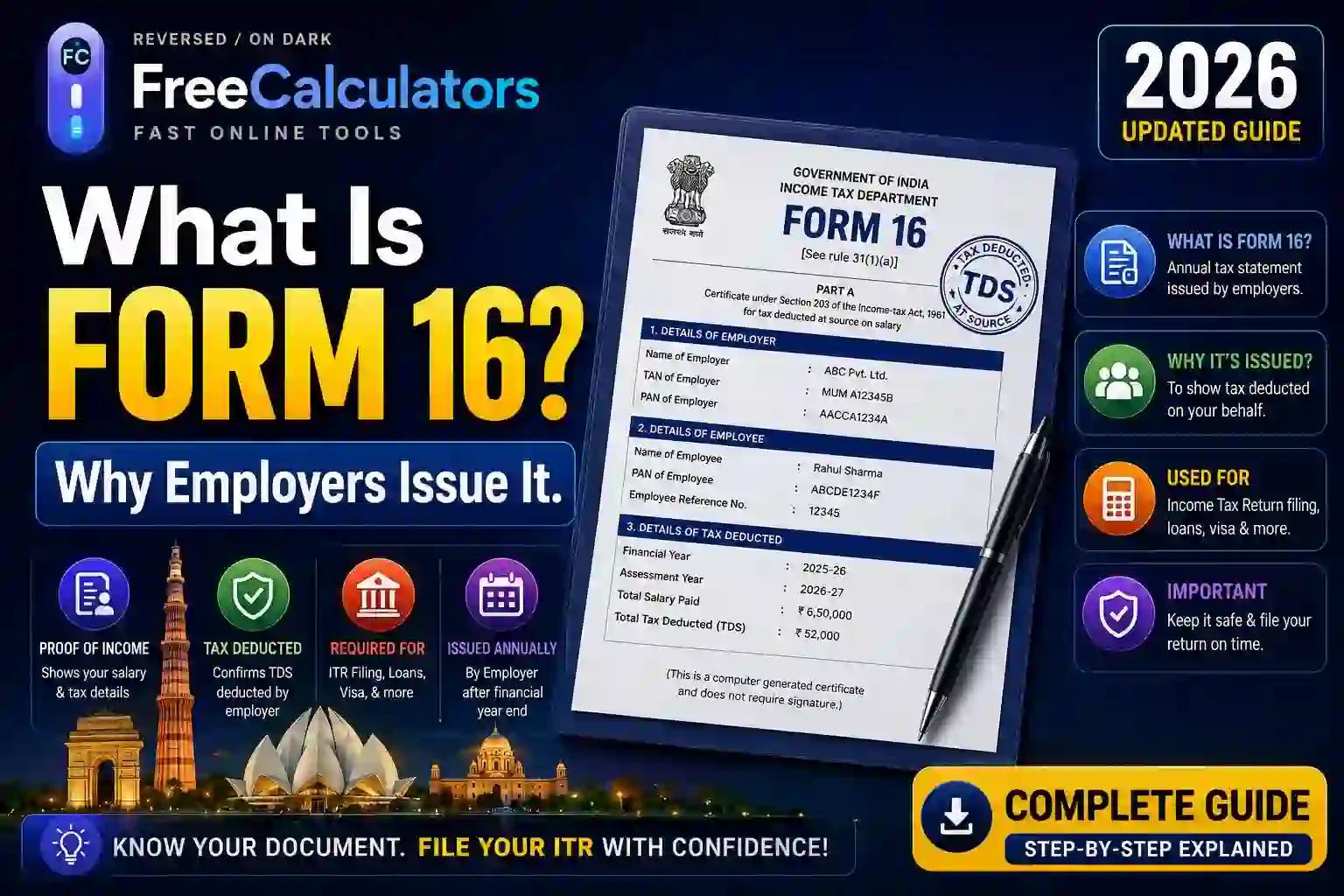
If you've ever opened a salary-related email around June and found a PDF asking for a password, that's almost certainly your Form 16. In short: Form 16 is a TDS certificate your employer is required to issue under Section 203 of the Income Tax Act, confirming exactly how much tax was deducted from your salary during the year and deposited with the government — and it's the single most useful document you'll use when filing your income tax return.
This guide covers what Form 16 actually contains, why employers are legally required to issue it, how to download it, and what's changing with it under India's new tax law.
What Is Form 16, Exactly?
Form 16 is a certificate — not a form you fill out yourself, despite the name. Your employer generates and issues it to you, and it serves as documented proof that tax was deducted at source (TDS) from your salary under Section 192 of the Income Tax Act during the financial year.
Think of it less as paperwork and more as a receipt. Every month, your employer withholds a portion of your salary as tax and deposits it with the government on your behalf. Form 16 is the official confirmation that this actually happened — how much was deducted, when, and against which PAN and TAN. Without it, you'd be filing your return based on your own salary slips and guesswork, with no government-backed document to fall back on if numbers get questioned later.
Why Do Employers Issue Form 16?
This isn't optional courtesy — it's a legal obligation. Under Rule 31(3) of the Income Tax Rules, 1962, any employer who has deducted TDS from an employee's salary during the financial year must issue Form 16 by the prescribed deadline.
There's a specific exception worth knowing: if your total income fell below the taxable threshold and no TDS was deducted at all, your employer isn't legally required to issue Form 16. That said, many employers issue a nil-TDS Form 16 anyway as good practice, since employees often need it for loan applications or as general income proof, independent of tax filing.
The consequence for non-compliance is real. Employers who miss the issuance deadline face a penalty of ₹100 per day per certificate under Section 272A(2)(g), capped at the amount of tax deductible. For a mid-sized company with fifty employees issuing certificates a month late, that penalty can run into lakhs — which is exactly why HR and payroll teams treat this deadline seriously rather than treating it as a soft internal target.
What's Inside Form 16: Part A and Part B Explained
Form 16 comes in two distinct parts, generated through different processes, and understanding the difference actually matters when you're checking your document for accuracy.
Part A is the government-verified half. It's pulled straight from TRACES (TDS Reconciliation Analysis and Correction Enabling System) based on the employer's quarterly TDS returns, and it carries a unique certificate number. This matters because a Part A that hasn't come from TRACES — say, one typed up manually — carries no legal validity. If your employer's Part A doesn't have that TRACES-generated certificate number, that's worth flagging immediately.
Part B is where the detail lives: your gross salary, house rent allowance exemptions, the standard deduction, deductions claimed under Chapter VI-A (Section 80C investments, health insurance premiums, and so on), and the final tax computed. This section now also indicates which tax regime — old or new — was used to compute your TDS, which is useful to cross-check against what you actually intended to file under.
If you're unclear on how the old and new tax regimes affect your final numbers, our comparison of the old tax regime vs. new tax regime in India breaks down which one typically works out better depending on your deduction profile, and our Section 80C deductions guide covers exactly what counts toward the Chapter VI-A figures shown in Part B.
When Must Employers Issue Form 16 for FY 2025-26?
For the financial year that just ended (FY 2025-26, assessed as AY 2026-27), the statutory deadline for employers to issue Form 16 is June 15, 2026.
The logic behind that specific date is worth understanding, because it explains why Form 16 sometimes arrives later than employees expect:
- Employers file quarterly TDS returns (Form 24Q) throughout the year, with the Q4 return covering January–March due by May 31, 2026.
- Only after all four quarters are filed can the employer generate Part A from TRACES — the system won't produce it earlier.
- Employers then get roughly two weeks to compile Part B and issue the complete certificate, landing on the June 15 deadline.
That timeline leaves employees about six weeks of breathing room before the standard ITR filing deadline of July 31, 2026 for most salaried taxpayers — enough time to review the document, flag discrepancies, and file, but not much more. If you're already thinking ahead to the filing itself, our guide on calculating income tax for salaried individuals in India walks through the process once you have Form 16 in hand.
An Important Change: Form 16 Is Becoming Form 130
Here's a detail that's easy to miss and worth flagging clearly: under India's new Income Tax Act, 2025, Form 16 is being renumbered as Form 130, effective from Tax Year 2026-27 (starting April 1, 2026) onward.
For the certificate you're receiving right now — covering FY 2025-26 — nothing changes. It's still issued and referred to as Form 16, since that year is governed entirely by the older Income Tax Act, 1961. The renumbering only takes effect for income earned from April 2026 onward, which employees will encounter for the first time when filing returns in 2027. If you see references online to "Form 130" alongside Form 16, that's the reason — it's the same certificate under new legislation, not a separate document.
How to Download Form 16
Most employees receive Form 16 directly from their employer's HR or payroll system rather than downloading it themselves — Part A specifically can only be generated by the employer through TRACES, not by individual employees. That said, here's how the process works end to end:
- Employer files all four quarterly TDS returns (Form 24Q) for the financial year, with the final quarter due by May 31.
- Employer logs into TRACES and generates Part A once all returns are confirmed and default-free.
- Employer prepares Part B in the CBDT-prescribed format, covering salary breakup and deductions.
- The complete certificate is digitally signed (via DSC) and distributed to employees, typically as a password-protected PDF.
- You receive Form 16 through your company's HR portal or email, usually before the June 15 deadline.
If you switched jobs during the financial year, make sure you've received a Form 16 from each employer you worked for during that period — a common oversight is only requesting it from your current employer and forgetting the one from a company you left mid-year.
Form 16 vs. Form 26AS vs. AIS: What's the Difference?
This trips up a lot of first-time filers, so it's worth being precise. Form 16 shows TDS deducted by one specific employer. Form 26AS — now effectively folded into the broader Annual Information Statement (AIS) — is your comprehensive tax passbook, showing TDS credited from every source: your employer, bank interest, any other deductors who've withheld tax on your behalf during the year.
Before filing your return, it's genuinely worth reconciling the two. Mismatches between what Form 16 states and what shows up in Form 26AS/AIS are one of the most common triggers for tax department notices — usually not because of fraud, but because of a filing error, a TDS deposit that hasn't been reconciled yet, or a discrepancy in reported figures somewhere in the chain.
Can You File Your ITR Without Form 16?
Yes — Form 16 makes the process significantly easier, but it isn't strictly mandatory to file. If your employer hasn't issued one (say, because no TDS was deducted, or there's been a delay), you can still file using your salary slips, Form 26AS/AIS, and bank statements to reconstruct the same figures manually. It's more work and leaves more room for error, but it's entirely possible.
This is also worth knowing if you're a freelancer or contract worker rather than a salaried employee — Form 16 specifically applies to salary income under Section 192. If you receive payments as a consultant or freelancer, you'd typically be dealing with Form 16A instead, which covers TDS on non-salary payments like professional fees.
What If There's an Error in Your Form 16?
Errors happen more often than you'd expect — a mismatched PAN, an incorrect deduction figure, or a salary component that doesn't match your actual payslips. If you spot something off:
- Don't file your return with incorrect figures just because that's what Form 16 shows — cross-check against your salary slips first.
- Flag it to your employer's payroll or HR team immediately, since only they can correct the underlying Form 24Q return that Part A is generated from.
- Wait for the corrected certificate before filing, if the discrepancy affects your tax liability — filing with an error and correcting it later through a revised return is more effort than getting it right upfront.
Frequently Asked Questions
What is Form 16 used for? Form 16 serves as official proof of the tax your employer deducted from your salary and deposited with the government during the financial year. It's the primary document salaried employees use to file their income tax return, and it's also commonly required for loan applications and visa processing as income proof.
Is Form 16 mandatory for all employees? It's mandatory only when TDS has actually been deducted from your salary. If your income fell below the taxable threshold and no tax was withheld, your employer isn't legally obligated to issue it, though many do anyway as a courtesy for employees who need income documentation.
Can I file my income tax return without Form 16? Yes. While Form 16 makes the process considerably easier, you can file using salary slips, Form 26AS, and the Annual Information Statement to calculate your income and TDS manually if your employer hasn't issued one.
What is the due date for issuing Form 16? For FY 2025-26 (AY 2026-27), employers must issue Form 16 by June 15, 2026, as prescribed under Rule 31(3) of the Income Tax Rules, 1962. Missing this deadline attracts a penalty of ₹100 per day per certificate.
What is the difference between Form 16 and Form 16A? Form 16 covers TDS deducted on salary income under Section 192. Form 16A covers TDS on non-salary payments — professional fees, rent, interest, and similar income — and is what freelancers and consultants typically receive instead.
How can I download Form 16 online? Employees generally receive Form 16 directly from their employer rather than downloading it independently, since Part A can only be generated by the employer through the TRACES portal after all quarterly TDS returns are filed. If you haven't received yours near the deadline, follow up with your company's payroll team directly.
Where This Leaves You
Form 16 isn't just a formality your employer hands over each June — it's the government-verified record of tax already paid on your behalf, and reconciling it carefully against Form 26AS before filing is one of the simplest ways to avoid a tax notice down the line. With the June 15 issuance deadline and the July 31 filing deadline sitting just six weeks apart, it's worth reviewing your Form 16 the moment it arrives rather than setting it aside until the last week of July.
If you're ready to work out your actual tax liability once Form 16 is in hand, our income tax calculator can help you cross-check the final numbers before you file, and our essential tax terms glossary is a useful reference if any of the terminology here — TDS, TRACES, Chapter VI-A — still feels unfamiliar.
For the current assessment year's exact deadlines and any updates related to the transition to Form 130, always verify directly on the Income Tax Department's official portal before filing, since compliance dates can shift with CBDT notifications.