
The basic GST formula is simple: GST Amount = (Original Price × GST Rate) ÷ 100, and the final price you pay is the original price plus that GST amount. If you're working backward from a GST-inclusive price instead, the formula flips to GST Amount = Original Price × [GST Rate ÷ (100 + GST Rate)]. Both versions matter in real business situations, and this guide walks through exactly when and how to use each one — with current 2026 GST slab rates, worked examples, and the CGST/SGST/IGST split explained clearly.
A Quick Note on Current GST Rates (2026)
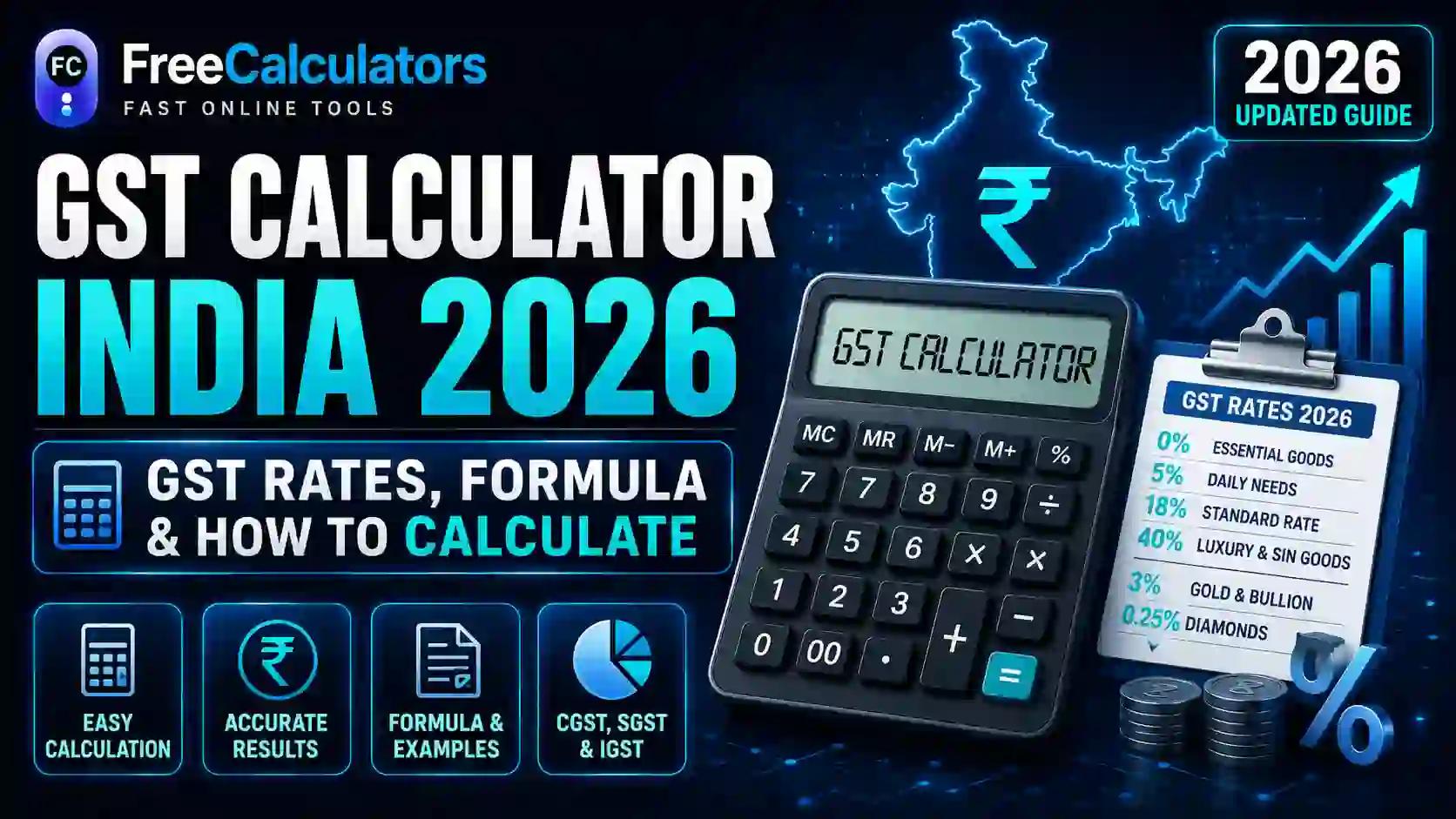
Before working through any calculation, it's worth knowing that India's GST structure changed significantly under what's called GST 2.0, effective September 22, 2025. The old five-tier system of 0%, 5%, 12%, 18%, and 28% was simplified into a leaner structure: 0%, 5%, 18%, and a new 40% slab for luxury and sin goods like tobacco, aerated drinks, and high-end vehicles. The 12% and 28% slabs were largely retired, with most items shifting down to 5% or 18%. A few niche rates — 3% for gold, 0.25% for diamonds — continue to exist outside this main structure.
This matters directly for calculation accuracy: if you're still applying a 12% or 28% rate to an invoice dated after September 22, 2025, that invoice is technically non-compliant. The examples throughout this guide use the current 2026 rate structure.
The Basic GST Calculation Formula
There are two directions you'll need to calculate GST: adding GST to a base price (forward calculation) and extracting GST from a price that already includes it (reverse calculation). Both come up constantly in real business scenarios, so it's worth being comfortable with both rather than only knowing one.
Forward Calculation: Adding GST to a Price
Use this when you have a base price and need to add GST to arrive at the final selling price.
Formula: GST Amount = Original Price × (GST Rate ÷ 100) Final Price = Original Price + GST Amount
Worked example: A retailer sells a product with a base price of ₹1,000, taxed at the standard 18% GST rate.
- GST Amount = ₹1,000 × (18 ÷ 100) = ₹180
- Final Price = ₹1,000 + ₹180 = ₹1,180
This is the calculation you'd use when pricing a product or service and need to know what to actually charge the customer.
Reverse Calculation: Extracting GST from a Total Price
Use this when you already have a GST-inclusive price — say, an MRP printed on a package or a total invoice amount — and need to work out how much of that total is actually tax versus base price.
Formula: GST Amount = Total Price × [GST Rate ÷ (100 + GST Rate)] Base Price = Total Price − GST Amount
Worked example: A product is sold at an MRP of ₹1,180, and you need to know the base price and GST component, assuming the standard 18% rate applies.
- GST Amount = ₹1,180 × [18 ÷ (100 + 18)] = ₹1,180 × 0.1525 = ₹180
- Base Price = ₹1,180 − ₹180 = ₹1,000
This reverse calculation trips up a lot of people because it's tempting to simply multiply the total by 18%, but that overstates the GST amount — you have to divide by 118, not 100, since the 18% was originally calculated on the smaller base price, not the larger total.
GST Rate Slabs at a Glance (2026)
Here's how the current structure breaks down, along with what an item at each slab would look like on a ₹1,000 base price:
| GST Slab | Example Goods/Services | GST on ₹1,000 | Total Price |
|---|---|---|---|
| 0% (Nil) | Fresh produce, specified life-saving drugs, educational materials | ₹0 | ₹1,000 |
| 5% | Packaged food, household essentials (soap, toothpaste), footwear under ₹2,500 | ₹50 | ₹1,050 |
| 18% | Most goods and services — electronics, IT services, financial services, standard consumer durables | ₹180 | ₹1,180 |
| 40% | Luxury vehicles, tobacco products, aerated and caffeinated beverages, high-end goods | ₹400 | ₹1,400₹1,400 |
A few categories sit outside this main table entirely: gold and gold bullion continue at 3%, and diamonds are taxed at 0.25%, both unchanged by the GST 2.0 restructuring.
Because HSN and SAC code classifications determine which slab a specific product or service actually falls into, and because these classifications get revised periodically, the safest habit is checking your item's current classification directly rather than assuming based on general category. Our Income Tax Calculator and other tax tools are useful for broader tax planning once your GST numbers are settled, though GST itself is calculated separately from your income tax liability.
CGST, SGST, and IGST: How the Split Actually Works
This is where a lot of people get confused, because the rate you calculate and the way that tax gets divided are two different questions entirely.
For transactions within the same state (intra-state): GST is split equally between Central GST (CGST) and State GST (SGST). Each gets exactly half of the total GST rate.
Worked example: A Delhi-based shop sells a product to a Delhi customer at 18% GST on a ₹1,000 base price.
- Total GST = ₹180
- CGST (9%) = ₹90
- SGST (9%) = ₹90
- Total collected = ₹180, split evenly between the central and Delhi state governments
For transactions across state lines (inter-state): The entire GST amount is charged as Integrated GST (IGST), collected by the central government and later apportioned to the destination state.
Worked example: The same Delhi-based shop sells an identical ₹1,000 product to a customer in Maharashtra, still at 18% GST.
- IGST (18%) = ₹180
- No CGST/SGST split — it's charged as a single IGST line on the invoice
The practical rule of thumb: IGST rate always equals CGST rate + SGST rate. So whether a transaction is taxed as 9% CGST + 9% SGST or a flat 18% IGST, the total tax burden on the customer is identical — only the way it's recorded and distributed between governments changes. This distinction matters most for how you structure your invoices, not for how much your customer ultimately pays.
How to Calculate GST for Services
Service-based GST calculation follows the exact same formula as goods, but the classification uses an SAC (Services Accounting Code) rather than an HSN code, and the vast majority of professional and business services fall under the standard 18% slab.
Worked example: A freelance consultant bills a client ₹50,000 for a project, and the applicable service falls under the standard 18% rate.
- GST Amount = ₹50,000 × (18 ÷ 100) = ₹9,000
- Total Invoice Value = ₹50,000 + ₹9,000 = ₹59,000
If the consultant's client is in the same state, that ₹9,000 splits into ₹4,500 CGST and �:4,500 SGST. If the client is in a different state, it's billed as a flat ₹9,000 IGST.
A small number of services carry different rates — some financial and insurance-related services, for instance, use rates outside the standard 18% slab — so it's worth confirming the specific SAC classification for anything outside straightforward consulting or professional services.
GST on Discounted Prices and Freight Charges
Two situations regularly confuse people doing manual GST calculations: discounts and freight.
Discounts: GST is generally calculated on the price after the discount is applied, not the original pre-discount price — provided the discount is clearly shown on the invoice itself.
Worked example: A product with a list price of ₹2,000 is sold with a 10% discount, taxed at 18% GST.
- Discounted price = ₹2,000 − (10% of ₹2,000) = ₹1,800
- GST Amount = ₹1,800 × 18% = ₹324
- Final Price = ₹1,800 + ₹324 = ₹2,124
Freight and shipping charges: These are generally included in the taxable value and taxed at the same GST rate as the primary goods or services being supplied, unless freight is billed as a genuinely separate, independent service with its own distinct classification. In most straightforward retail and e-commerce contexts, freight simply gets added to the taxable base before GST is calculated.
Step-by-Step: Calculating GST Manually Without a Calculator
If you want to work through GST calculations by hand — useful for quick mental math or spot-checking an invoice — here's the process broken into clear steps:
- Identify the correct GST rate for your specific goods or service based on its HSN/SAC classification (0%, 5%, 18%, or 40% under the current structure).
- Determine whether you're calculating forward or backward — do you have a base price that needs GST added, or a total price that already includes GST?
- For forward calculation: multiply the base price by the GST rate, then divide by 100. Add this result to your original price.
- For reverse calculation: multiply the total price by the GST rate, then divide by (100 + GST rate). This gives you the GST amount; subtract it from the total to get the base price.
- Split CGST/SGST or apply IGST based on whether the transaction is within the same state or across state lines.
- Round to the nearest rupee per standard invoicing convention, since GST invoices typically don't carry paise-level precision in most business software.
- Cross-check your result against a GST calculator tool for anything involving larger sums, since manual errors compound quickly on bigger invoices.
Common GST Calculation Mistakes to Avoid
A few recurring errors show up constantly in manually prepared invoices and small business bookkeeping:
- Applying the forward formula to a GST-inclusive price. This is the single most common mistake — multiplying an MRP directly by the GST rate percentage instead of using the reverse formula, which overstates the actual GST component.
- Forgetting to update rates after the GST 2.0 transition. Any invoice using the old 12% or 28% slabs after September 22, 2025 is using an outdated rate structure and needs correction.
- Calculating GST on the pre-discount price when the discount was clearly shown on the invoice, resulting in an overstated tax amount.
- Mixing up CGST/SGST and IGST. Charging CGST+SGST on an interstate transaction (or vice versa) is a genuine compliance error, not just a rounding issue, and can create real filing problems.
- Ignoring compensation cess where it still applies. While cess has been phased out for most categories following GST 2.0, certain tobacco-related products still carry cess obligations separately from the standard rate.
GST Calculation for Different Business Types
Retailers and wholesalers generally apply the standard forward calculation on each line item, with the specific rate depending on product category — most general merchandise now falls under 5% or 18% following the GST 2.0 restructuring.
E-commerce sellers need to account for an additional layer: platforms like Amazon and Flipkart collect Tax Collected at Source (TCS) at 1% on net taxable supplies, which is separate from the GST charged on the product itself and gets adjusted against your GST liability when filing returns.
Exporters typically deal with zero-rated supplies, meaning GST isn't charged on the export transaction itself, though input tax credit on related purchases can usually still be claimed or refunded — a genuinely different calculation logic from standard domestic sales.
Restaurants apply GST based on their specific classification and whether they're operating under the composition scheme, which uses a flat percentage of turnover rather than the standard invoice-by-invoice calculation covered in this guide.
Frequently Asked Questions
What is the formula to calculate GST? GST Amount = Original Price × (GST Rate ÷ 100) for adding GST to a base price, or GST Amount = Total Price × [GST Rate ÷ (100 + GST Rate)] for extracting GST from a price that already includes it.
How do I calculate GST from the total amount? Use the reverse formula: divide the total amount by (100 + GST rate), then multiply by the GST rate — for an 18% rate, that means dividing the total by 118 and multiplying by 18, not simply taking 18% of the total.
How is CGST and SGST calculated separately? For transactions within the same state, the total GST rate splits exactly in half between CGST and SGST — an 18% GST rate becomes 9% CGST plus 9% SGST, both calculated on the same taxable value.
What is the difference between GST inclusive and exclusive price? A GST-exclusive price is the base amount before tax is added, while a GST-inclusive price already has the GST amount built into the total — the calculation method differs depending on which one you're starting from.
How do I calculate GST for interstate transactions? Interstate transactions use IGST at the full applicable rate (equal to CGST + SGST combined), calculated the same way as the forward or reverse formula, but recorded as a single IGST line rather than split into two components.
Can I calculate GST without a calculator? Yes — the formulas are straightforward multiplication and division that can be done manually or with a basic phone calculator, though a dedicated GST calculator reduces the risk of error on larger or more complex invoices.
What is the reverse GST calculation formula? GST Amount = Total Price × [GST Rate ÷ (100 + GST Rate)], followed by subtracting that GST amount from the total price to arrive at the original base price.
How is GST rounded off on an invoice? GST amounts are typically rounded to the nearest whole rupee on standard invoices, following normal rounding conventions, though the specific rounding rule can vary slightly depending on the accounting or billing software in use.
The Bottom Line
GST calculation comes down to two directions — adding tax to a base price, or extracting it from a total that already includes tax — and getting the formula right in each direction matters more than memorizing every rate slab by heart. With GST 2.0's simplified 0%/5%/18%/40% structure now in effect, most everyday goods and services fall cleanly into just two working slabs, which genuinely makes manual calculation easier than it was under the old five-tier system.
For quick, error-free calculations on actual invoices — especially when you're juggling CGST/SGST splits, discounts, or reverse calculations from an MRP — running the numbers through our GST-related tax tools saves the manual math and reduces the risk of a compliance-affecting rounding error. And if you're still getting your business registered before any of this applies to you, our companion guide on GST registration for small businesses walks through that first step in detail.