
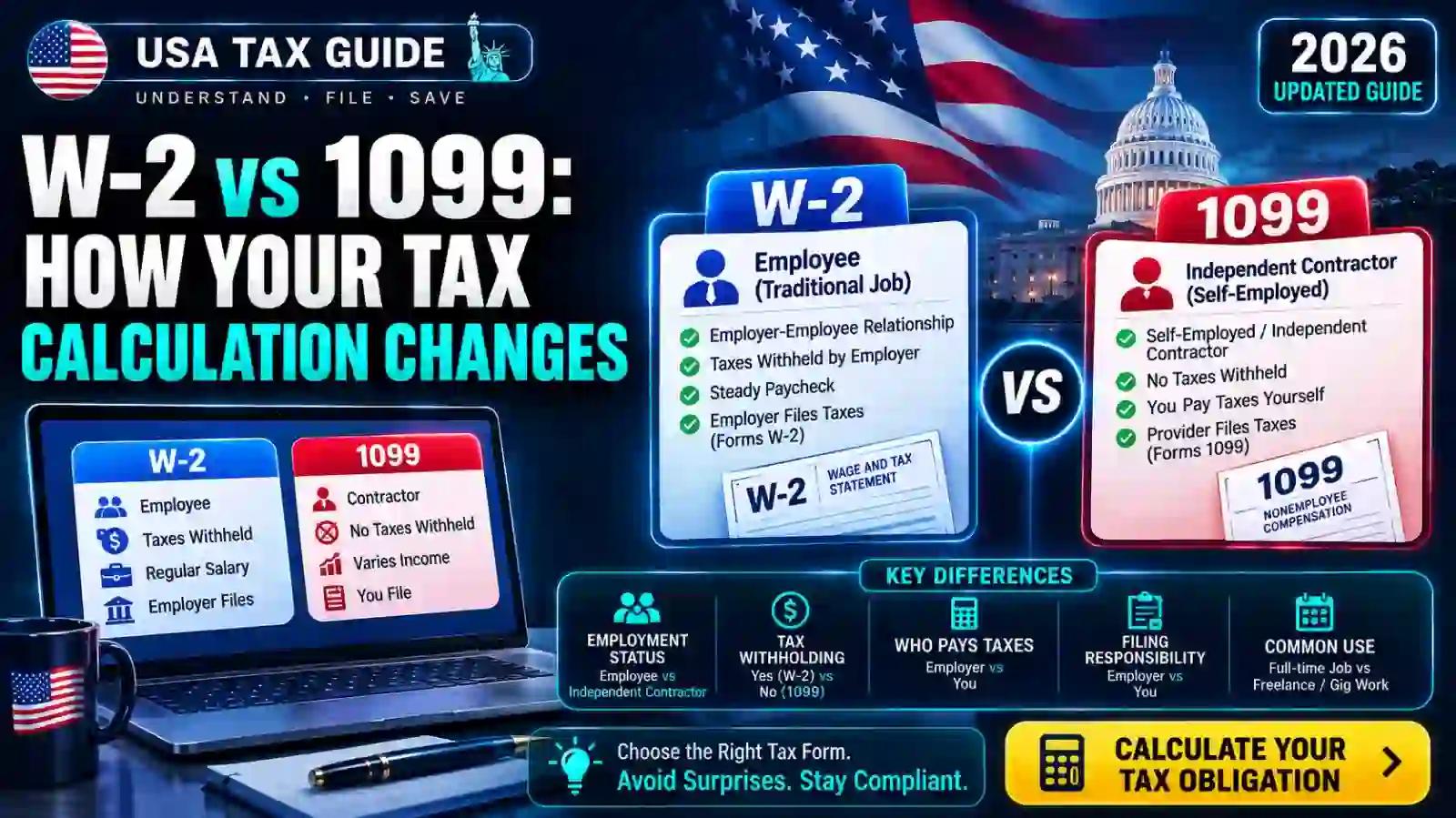
If you're a W-2 employee, your employer withholds income tax and splits your Social Security and Medicare tax with you, paying half of the 15.3% FICA rate on your behalf. If you're a 1099 independent contractor, none of that happens automatically — you owe the full 15.3% self-employment tax yourself, on top of regular income tax, and you're responsible for sending estimated payments to the IRS four times a year instead of having tax withheld from every paycheck.
That single structural difference — who pays the employer half of payroll tax, and when — is the root of nearly every confusion people have when comparing W-2 and 1099 income. This guide breaks down exactly how your tax calculation changes between the two classifications, walks through a real numeric comparison, and covers the deductions that help offset the extra cost of being self-employed.
The Core Difference: Who's Responsible for What
A W-2 employee works under an employer's direction, has taxes withheld automatically from each paycheck, and typically receives benefits like health insurance or a 401(k) match. Your employer files a Form W-2 at year-end summarizing your wages and everything withheld on your behalf.
A 1099 contractor (technically called an independent contractor) works independently, invoices for services rendered, and receives a Form 1099-NEC from any client who paid them $600 or more during the year. No taxes are withheld from these payments — the full amount lands in your account, and it's on you to set aside money for taxes and pay them directly to the IRS.
| Aspect | W-2 Employee | 1099 Contractor |
|---|---|---|
| Tax withholding | Automatic, every paycheck | None — self-managed |
| Who pays FICA/Social Security & Medicare | Split 50/50 with employer (7.65% each) | Contractor pays both halves (15.3% total) |
| Payment schedule to IRS | Continuous via payroll withholding | Quarterly estimated payments (Form 1040-ES) |
| Tax form received | Form W-2 | Form 1099-NEC |
| Business expense deductions | Very limited (mostly eliminated post-2017) | Broad — Schedule C deductions |
| Unemployment insurance | Employer-paid, contractor may qualify | Generally not covered |
How Self-Employment Tax Actually Works
This is the single biggest calculation difference, so it's worth walking through carefully. When you're a W-2 employee, FICA tax — the combined Social Security and Medicare tax — is split evenly: you pay 7.65% (6.2% Social Security + 1.45% Medicare), and your employer matches that with another 7.65% on your behalf, for a combined 15.3% total.
When you're self-employed, there's no employer to pay that other half — so the IRS collects the full 15.3% directly from you through what's called self-employment tax, governed by the Self-Employment Contributions Act (SECA). According to the IRS's own guidance on self-employment tax, this tax applies to net earnings from self-employment of $400 or more, and it's calculated on 92.35% of your net self-employment income, not the full amount — that 7.65% reduction accounts for the fact that a W-2 employee's employer-paid half is never counted as taxable wages in the first place, so the calculation adjusts to keep things roughly equivalent.
Breaking Down the 15.3% Rate
- 12.4% goes to Social Security, but only on income up to the annual wage base — $184,500 for 2026, up from $176,100 in 2025. Any self-employment income above that threshold isn't subject to the Social Security portion.
- 2.9% goes to Medicare, and unlike Social Security, there's no income cap — every dollar of net self-employment income is subject to this portion.
- An additional 0.9% Medicare surtax applies to self-employment income above $200,000 (single filers) or $250,000 (married filing jointly), bringing the effective Medicare rate to 3.8% above those thresholds.
The Silver Lining: The Employer-Equivalent Deduction
Here's a detail that gets missed constantly: self-employed taxpayers can deduct the "employer half" of self-employment tax (effectively 7.65% of the 15.3%) as an above-the-line adjustment to income on their Form 1040. This doesn't erase the extra tax burden, but it does reduce your adjusted gross income, which softens the blow somewhat and can affect other calculations tied to AGI, like certain deduction phase-outs.
Worked Example: Same $70,000 Income, W-2 vs. 1099
Numbers make this concrete faster than any explanation, so here's a simplified side-by-side comparison using $70,000 in gross income for both scenarios, filing as single with no dependents.
As a W-2 Employee Earning $70,000
- Employee FICA withheld: $70,000 × 7.65% = $5,355 (employer pays a matching $5,355, which doesn't come out of your check)
- Federal income tax withheld throughout the year based on your W-4 elections
- Net effect: your paycheck already has FICA and estimated income tax removed before you see it
As a 1099 Contractor Earning $70,000 (Gross Revenue)
- Self-employment tax base: $70,000 × 92.35% = $64,645
- Self-employment tax owed: $64,645 × 15.3% = $9,891
- Half of that ($4,946) is deductible above the line, reducing taxable income for regular income tax purposes
- Federal income tax is then calculated on the reduced taxable income, and you're responsible for paying both the self-employment tax and income tax yourself, typically in quarterly installments
The contractor pays roughly $4,500 more in combined payroll-equivalent tax on the same gross income compared to the W-2 employee's withheld share, purely because there's no employer covering half. This is exactly why financial advisors commonly suggest that a 1099 rate needs to run meaningfully higher than an equivalent W-2 salary to actually net the same take-home pay — a rough industry rule of thumb is 20–30% higher, though the right adjustment depends on your specific deduction situation and state.
If you want to run your own specific numbers rather than relying on this generalized example, a US self-employment tax calculator handles the 92.35% adjustment and wage base cap automatically, and pairing it with a US state income tax calculator gives you the fuller picture once state tax is factored in too.
Quarterly Estimated Taxes: The Part That Catches New Contractors Off Guard
W-2 employees rarely think about "paying" their taxes because withholding happens invisibly every pay period. First-time 1099 contractors often don't realize this responsibility shifts entirely onto them until a tax bill (and potentially a penalty) shows up the following spring.
The IRS generally requires quarterly estimated payments, using Form 1040-ES, if you expect to owe $1,000 or more in tax for the year after subtracting withholding and credits. These payments are typically due in mid-April, mid-June, mid-September, and mid-January of the following year — a schedule that doesn't align neatly with calendar quarters, which trips up plenty of first-year freelancers.
Missing these payments, or underpaying significantly, can trigger an underpayment penalty even if you pay everything owed by the April filing deadline. A commonly used safe harbor is paying at least 90% of the current year's tax liability, or 100% of the prior year's total tax (110% if your prior-year AGI was above $150,000), spread across the four quarterly payments — meeting either threshold generally protects you from the penalty.
Deductions: Where 1099 Contractors Actually Come Out Ahead
This is the part of the comparison that softens the self-employment tax hit, and it's worth taking seriously rather than treating as a footnote. W-2 employees lost most unreimbursed employee business expense deductions after the Tax Cuts and Jobs Act of 2017, meaning a W-2 worker who buys their own equipment or drives for work generally can't deduct those costs anymore.
1099 contractors, by contrast, report income and expenses on Schedule C of Form 1040, and the list of deductible business expenses is genuinely broad:
- Home office deduction, if you use part of your home regularly and exclusively for business
- Business mileage or vehicle expenses, using either the standard mileage rate or actual expense method
- Equipment, software, and supplies used directly for the work
- Health insurance premiums, deductible above the line for self-employed individuals covering themselves and their family
- Retirement contributions to a SEP-IRA or Solo 401(k), which allow significantly higher contribution limits than a typical employee retirement account
- Professional services, like accounting or legal fees related to the business
The QBI Deduction Adds Another Layer
Beyond Schedule C expenses, many self-employed individuals also qualify for the Qualified Business Income (QBI) deduction, which allows eligible taxpayers to deduct up to 20% of their qualified business income, subject to income thresholds and business type limitations. This deduction, created under the same 2017 tax legislation that eliminated employee expense deductions, is one of the more significant tax advantages available specifically to self-employed workers and pass-through business owners — it's worth discussing with a tax professional if your 1099 income is substantial, since the calculation involves several moving parts depending on your total taxable income and business category.
Between Schedule C deductions and the QBI deduction, many contractors meaningfully reduce their effective tax rate compared to a naive "gross income × tax rate" calculation — which is exactly why comparing W-2 and 1099 purely on withholding percentages, without accounting for deductions, tells an incomplete story.
Misclassification: Why the W-2 vs. 1099 Line Matters Legally, Not Just Financially
It's worth flagging that whether someone should be classified as a W-2 employee or a 1099 contractor isn't simply a matter of preference between the worker and the business — it's governed by specific legal tests, and getting it wrong (intentionally or not) carries real consequences. The Department of Labor and IRS both apply multi-factor tests examining the degree of control the business has over how, when, and where the work is performed, among other factors.
Businesses that misclassify employees as contractors to avoid payroll tax obligations can face back taxes, penalties, and in some cases legal action from misclassified workers seeking employee benefits they were denied. If you're a worker who suspects you've been misclassified — receiving a 1099 despite working under close direction, fixed hours, and using company equipment — it's worth understanding your position, since the classification affects far more than just how your taxes are calculated.
State-Level Considerations
Everything covered so far is federal, but state income tax adds another layer that varies significantly depending on where you live and work. States with no income tax — including Texas, Florida, and a handful of others — remove one variable from the comparison entirely, while states with progressive income tax brackets can meaningfully change the math for higher-earning contractors.
If you're weighing a W-2 offer against a 1099 opportunity and considering your state's specific tax environment, these state-specific guides can help you model the full picture: California income tax rates for 2026, Texas income tax (which has no state income tax, only relevant sales and property tax considerations), and a broader breakdown of federal vs. state income tax in the USA if you're new to how these two layers interact. For a full list of income-tax-free states relevant to contractors weighing relocation or remote work options, this guide to states with no income tax covers the complete list.
Should You Negotiate a Higher Rate as a 1099 Contractor?
Given everything above, the short answer is generally yes — but the "how much higher" question depends on your specific deduction profile, state, and benefits situation. A useful mental framework: start with the W-2 salary you'd otherwise accept, add back the value of any benefits you'd lose (health insurance, employer retirement match, paid time off), then add roughly the extra self-employment tax burden after accounting for the deductions you'd realistically claim.
This is exactly the kind of calculation worth running carefully before accepting a 1099 arrangement, rather than assuming a headline hourly or project rate that looks similar to a W-2 salary is actually equivalent once taxes are factored in. This guide on preparing your numbers before meeting an accountant is a useful starting point if you want to walk into that negotiation — or that first tax season as a contractor — with a clearer picture already in hand.
Frequently Asked Questions
What is the difference between W-2 and 1099 for taxes? W-2 employees have income tax and half of FICA (Social Security and Medicare) automatically withheld by their employer, who pays the other half. 1099 contractors receive gross payments with nothing withheld, and are responsible for paying the full 15.3% self-employment tax themselves plus regular income tax, typically through quarterly estimated payments.
Do 1099 workers pay more taxes than W-2 employees? On the same gross income, 1099 workers generally pay more in combined payroll-equivalent tax because they cover both the employee and employer portions of FICA through self-employment tax. However, broader deduction eligibility (Schedule C expenses, QBI deduction) can partially offset this difference.
What is the self-employment tax rate? The self-employment tax rate is 15.3%, made up of 12.4% for Social Security (up to the annual wage base, $184,500 for 2026) and 2.9% for Medicare, which has no income cap. It's calculated on 92.35% of net self-employment earnings.
Can 1099 contractors deduct business expenses? Yes. 1099 contractors report income and expenses on Schedule C and can deduct legitimate business costs including home office expenses, business mileage, equipment, software, health insurance premiums, and retirement contributions, among others.
How often do 1099 workers need to pay taxes? Most 1099 workers who expect to owe $1,000 or more in tax for the year need to make quarterly estimated tax payments using Form 1040-ES, due in mid-April, mid-June, mid-September, and mid-January of the following year.
Does a 1099 worker get taxes withheld automatically? No. Clients paying a 1099 contractor generally don't withhold any taxes from payments, which means the full gross amount is received, and the contractor is responsible for setting aside and paying their own taxes.
What tax form do independent contractors use to file? Independent contractors report self-employment income and expenses on Schedule C (Form 1040) and calculate self-employment tax on Schedule SE, in addition to the standard Form 1040 used by all taxpayers.
Is it better to be paid as a W-2 or 1099 for take-home pay? On identical gross pay, a W-2 arrangement typically nets more take-home pay due to the employer covering half of FICA tax and often providing benefits. A 1099 arrangement can still come out ahead financially if the contract rate is negotiated meaningfully higher to account for the additional tax burden and lack of employer-provided benefits.
Final Takeaway
The core shift between W-2 and 1099 tax calculation comes down to one structural change: as a contractor, you inherit the "employer half" of payroll tax that a traditional job would otherwise absorb for you, and you take on the responsibility of paying it yourself throughout the year rather than having it withheld automatically. That shift genuinely costs more on paper, but broader deduction access — Schedule C expenses and the QBI deduction in particular — meaningfully narrows the gap for contractors who track their expenses properly and plan ahead for quarterly payments.
Before accepting or negotiating a 1099 arrangement, run your specific numbers through a self-employment tax calculator rather than relying on a rough mental estimate — the 92.35% adjustment and wage base cap make manual math easy to get wrong, and knowing your real number upfront puts you in a much stronger position at the negotiating table.