
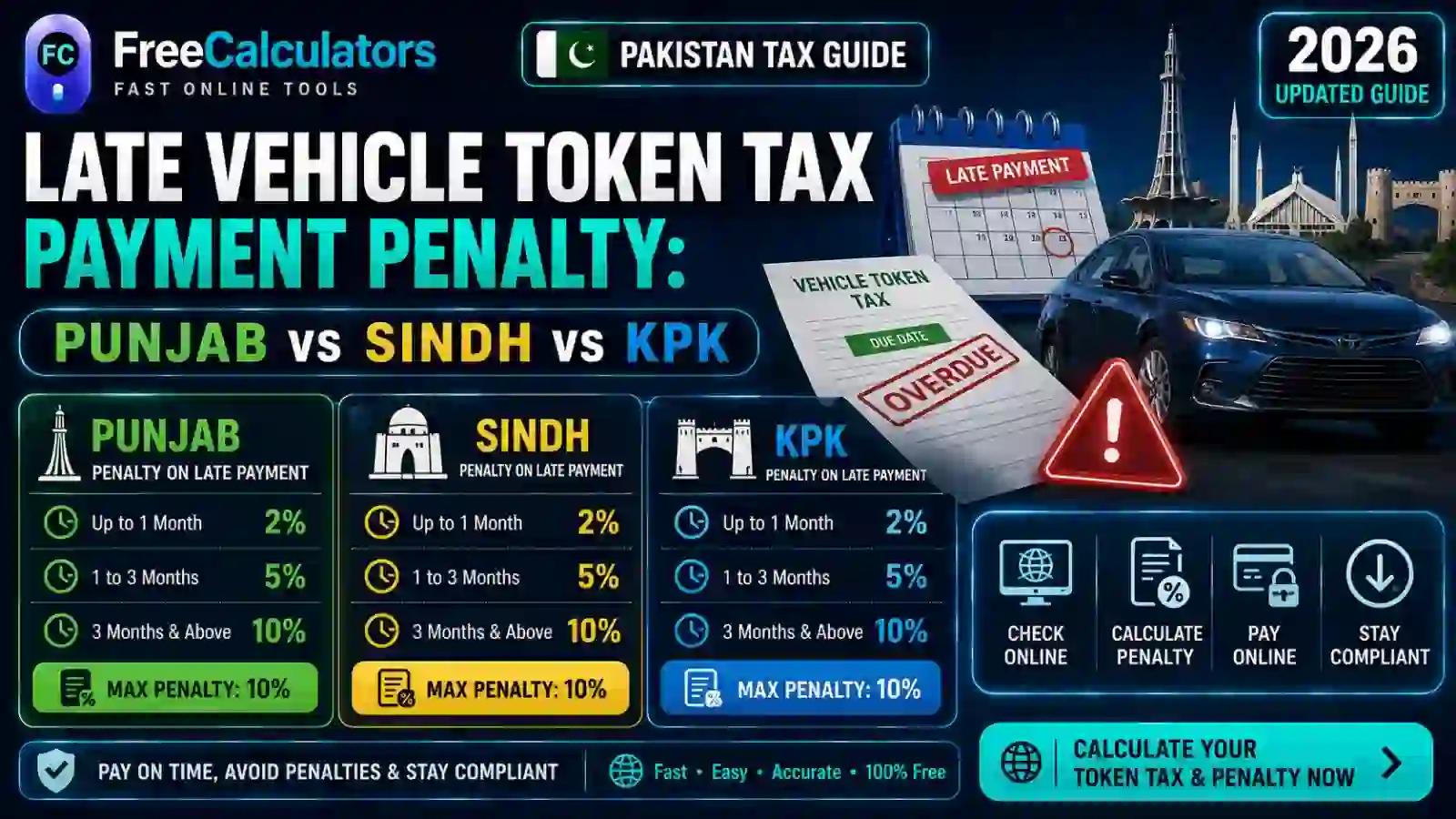
Missing your vehicle token tax deadline triggers a late payment surcharge in every Pakistani province, but the structure and rate differ meaningfully depending on where your vehicle is registered — Punjab and Sindh generally apply a percentage-based or monthly-accruing surcharge on the outstanding amount, while KPK uses a flat quarterly penalty of Rs. 100 regardless of vehicle size. The one constant across all three: the longer the tax goes unpaid, the more expensive it gets, and multi-year arrears compound into a genuinely painful number if left unaddressed.
This guide breaks down exactly how each province structures its late payment penalty, what happens if you let token tax lapse for multiple years, and the practical steps to check and clear arrears before they turn into a bigger problem than the tax itself.
Late Fee vs. Legal Penalty: A Distinction Worth Understanding First
Before comparing provinces, it's worth clearing up a point of confusion that trips up a lot of vehicle owners. A late payment surcharge is an administrative charge added to your token tax bill by the Excise department simply because payment came in after the due date — it's automatic, it's calculated, and paying it clears your record.
A traffic challan for unpaid token tax is a different thing entirely — it's an enforcement action, typically issued if a traffic officer or Excise inspector checks your vehicle's documentation and finds the token tax lapsed, separate from whatever surcharge has already accrued on the account. In practice, this means you could be carrying an administrative surcharge on your token tax bill and also risk a separate on-the-spot fine if you're driving the vehicle while that tax remains unpaid. Understanding this distinction matters because clearing the surcharge through the Excise portal doesn't retroactively erase a challan already issued against the vehicle for driving with lapsed tax.
Province-by-Province Penalty Comparison
Here's how the three provinces structure their late payment penalties, based on current published rules.
| Aspect | Punjab | Sindh | KPK |
|---|---|---|---|
| Managing authority | Excise, Taxation & Narcotics Control Department | Sindh Excise, Taxation & Narcotics Control Department | KP Excise & Taxation Department |
| Penalty structure | Surcharge added to outstanding amount, typically accruing on a monthly basis | Surcharge applied to overdue token tax, structure varies by vehicle category | Flat penalty of Rs. 100 per quarter of default |
| Grace period | Limited to none — surcharge generally begins once the due date passes | Limited to none — surcharge generally begins once the due date passes | Limited to none — quarterly penalty applies from the point of default |
| Multi-year default treatment | Arrears compound annually; higher-CC vehicles accumulate larger surcharges | Arrears accumulate similarly, with total dues carried forward each year | Flat Rs. 100 per quarter continues to accrue, which stays comparatively lower on smaller vehicles over time |
| Payment channel for arrears | ePay Punjab, MTMIS portal, bank counters | Sindh Excise Department portal, bank counters | District Excise office, limited online options |
Since exact surcharge percentages and rupee figures are periodically revised through each province's Finance Act, treat this table as a structural comparison rather than a source for a precise current rupee amount — always confirm the exact figure against your provincial Excise portal or a current vehicle token tax calculator before assuming a specific number.
Punjab: How the Late Payment Surcharge Works
Punjab's token tax system, run through MTMIS and the Excise, Taxation and Narcotics Control Department, applies a surcharge once your annual due date passes without payment. Based on current published guidance, this surcharge typically accrues progressively — meaning the longer the delay, the larger the accumulated penalty, and this compounds faster on higher-CC vehicles where the base token tax is already larger.
Punjab has also moved toward a value-based token tax system for higher-value vehicles in recent years, meaning cars above certain invoice value thresholds are taxed as a percentage of that value rather than a flat CC-based rate. This matters for the penalty conversation because a percentage-based surcharge on a larger base tax amount produces a meaningfully bigger absolute penalty than the same surcharge structure applied to a smaller-engine vehicle.
Punjab has periodically offered early-payment discounts as an incentive — for instance, a reduced rate for payments made before a specific date each year through the ePay Punjab app — which functions as the inverse of a late penalty: pay early and save, pay late and pay more. If you're trying to estimate your specific surcharge exposure, a Punjab token tax calculator gives a current estimate based on your vehicle's engine capacity and filer status, and this deeper guide on the Punjab vehicle tax calculator for 2026 walks through how the value-based system affects your total.
Sindh: Penalty Structure for Late Token Tax
Sindh's Excise, Taxation and Narcotics Control Department applies a surcharge on overdue token tax as well, though the specific rate structure and how it's communicated to vehicle owners has historically been less centrally documented online compared to Punjab's system. In practice, Sindh vehicle owners typically see accumulated arrears — base tax plus surcharge — reflected when they check status through the province's Excise verification system or inquire directly at a district office.
Sindh's token tax rates themselves are structured by engine capacity and vehicle category, similar to other provinces, meaning the absolute penalty amount on a lapsed 1300cc car will differ from a lapsed 1800cc car even if the surcharge percentage or structure is comparable. Given that Sindh's online system for token tax verification is less uniformly available across all districts, confirming your exact arrears amount — including any accrued surcharge — directly with your local Excise office or the Sindh Excise portal is often the more reliable path if the online figure seems unclear.
KPK: The Flat Quarterly Penalty Structure
Khyber Pakhtunkhwa's Excise & Taxation Department applies a distinctly different penalty model compared to Punjab and Sindh — rather than a percentage-based or CC-scaled surcharge, KPK charges a flat Rs. 100 penalty per quarter of default, according to the province's published token tax schedule. This applies uniformly regardless of the vehicle's engine capacity or tax bracket.
This flat structure has a practical implication worth noting: on smaller vehicles, KPK's penalty can end up proportionally lighter than the accruing surcharge models used elsewhere, since Rs. 100 per quarter stays constant rather than scaling with the vehicle's tax bracket. On the other hand, for owners who let default run for several years, that flat penalty still accumulates steadily — four quarters a year at Rs. 100 each adds up to a meaningful number over a multi-year lapse, even though it's structurally simpler than Punjab or Sindh's approach.
What Happens If Token Tax Goes Unpaid for Multiple Years
This is a genuinely different situation from a single missed annual payment, and it deserves separate attention since a meaningful number of vehicle owners — particularly those who inherited a vehicle, bought one with existing arrears, or simply let payments lapse during a period of financial strain — end up here.
Arrears compound year over year. Each unpaid year adds both the base token tax for that year and the accrued penalty on top of it, meaning a vehicle with three or four years of lapsed tax can carry a surprisingly large combined bill by the time an owner goes to clear it.
Ownership transfer becomes blocked. Every province requires token tax to be current before an ownership transfer can be processed, so multi-year arrears become a direct obstacle if you're trying to sell the vehicle — buyers checking token tax status before purchase will see the outstanding balance immediately.
Vehicles can't get a smart card or registration update while tax is outstanding. Any registration-related service — a duplicate smart card, a registration detail update — typically requires clearing pending token tax first, so arrears don't just sit passively; they actively block other administrative needs.
Some provinces have periodically offered amnesty or reduced-penalty schemes for long-overdue token tax as part of broader revenue drives, though these aren't a standing feature and shouldn't be assumed available — if you're carrying multi-year arrears, it's worth checking with your provincial Excise department whether any current amnesty applies before assuming you'll pay the full accumulated penalty.
If you're dealing with a used vehicle purchase where arrears are part of the picture, this broader guide to vehicle ownership transfer in Pakistan explains how outstanding token tax factors into the transfer process specifically.
How to Check and Clear Your Token Tax Arrears
Regardless of which province your vehicle is registered in, the process for resolving overdue token tax follows a similar sequence.
- Check your current status online. Use MTMIS for Punjab, the Sindh Excise Department's verification system for Sindh, or contact your district office directly for KPK, entering your vehicle's registration number to see the outstanding balance including any accrued surcharge.
- Confirm the breakdown. If the amount shown seems unexpectedly high, it likely includes multiple years of base tax plus compounding surcharge rather than a single year's penalty — request or review an itemized breakdown if your province's portal provides one.
- Pay through the available online channel where possible — ePay Punjab for Punjab, or your provincial equivalent — or visit a designated bank branch or Excise office counter if online payment isn't available for your specific arrears situation.
- Retain your payment receipt. This becomes your proof of clearance, which matters if there's any discrepancy in the system afterward or if you're proceeding immediately into an ownership transfer.
- Re-verify status after payment. Database updates aren't always instant — some systems take 24 to 72 hours to reflect a recent payment, so don't be alarmed if your status doesn't update the same day.
For Islamabad specifically, which operates under a separate federal structure rather than a provincial one, the late payment penalty follows its own distinct rules — this dedicated guide on Islamabad's token tax late payment penalty covers that jurisdiction's specific structure, since it doesn't fall under Punjab, Sindh, or KPK's provincial systems.
Filer vs. Non-Filer Status and Its Effect on Total Cost
It's worth mentioning that while this article focuses specifically on late payment penalties, your FBR filer status has a separate, and often larger, effect on your total token tax bill. Non-filers pay meaningfully higher token tax rates than active filers across every province, and this differential applies before any late payment surcharge is even calculated — meaning a non-filer with lapsed tax is compounding a penalty on top of an already higher base amount. If you're not currently an active filer, this comparison of filer vs. non-filer vehicle tax in Pakistan explains the practical cost difference, which is often significant enough to make becoming a filer worthwhile before your next renewal.
Practical Tips to Avoid Late Payment Penalties Going Forward
- Set a calendar reminder tied to your specific renewal date, since token tax deadlines aren't always the same date every vehicle owner assumes — checking your actual due date through your provincial portal avoids relying on guesswork.
- Consider a lifetime token tax option if your vehicle qualifies. Smaller-engine cars and most motorcycles across several provinces are eligible for a one-time lifetime payment instead of annual renewal, which eliminates the late-payment risk entirely going forward.
- Take advantage of early-payment discounts where offered. Punjab in particular has periodically offered a discount for payments made before a specific date each year — paying early isn't just about avoiding a penalty, it can actively save money.
- Check status immediately after any vehicle purchase, particularly for used vehicles, since inherited arrears from a previous owner are your responsibility to clear once the vehicle is in your name.
Frequently Asked Questions
What is the penalty for late vehicle token tax in Pakistan? The penalty varies by province: Punjab and Sindh generally apply a surcharge that accrues on the outstanding amount over time, while KPK charges a flat Rs. 100 per quarter of default regardless of vehicle size. All three penalties increase the longer payment remains outstanding.
How much extra do you pay for expired token tax? The exact amount depends on your province, vehicle's engine capacity or value bracket, and how many months or years the tax has been overdue. Rather than a fixed figure, check your specific arrears through your provincial Excise portal or a token tax calculator for a current estimate.
Does Punjab or Sindh have a higher late token tax penalty? Both provinces apply an accruing surcharge structure rather than a flat fee, and the exact rates are revised periodically through provincial finance legislation. Since published rate details vary in availability between the two systems, confirming the current figure directly through each province's Excise portal is the most reliable approach.
Is there a grace period before token tax penalties apply? Generally, no — surcharges in Punjab and Sindh, and the quarterly penalty in KPK, typically begin accruing once the due date passes, without an extended grace period built into the standard schedule.
What happens if token tax remains unpaid for years? Arrears compound annually, combining unpaid base tax from each year with accumulated surcharge, which can produce a substantial total bill. Multi-year unpaid tax also blocks ownership transfer, smart card issuance, and other registration-related services until cleared.
Can unpaid token tax lead to vehicle seizure in Pakistan? Unpaid token tax primarily results in financial penalties (surcharge) and potential traffic challans if the vehicle is checked while tax is lapsed, rather than automatic seizure. However, prolonged non-compliance combined with other violations can escalate enforcement action depending on the circumstances and province.
How is the late payment surcharge calculated on vehicle tax? In Punjab and Sindh, the surcharge is generally calculated as an accruing charge on the outstanding token tax amount, often scaling with how overdue the payment is. KPK instead applies a flat Rs. 100 charge per quarter of default, independent of the vehicle's tax bracket.
Are there any amnesty schemes for token tax arrears? Provinces have occasionally introduced temporary amnesty or reduced-penalty schemes for long-overdue token tax as part of broader revenue initiatives, though these aren't permanent features. Check directly with your provincial Excise department to see whether any current scheme applies to your situation.
Final Takeaway
Late vehicle token tax penalties aren't identical across Pakistan — Punjab and Sindh scale their surcharge with the outstanding balance, while KPK keeps things simpler with a flat quarterly fee, and all three get more expensive the longer a payment sits unresolved. If you're carrying arrears right now, whether from one missed year or several, the fastest way to stop the number from growing further is checking your exact balance through your provincial portal and clearing it before it compounds into a bigger obstacle for a future transfer, resale, or smart card renewal.
Before your next renewal date arrives, run your vehicle through a current token tax calculator so you know exactly what's due and when — a few minutes of checking now is considerably cheaper than a surcharge later.