
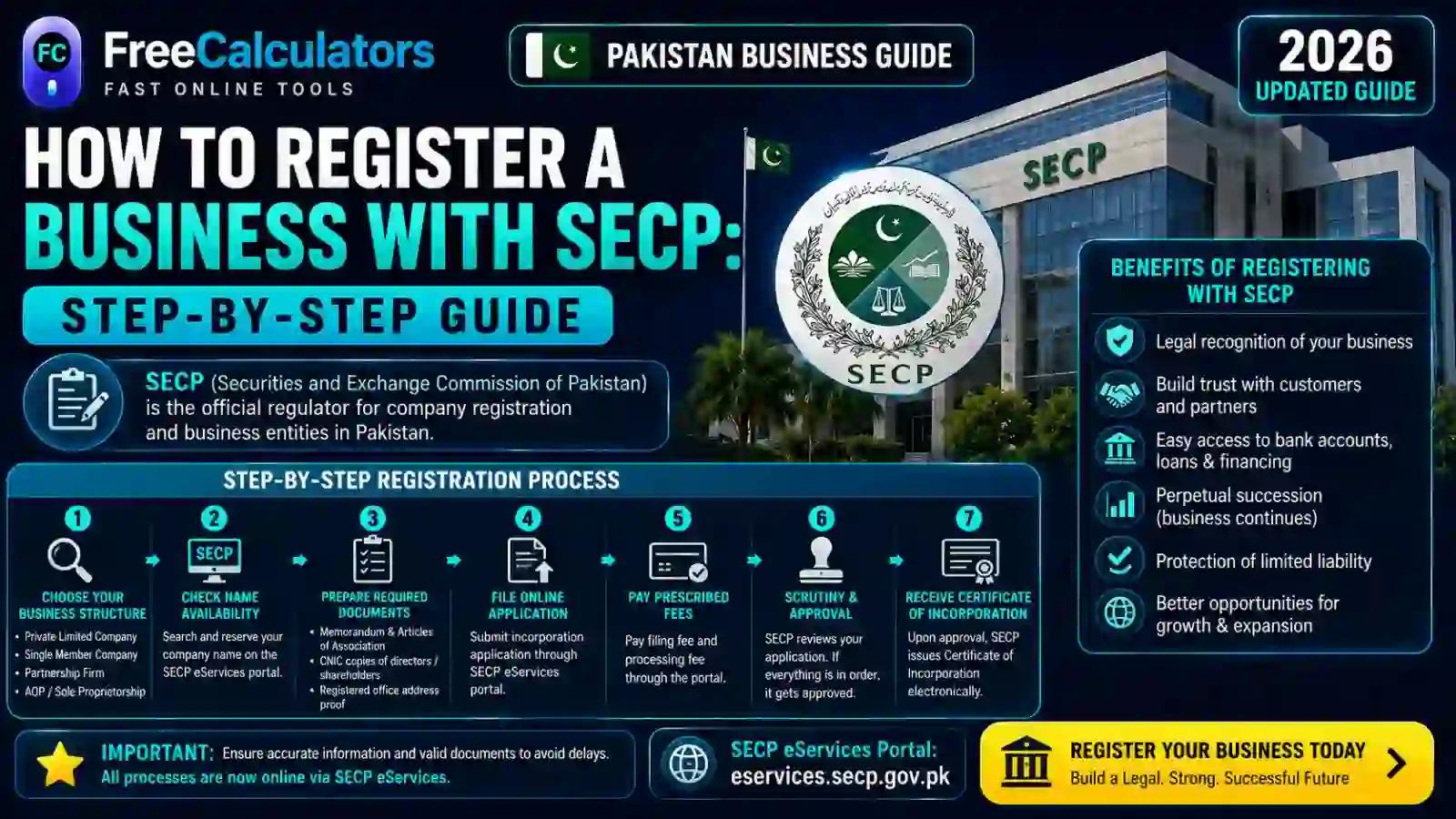
To register a business with SECP, you create an account on the SECP portal using your CNIC, reserve your company name, prepare your Memorandum and Articles of Association, submit the incorporation application with required documents, pay the government fee, and receive your digital Certificate of Incorporation. For a straightforward private limited company with complete documents, the full process typically takes about 3 to 7 working days.
If you're starting a business in Pakistan, registering with the Securities and Exchange Commission of Pakistan isn't optional paperwork you can put off — it's the step that turns your idea into a legal entity that can open a bank account, sign contracts, hire people, and pay taxes under its own name. A lot of first-time founders assume this process still means standing in line at a government office with a stack of physical forms. It doesn't. SECP has been steadily digitizing incorporation, and the process of name reservation and company incorporation is now end-to-end digitized through the commission's official registration portal.
That said, the portal landscape has genuinely shifted in the past couple of years, and a lot of guides floating around online are already out of date. This article walks through the actual steps, the documents you'll need, realistic timelines and costs, and what happens after you get your certificate — plus where the terminology has changed and what to double-check before you file.
What Is SECP and Why Registration Matters
The Securities and Exchange Commission of Pakistan is the country's corporate regulator — the body responsible for company incorporation, capital markets, insurance, and non-banking financial companies. SECP was formed on January 1, 1999, succeeding the earlier Corporate Law Authority, and is headquartered in Islamabad. Company incorporation itself is governed by the Companies Act, 2017, with SECP acting as the sole federal registrar for all company types in Pakistan.
Registering with SECP matters for a few concrete reasons:
- Legal separation. A registered company is its own legal person. Your personal assets — your house, your savings, your car — stay separate from business debts and liabilities.
- Credibility. Banks, investors, and larger clients routinely ask for a Certificate of Incorporation before they'll do business with you at scale.
- Access to formal channels. You can't open a corporate bank account, bid on most public tenders, or register for a company NTN with FBR without a completed SECP registration.
- Continuity. Unlike a sole proprietorship, a registered company doesn't legally dissolve if the founder steps away — ownership can transfer through shares.
If you're currently running as an unregistered sole proprietorship and wondering whether it's worth the switch, the honest answer is: it depends on scale. A one-person freelance setup billing a few clients a year may not need it yet. A business planning to raise investment, hire staff, or sign formal contracts almost always will.
SECP eServices vs. eZfile: Which Portal Do You Actually Use?
This is where a lot of confusion creeps in, and it's worth addressing directly instead of glossing over it.
For years, SECP registrations ran through the eServices portal at eservices.secp.gov.pk, where users log in with their CNIC, NICOP, POC, or passport number as the login ID after completing user registration. That portal is still referenced in SECP's own FAQ page on incorporating through eServices.
More recently, SECP has been shifting company formation onto a newer system generally referred to as eZfile, also known as LEAP. This transition means each director and shareholder now needs a separate individual account rather than sharing one login, and the older eServices system is gradually being phased out in favor of eZfile.
Practical takeaway: Before you start, go to secp.gov.pk directly and use whichever portal link is currently live and labeled for "company registration" or "incorporation." Don't bookmark a URL from an old blog post — portal names and links have changed more than once, and filing on a deprecated system can cost you time you don't need to lose.
Step-by-Step: How to Register a Business with SECP
Here's the actual sequence, broken into the stages that matter.
Step 1: Decide Your Business Structure
Before you touch the portal, choose the legal structure that fits your situation. This decision affects your minimum directors, your liability exposure, and your paperwork going forward.
- Sole Proprietorship — Not registered with SECP at all; instead, it's registered with FBR. You and the business are legally the same entity, which means full personal liability.
- Single Member Company (SMC-Private Limited) — One person, one director, but with limited liability protection. A good middle ground for solo founders who want legal separation without bringing in a co-founder.
- Private Limited Company (Pvt. Ltd.) — The most popular structure for entrepreneurs, startups, and SMEs in Pakistan, requiring a minimum of two shareholders and two directors, who can be the same people, with a minimum paid-up capital of PKR 100,000 in most cases.
- Limited Liability Partnership (LLP) — A hybrid between a traditional partnership and a company, offering more operational flexibility than a Pvt. Ltd. while still limiting personal liability.
- Public Limited Company — Built for larger businesses that intend to raise capital from the public or eventually list on the Pakistan Stock Exchange. Not the right fit for most new businesses.
Step 2: Create Your SECP Account
Every proposed director and shareholder needs their own individual login — this isn't a "one account per company" system. You'll typically need:
- A valid CNIC, NICOP, or passport number
- A working email address and mobile number
- Basic personal details (name, father's name, residential address)
After submitting these, SECP sends a verification code or PIN to confirm your identity, and your CNIC or passport number becomes your permanent login ID going forward.
Step 3: Reserve Your Company Name
Once your account is active, search for your proposed company name through the name-availability search tool on the SECP registration portal. Your name can't be identical to, or deceptively similar to, an existing registered company.
Practical tips that save time here:
- Propose two or three name alternatives up front, in case your first choice is rejected.
- Avoid generic, overly common words that overlap heavily with existing registrations.
- Don't include restricted words (like "Bank," "National," or "Foundation") unless your business actually qualifies for that designation — these trigger additional scrutiny.
Once approved, your name reservation is valid for a set period before you need to file the full incorporation application — commonly cited as around 60 days, though this window has been adjusted by SECP orders before, so confirm the current validity period shown in your own approval notice rather than assuming a fixed number.
Step 4: Prepare Your Memorandum and Articles of Association
The Memorandum of Association (MOA) defines what your company is legally allowed to do — its objectives and scope of business. The Articles of Association (AOA) set out how the company will be internally governed — shareholder rights, director powers, and decision-making procedures.
SECP provides standard, pre-approved templates for common company types, which is the faster route for most small businesses. If your business operates in a specialized or regulated sector (finance, insurance, education, healthcare), custom-drafted MOA/AOA is usually worth the extra time and, often, legal input.
Step 5: Submit Your Incorporation Application
With your name approved and MOA/AOA ready, you complete the full incorporation form. This typically requires:
- CNIC/NICOP/passport copies of all directors and shareholders
- Proposed registered office address
- Principal line of business (main objects)
- Authorized and paid-up share capital details
- Shareholding percentage breakdown among subscribers
- Contact details: email, phone, company website (if applicable)
Double-check every field before submitting. Mismatched CNIC details, inconsistent addresses, or unclear shareholding percentages are among the most common reasons applications bounce back for correction, which adds days to your timeline unnecessarily.
Step 6: Pay the Government Fee
Fees are calculated based on your authorized share capital — the higher your authorized capital, the higher the incorporation fee. As a general benchmark, government fees have started from around PKR 1,000 for companies with authorized capital up to PKR 100,000, increasing in tiers as authorized capital rises, with professional consultancy fees charged separately by any advisor you use. Name reservation itself carries a much smaller, separate fee.
Because fee schedules are set by SECP order and do get revised, treat any number you read online — including this one — as a starting reference point, and confirm the exact current figure on the fee calculator on secp.gov.pk before you pay.
Step 7: Receive Your Certificate of Incorporation
Once SECP reviews and approves your application, you receive a digital Certificate of Incorporation through the portal, which you can download and print. This certificate is your official, legal proof that the company exists — you'll need it for nearly every step that follows, from opening a bank account to registering with FBR.
Realistic Timeline and Fee Snapshot
| Stage | Typical Duration |
|---|---|
| Name reservation approval | 24–48 hours |
| Certificate of Incorporation after complete submission | 1–3 working days |
| Full process (name reservation to certificate) | 3–7 working days for straightforward filings |
| Complex structures or applications with SECP queries | Up to 3–4 weeks |
End-to-end, a straightforward private-limited filing submitted with complete documents can be completed in as little as five working days, while more complex structures or applications that draw SECP queries may take three to four weeks.
SMC vs. Private Limited vs. LLP vs. Sole Proprietorship
Choosing the wrong structure early on tends to create headaches later — restructuring after incorporation is possible but adds cost and time. Here's the comparison worth sitting with before you file:
| Feature | Sole Proprietorship | SMC-Private Limited | Private Limited | LLP |
|---|---|---|---|---|
| Registered with | FBR only | SECP | SECP | SECP |
| Minimum owners | 1 | 1 | 2 | 2 |
| Personal liability | Unlimited | Limited | Limited | Limited |
| Legal separation from owner | No | Yes | Yes | Yes |
| Best suited for | Freelancers, small side businesses | Solo founders wanting protection | Startups, SMEs with co-founders | Professional partnerships (consultancies, agencies) |
| Complexity of compliance | Low | Moderate | Moderate to high | Moderate |
If you're testing a low-risk idea with minimal revenue, a sole proprietorship registered with FBR might genuinely be enough for now. If you're building something you expect to grow, bring on investors, or protect personally, an SMC or Private Limited company is almost always the better long-term move.
Documents Required for SECP Company Registration
Keep this checklist handy — incomplete documentation is the single biggest cause of delayed applications:
- Valid CNIC (or NICOP/passport for overseas Pakistanis and foreign nationals) for every director and shareholder
- Passport-size photographs, in some cases
- Proposed company name(s), in order of preference
- Registered office address in Pakistan
- Memorandum and Articles of Association
- Details of authorized and paid-up capital
- Shareholding pattern among subscribers
- Contact information: email, phone number, and website if available
Foreign investors and overseas Pakistanis can register companies with SECP as well, though foreign shareholding often requires additional documentation, such as board resolutions from a parent company or notarized authorizations — worth planning for early rather than discovering mid-application.
What Happens After Incorporation
Getting your Certificate of Incorporation is the beginning of your compliance obligations, not the end of them. Here's the sequence that follows:
- Register for your company NTN with FBR. This is required for tax purposes and is done through FBR's online portal, using your Certificate of Incorporation as supporting documentation. If you're unfamiliar with what an NTN actually is and why every registered entity needs one, our guide on what is NTN (National Tax Number) breaks it down in plain terms.
- File your General Information Statement (GIS) and beneficial ownership return. This must be submitted to SECP within 30 days of incorporation, and recent SECP orders have reinforced the requirement for this to be filed electronically. Missing this deadline is one of the most common — and most avoidable — compliance slip-ups new companies make.
- Register for sales tax, if applicable. If your turnover crosses the relevant threshold or your business involves taxable goods and services, you'll need Sales Tax Registration through FBR, and possibly with your provincial revenue authority as well. If you're operating in Punjab, our breakdown of PRA tax registration in Pakistan covers how that layer works alongside your federal obligations.
- Open a corporate bank account. Banks will ask for your Certificate of Incorporation, NTN, company resolutions authorizing account opening, and CNIC copies of authorized signatories.
- Deposit your paid-up capital, as declared in your MOA, into the new corporate account.
- Plan for ongoing annual filings. Registered companies must submit annual returns and financial statements to SECP; missing these can result in penalties or, eventually, deregistration.
Once you're through registration and NTN setup, most founders find it useful to actually estimate their tax position early rather than being surprised at filing time. Our FBR tax calculator for Pakistan is a fast way to get a realistic sense of what your company's tax obligations will look like once revenue starts coming in, and pairs well with our guide on becoming a tax filer in Pakistan if you're setting up FBR compliance for the first time alongside your SECP registration.
Common Mistakes That Slow Down SECP Registration
A few patterns show up again and again in delayed applications, based on how the process typically plays out:
- Choosing a name too close to an existing company. Even unintentional overlaps get flagged and rejected, costing you the name-reservation cycle.
- Inconsistent CNIC details across documents. If your CNIC spelling or address doesn't match across forms, expect a query back from SECP.
- Vague or overly broad business objectives in the MOA. This can trigger requests for clarification, especially for regulated sectors.
- Missing the 30-day GIS filing deadline. This is a post-incorporation trap — founders celebrate getting the certificate and forget the clock is already running on the next obligation.
- Using an outdated portal link. With the eServices-to-eZfile transition, some founders start an application on a portal that's being phased out, leading to confusion about where their submission actually lives.
Frequently Asked Questions
How do I register a business with SECP? Create an account on SECP's registration portal using your CNIC, reserve your company name, prepare your Memorandum and Articles of Association, submit the incorporation application with required documents, pay the applicable government fee, and receive your digital Certificate of Incorporation once approved.
What documents are needed for SECP company registration? You'll need valid CNIC (or passport/NICOP) copies for all directors and shareholders, your proposed company name, registered office address, Memorandum and Articles of Association, and details of your authorized and paid-up capital.
How long does SECP company registration take? A straightforward private limited company filing with complete documents typically takes about 3 to 7 working days from name reservation to Certificate of Incorporation. Complex structures or applications that draw SECP queries can take three to four weeks.
How much does SECP company registration cost? Government fees are tiered based on authorized share capital, starting from roughly PKR 1,000 for lower capital tiers, plus a smaller separate fee for name reservation. Always confirm the current fee schedule on SECP's official site since these figures are periodically revised.
What is the difference between SMC and Private Limited? An SMC (Single Member Company) allows one person to own and run a limited-liability company alone. A Private Limited company requires a minimum of two shareholders and two directors, who can be the same individuals, but legally involves more than one owner on record.
Can a foreigner register a company with SECP? Yes. Foreign nationals and overseas Pakistanis can register companies in Pakistan, typically using a passport or NICOP in place of a CNIC, though additional documentation is often required for foreign shareholding structures.
Do I need a lawyer to register a company with SECP? Not strictly — SECP's standard templates and digital portal are designed for self-filing. That said, businesses in regulated sectors, or those with complex shareholding or foreign investment, often benefit from legal input on the MOA and AOA.
What happens after I get my Certificate of Incorporation? You'll need to register for an NTN with FBR, file your General Information Statement and beneficial ownership return with SECP within 30 days, open a corporate bank account, and, depending on your business activity, register for sales tax.
Key Takeaway
Registering a business with SECP is genuinely more accessible than it used to be — the process is digital, the templates are standardized, and a clean application with complete documents can realistically be done in under a week. The parts that trip people up aren't the registration itself; they're the details around it: picking the wrong structure for your situation, using an outdated portal, or missing the 30-day GIS deadline right after incorporation.
Before you file, confirm three things directly on secp.gov.pk: the current live portal (eServices or eZfile), the up-to-date fee schedule for your capital tier, and the name-reservation validity window shown on your own approval. Once your certificate is in hand, move quickly on your FBR NTN registration and GIS filing — those first 30 days matter more than most founders expect.