
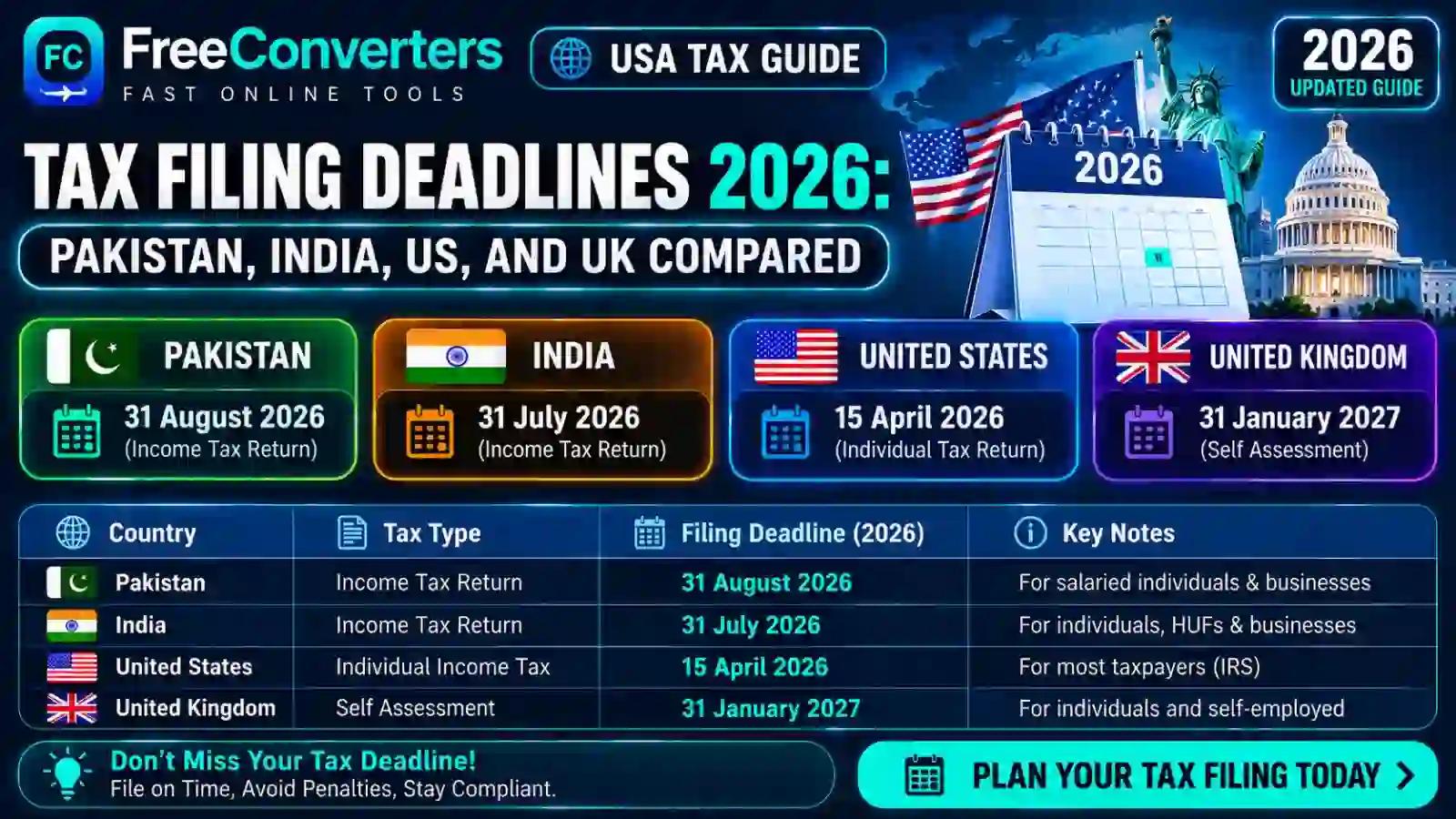
If you're juggling tax obligations across more than one country, here's the quick answer: Pakistan's deadline for individuals is September 30, 2026; India's staggered system runs from July 31 to November 30, 2026 depending on your ITR form; the US standard deadline is April 15, 2026; and the UK's online Self Assessment deadline is January 31, either just passed or upcoming depending on which tax year you're filing for. Each country runs on a genuinely different tax year, uses different terminology, and penalizes lateness in different ways — which is exactly why side-by-side confusion is so common for expats, freelancers, and cross-border business owners.
This guide breaks down each country's system individually, then brings it all together in one master comparison table so you can see exactly where your obligations stand.
Master Comparison Table: 2026 Tax Filing Deadlines
| Country | Tax Year Period | Standard Filing Deadline | Late Filing Penalty |
|---|---|---|---|
| Pakistan | 1 July 2025 – 30 June 2026 | 30 September 2026 (individuals/AOPs); 31 December 2026 (companies) | Rs. 1,000/day (up to Rs. 50,000 for individuals), loss of Active Taxpayer List status |
| India | 1 April 2025 – 31 March 2026 (FY 2025-26 / AY 2026-27) | 31 July 2026 (ITR-1/2); 31 August 2026 (ITR-3/4 non-audit); 31 October 2026 (audit cases) | Late fee up to ₹5,000 under Section 234F, plus 1% monthly interest on unpaid tax |
| United States | 1 January 2026 – 31 December 2026 | 15 April 2026 | 5% of unpaid tax per month (up to 25%), plus separate late-payment penalty |
| United Kingdom | 6 April 2025 – 5 April 2026 | 31 January 2026 (online, for 2024-25 tax year); 31 January 2027 (online, for 2025-26 tax year) | £100 immediate penalty, escalating with further delay |
Because these four systems don't share a common tax year or a common due-date logic, treat this table as your quick reference — but read the country-specific sections below before assuming anything applies directly to your situation, since each jurisdiction has its own nuances around extensions, staggered categories, and penalty structures.
Pakistan: FBR Deadline for Tax Year 2026
Pakistan's Federal Board of Revenue (FBR) runs its tax year from July 1 to June 30, a detail that trips up plenty of first-time filers who assume it follows the calendar year. Tax Year 2026 covers income earned between 1 July 2025 and 30 June 2026, filed on the FBR IRIS 2.0 portal.
Key Pakistan deadlines:
- Salaried individuals, non-salaried individuals, and Associations of Persons (AOPs): file by 30 September 2026
- Companies with a 30 June year-end: file by 31 December 2026
Filing happens exclusively through iris.fbr.gov.pk, and the return-submission window for Tax Year 2026 opened on July 1, giving filers the standard three-month statutory window under the Income Tax Ordinance, 2001. If you haven't set up your IRIS profile yet, our detailed FBR IRIS portal guide walks through registration and document prep before you get to the actual filing stage.
What happens if you miss the Pakistan deadline:
- Late-filing penalty of Rs. 1,000 per day starting October 1, 2026, capped at Rs. 50,000 for individuals and AOPs
- Loss of Active Taxpayer List (ATL) status until you file, which raises withholding tax rates on banking transactions, property purchases, and vehicle registration — often a far bigger real cost than the penalty itself
- An ATL surcharge of Rs. 1,000 to get reinstated after filing late
Is an FBR extension likely for Tax Year 2026? History suggests caution here. FBR extended the Tax Year 2024 deadline to October 31, 2024, and after publicly denying an extension for Tax Year 2025, ultimately pushed that deadline to October 15, 2025 following technical glitches and pressure from trade bodies. As of late July 2026, no general extension has been announced for Tax Year 2026, and FBR's public messaging has leaned toward discouraging that expectation. The practical advice from tax consultants across the board: file early rather than betting on an extension — IRIS runs noticeably smoother in July and August than it does in the final week of September. Even taxpayers with zero tax payable should still file a nil return to preserve their filer status; our guide on how to become a tax filer in Pakistan covers this specific scenario. For a closer look at the exact penalty structure and how ATL removal affects your finances beyond the flat fee, see our dedicated breakdown of the FBR tax filing deadline and penalties.
India: ITR Deadlines for AY 2026-27
India's tax system runs on a fiscal year from April 1 to March 31, referred to as the Financial Year (FY), with tax returns filed in the following Assessment Year (AY). For income earned in FY 2025-26 (April 2025 to March 2026), you're filing your return in AY 2026-27.
The biggest change for this filing season: India has introduced staggered deadlines based on your ITR form for the first time, a shift announced in Union Budget 2026 specifically to reduce congestion on the e-filing portal.
India's staggered deadlines for AY 2026-27:
- ITR-1 and ITR-2 (most salaried individuals, non-audit cases): 31 July 2026
- ITR-3 and ITR-4 (business and professional income, non-audit): 31 August 2026
- Audit cases: 31 October 2026
- Transfer pricing cases: 30 November 2026
If you're filing ITR-1 or ITR-2 and reading this after July 31, that deadline has already passed for this season — check whether you now fall under the belated return window rather than the standard one. If you're filing ITR-3 or ITR-4 without an audit requirement, your August 31 deadline is imminent as of late August 2026, so this is worth prioritizing immediately rather than assuming there's comfortable runway left.
What happens if you miss the India deadline:
- A late filing fee of up to ₹5,000 under Section 234F, reduced to ₹1,000 if your total income is below ₹5 lakh
- Interest at 1% per month or part-month on any unpaid tax under Section 234A
- Loss of the ability to carry forward certain losses (like capital losses or business losses) to future years — a genuinely costly consequence beyond the flat penalty
- If you miss the standard window entirely, you can typically still file a belated return, though under a compressed timeline and without full access to loss carry-forward benefits
One important structural note: this is described as the final Assessment Year filed entirely under the Income Tax Act, 1961. Starting with income earned from April 1, 2026 onward (FY 2026-27), filings will be governed by the new Income Tax Act, 2025, which also replaces the terms "Previous Year" and "Assessment Year" with the simpler "Tax Year" — a terminology shift worth knowing about if you're filing again next season and the vocabulary suddenly looks different. If you want to understand how this fiscal year's income tax slabs affect your actual liability before you file, our guide to India income tax slabs for AY 2026-27 breaks that down, and our Income Tax Calculator can estimate your liability directly.
United States: IRS Deadline for Tax Year 2025 (Filed in 2026)
The US operates on a straightforward calendar-year tax system for most individuals — income earned between January 1 and December 31, 2025 is reported on the return due in 2026.
Standard US filing deadline: April 15, 2026.
This is the date by which most individual taxpayers must file Form 1040 and pay any tax owed. A few important nuances:
- Filing an extension using Form 4868 pushes your filing deadline to October 15, 2026 — but critically, this is an extension to file, not an extension to pay. Any tax owed is still due by April 15, and interest and penalties accrue on unpaid amounts from that date regardless of whether you've filed an extension.
- Quarterly estimated tax payments, relevant for freelancers and self-employed individuals, follow a separate schedule throughout the year (typically mid-April, mid-June, mid-September, and mid-January), distinct from the annual filing deadline itself.
- State tax deadlines generally mirror the federal April 15 date, though not universally — always confirm your specific state's deadline separately, since a handful of states run on different schedules or have their own extension rules.
- Disaster-related extensions are periodically granted by the IRS for taxpayers in federally declared disaster areas, pushing deadlines back for affected regions specifically rather than nationwide.
Penalties for missing the US deadline:
- Failure-to-file penalty: 5% of unpaid tax for each month or part of a month your return is late, capped at 25% of the unpaid tax
- Failure-to-pay penalty: A separate, smaller penalty (generally 0.5% per month) applies specifically to unpaid tax, even if you filed on time
- Combined, these penalties compound quickly, which is why the IRS consistently emphasizes filing on time even if you can't pay your full balance immediately — filing late is genuinely more expensive than paying late alone
If you're navigating the distinction between employee and contractor income for your filing this season, our comparison of W-2 vs. 1099 tax calculation covers how that affects your withholding and estimated payment obligations. For state-specific rates once you've confirmed your federal numbers, our US State Income Tax Calculator breaks down how your state's system layers on top of the federal deadline and liability. The IRS's official site remains the authoritative source for any deadline confirmation or disaster-relief extension specific to your area.
United Kingdom: Self Assessment Deadlines
The UK tax year is genuinely unlike the other three systems here — it runs from April 6 to April 5 of the following year, a quirk rooted in historical calendar reforms rather than any modern administrative logic, but one that still governs every Self Assessment deadline today.
UK Self Assessment deadlines:
- Paper returns: due by 31 October following the end of the tax year
- Online returns: due by 31 January following the end of the tax year — this is the deadline the vast majority of filers actually use, since paper filing has a considerably earlier cutoff
For the 2024-25 tax year (April 2024 to April 2025), the online Self Assessment deadline was January 31, 2026 — a date that, depending on exactly when you're reading this, may have just passed. For the 2025-26 tax year (April 2025 to April 2026), the next online deadline falls on January 31, 2027.
This is worth being precise about, since "the UK tax deadline in 2026" can genuinely mean two different things depending on which tax year someone means: the January 31, 2026 deadline for the previous tax year's return, or the eventual January 2027 deadline for the current tax year that's still underway as of this writing.
What happens if you miss the UK deadline:
- An immediate £100 penalty applies even if you owe no tax or are due a refund, simply for late filing
- Additional daily penalties of £10 per day apply after three months late, up to a 90-day maximum
- Further penalties escalate at the 6-month and 12-month marks, calculated as a percentage of tax owed
- Interest accrues separately on any unpaid tax from the original payment deadline
Self Assessment applies to self-employed individuals, higher earners with additional income sources, landlords, and anyone with income not fully covered by PAYE — most standard employees taxed entirely through PAYE never need to file a Self Assessment return at all. If you're trying to understand how UK council tax fits alongside your income tax obligations, since the two are frequently confused, our guide on council tax vs. income tax in the UK clarifies that distinction, and our UK National Insurance Calculator helps estimate the other major deduction that runs alongside your Self Assessment liability. HMRC's official Self Assessment guidance is the definitive source for confirming your specific deadline and any circumstances that might shift it.
Why These Four Systems Are So Different
Understanding why these deadlines don't align helps explain the confusion rather than just memorizing four separate dates:
- Tax year start dates differ entirely. Pakistan and India both use non-calendar fiscal years (July-June and April-March respectively), while the US uses the calendar year, and the UK uses its historically rooted April 6 start.
- Terminology varies meaningfully. India's "Assessment Year" versus "Financial Year" distinction has no real US or UK equivalent, and Pakistan's own "Tax Year" terminology doesn't map cleanly onto any of the others.
- Filing categories are structured differently. India's newly staggered ITR-form-based deadlines are a genuinely unusual approach compared to Pakistan's single date for most individuals, the US's uniform April deadline, or the UK's paper-versus-online split.
- Extension culture differs by country. Pakistan has a documented pattern of last-minute extensions in recent years (though not guaranteed), India occasionally extends via CBDT notification during technical disruptions, the US grants disaster-specific rather than blanket extensions, and the UK's deadlines are comparatively rigid with fixed statutory penalties.
Tax Filing Deadlines for Expats and Cross-Border Filers
If you're managing obligations across more than one of these countries — a common situation for overseas workers, remote freelancers, and multinational business owners — a few practical points are worth flagging:
- Dual filing obligations don't share a calendar. Someone with both Pakistani and UK tax obligations, for instance, is working against a September 30 deadline in one system and a January 31 deadline in the other, with entirely different fiscal year definitions underlying each.
- Foreign income reporting requirements vary independently of the filing deadline itself. Each country has its own rules for how foreign-earned income gets reported, and missing a foreign income disclosure can carry separate penalties from a simple late-filing fee.
- Double taxation treaties between these country pairs may affect what you actually owe, though they don't typically change the filing deadline itself — you still need to file on time in each relevant jurisdiction, then claim any treaty relief through the appropriate mechanism.
- Keep a single master calendar covering all your relevant deadlines rather than tracking each country's system in isolation, since the biggest practical risk for cross-border filers isn't confusion about any one country's rules — it's simply losing track of which deadline is coming up next.
Quick Reference: What To Do Right Now (As of Late August 2026)
Given today's date, here's where things stand across all four systems:
- Pakistan: Tax Year 2026 filing window is open; the September 30, 2026 deadline for individuals is about a month away — a good window to file before the typical late-September portal congestion.
- India: The July 31 ITR-1/2 deadline has passed; if that applied to you and you haven't filed, you're now in belated-return territory. The August 31 deadline for ITR-3/4 non-audit filers is imminent and should be treated as urgent.
- United States: The April 15, 2026 deadline for Tax Year 2025 has passed; if you filed an extension, your October 15, 2026 deadline is approaching, though any unpaid tax has been accruing penalties and interest since April.
- United Kingdom: You're currently mid-way through the 2025-26 tax year (which runs to April 5, 2026), with the corresponding online Self Assessment deadline not due until January 31, 2027 — plenty of runway, but a good time to start organizing records rather than waiting.
Frequently Asked Questions
What is the tax filing deadline in Pakistan for 2026? The FBR deadline for Tax Year 2026 is September 30, 2026 for salaried individuals, non-salaried individuals, and Associations of Persons, with companies on a 30 June year-end given until December 31, 2026.
What is the last date to file ITR in India for 2026? India's AY 2026-27 deadlines are staggered by form: July 31, 2026 for ITR-1 and ITR-2, August 31, 2026 for ITR-3 and ITR-4 non-audit cases, October 31, 2026 for audit cases, and November 30, 2026 for transfer pricing cases.
When is the US tax deadline in 2026? The standard IRS deadline for Tax Year 2025 individual returns is April 15, 2026, with an available extension to October 15, 2026 for filing only — any tax owed is still due by the original April deadline.
When is the UK Self Assessment deadline for 2026? For the 2024-25 tax year, the online deadline was January 31, 2026; for the current 2025-26 tax year, the online Self Assessment deadline falls on January 31, 2027.
What happens if you miss the tax filing deadline? Consequences vary by country but generally include flat late-filing penalties, accumulating interest on unpaid tax, and in some jurisdictions like Pakistan, loss of active taxpayer status that raises withholding tax rates on everyday financial transactions.
Can tax deadlines be extended? Yes, though practices differ — Pakistan has extended deadlines in some recent years but not others, India's CBDT occasionally extends via official notification, the US grants disaster-specific extensions, and the UK's statutory deadlines are comparatively fixed with predictable penalty structures.
Do all four countries have the same tax year? No — Pakistan runs July to June, India runs April to March, the US follows the calendar year, and the UK runs April 6 to April 5, meaning none of these four systems share an identical fiscal year structure.
What is the penalty for late tax filing? Penalties range from flat fees (the UK's £100 immediate penalty, India's up to ₹5,000 under Section 234F) to daily accruing charges (Pakistan's Rs. 1,000 per day) to percentage-based US penalties of 5% per month up to 25% of unpaid tax.
The Bottom Line
None of these four tax systems run on the same calendar, use the same terminology, or penalize lateness the same way — which makes a side-by-side comparison genuinely useful rather than just a formality. If you're filing in any single one of these countries, the practical takeaway is simple: know your exact deadline, don't count on an extension materializing, and file early enough to avoid the portal congestion that hits every one of these systems in the final week before the cutoff.
For deeper guidance on your specific country's process, our FBR filing deadline guide and India income tax slabs breakdown go further into the mechanics of filing correctly, not just on time — and our Income Tax Calculator is worth running before you file in any jurisdiction, so you know roughly what you owe well before the deadline pressure sets in.