
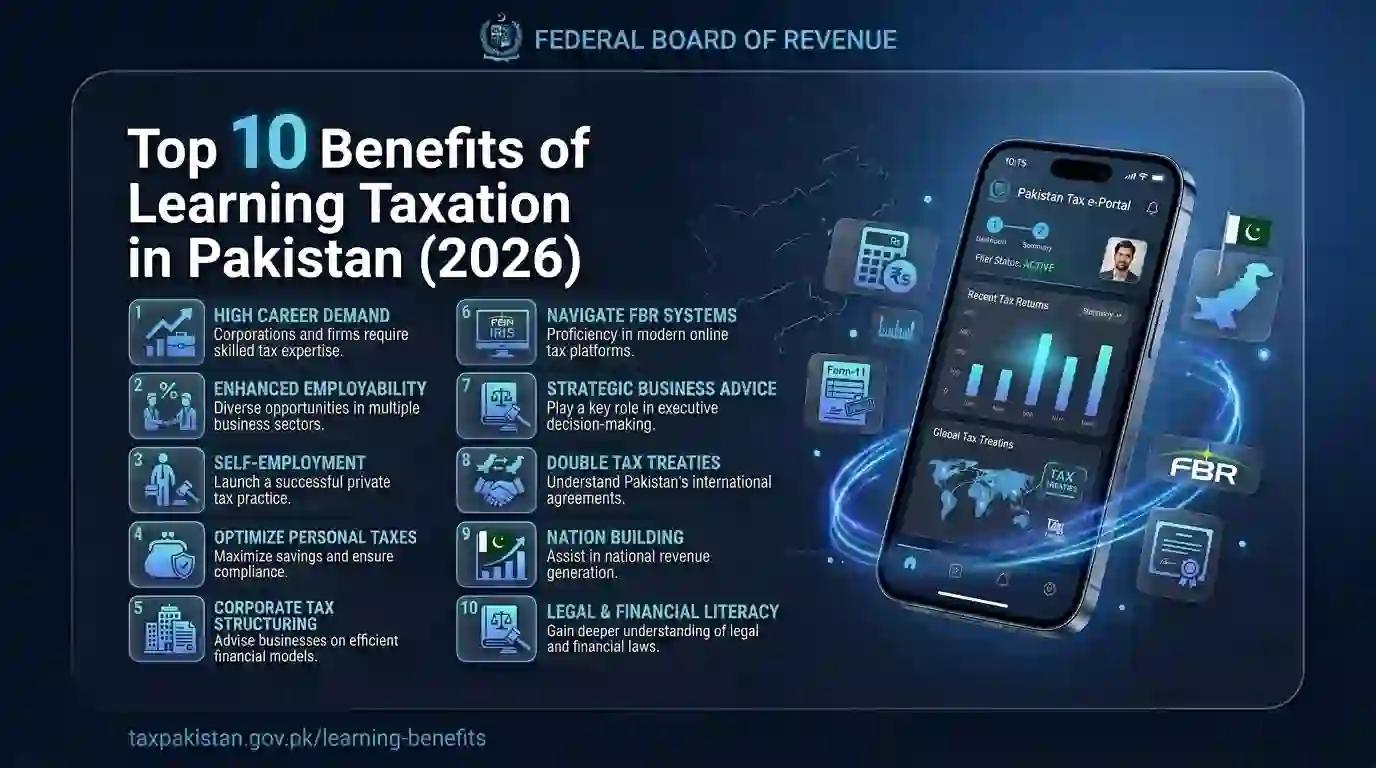
Taxation touches almost every part of daily life in Pakistan — from the salary you take home each month to the price you pay for groceries. Yet most people never formally learn how it works until they're filing a return under pressure or trying to understand a salary deduction they don't recognize. That's exactly why taxation education has quietly become one of the smartest skills a student, employee, or business owner can pick up in 2026.
Whether you're a fresh graduate deciding on a career path, a small business owner tired of relying on someone else for every tax question, or a freelancer trying to stay compliant with FBR rules, learning taxation in Pakistan pays off in ways that go far beyond passing an exam. In this guide, we'll walk through the top 10 benefits of learning taxation in Pakistan, what skills and tools you'll need, realistic salary expectations, and how to get started — with free resources you can use today.
Why Taxation Knowledge Matters in Pakistan Right Now
Pakistan's tax system has gone through major digital changes in the last few years. The Federal Board of Revenue (FBR) has pushed more processes onto the IRIS portal, tightened rules around the Active Taxpayer List (ATL), and increased scrutiny on freelancers, property transactions, and small businesses. If you're unfamiliar with how the Income Tax Ordinance 2001 or the Sales Tax Act 1990 actually apply to you, it's easy to overpay, underpay, or miss deadlines entirely — all of which cost money.
Learning taxation isn't just for accountants anymore. It's becoming a practical life skill, similar to basic financial literacy, for anyone earning an income in Pakistan.
Top 10 Benefits of Learning Taxation in Pakistan
1. Stronger Career Prospects and Job Security
Taxation knowledge opens doors across accounting firms, banks, corporate finance departments, and government bodies. Companies constantly need people who understand withholding tax, tax compliance, and filing procedures, and this demand isn't slowing down. Taxation jobs in Pakistan are consistently listed among the more stable career paths because every company — large or small — needs someone managing its tax obligations.
2. Higher Earning Potential
A tax consultant career in Pakistan can be genuinely lucrative once you build experience and credibility. Entry-level tax roles typically start modestly, but professionals with a few years of hands-on experience, especially those who combine taxation with ACCA, ICAP, or ICMA credentials, can command significantly higher salaries. Independent tax consultants who build a client base often earn well beyond a typical salaried position.
3. Better Personal Financial Planning
Once you understand how income tax slabs, tax rebates, and exemptions actually work, you stop guessing about your own finances. You'll know exactly how much of your salary is being withheld, when you're eligible for a refund, and how to plan investments or expenses around tax-saving opportunities. This single benefit alone makes taxation education worthwhile even if you never work in the field professionally.
4. Confidence to File Your Own Tax Return
Filing an income tax return in Pakistan through the IRIS portal feels intimidating the first time. Once you understand the process, though, it becomes routine. People who learn taxation stop depending on a tax practitioner for every small filing and can confidently manage their own annual income tax return, check their tax return status, or file a nil income tax return when required.
5. A Real Advantage for Business Owners
If you run or plan to run a business, taxation knowledge protects you from costly mistakes. Understanding sales tax registration, corporate tax rates, and withholding tax obligations means you won't be blindsided by a notice from the FBR or a missed filing deadline. Business owners who understand tax compliance also tend to build more trust with investors, banks, and clients, since clean tax records are often required for loans and contracts.
6. Essential Skill for Freelancers and Remote Workers
Pakistan's freelance economy has grown rapidly, and the FBR has taken notice. Freelancers earning through platforms like Upwork or Fiverr are increasingly expected to understand their tax obligations, including how foreign income is treated and whether they need to register as a filer. If you want a deeper walkthrough, this guide on freelancer income tax rules in Pakistan breaks down exactly what freelancers need to know about FBR compliance.
7. Understanding the Difference Between Filer and Non-Filer Status
One of the most practical benefits of learning taxation is finally understanding why "filer status" matters so much in Pakistan. Filers pay lower withholding tax on banking transactions, vehicle registration, and property transfers compared to non-filers. If you've ever wondered why a non-filer pays more tax on the same transaction, this comparison of filer vs non-filer status in Pakistan explains the real financial difference.
8. Opens the Door to Professional Certifications
Taxation is a core module in professional qualifications like ACCA, ICAP, and ICMA. Learning the basics early gives you a real head start if you plan to pursue any of these certifications later. Many students find that a foundational taxation course makes advanced accounting papers significantly easier to grasp.
9. Growing Relevance in an Automated, Digital Tax System
As FBR continues digitizing tax filing through the IRIS portal and expanding faceless assessment systems, understanding how these digital tools work is becoming a genuine advantage. People who are comfortable navigating digital tax filing, generating tax challans, and verifying sales tax registration online will have a real edge over those still relying entirely on manual processes or middlemen. For a clear breakdown of how this portal works, see this guide on what the FBR IRIS portal is and how tax filing works in Pakistan.
10. Contributing to Financial Literacy and National Development
On a broader level, a tax-literate population supports a healthier economy. Pakistan has historically struggled with a low tax-to-GDP ratio, partly due to widespread confusion and mistrust around the tax system. Every person who understands and complies with tax laws — rather than avoiding them out of confusion — contributes, in a small way, to a more transparent and functional system.
Key Skills You'll Learn in a Taxation Course
A solid taxation course in Pakistan typically covers:
- Income tax calculation and salary tax computation
- Sales tax registration, filing, and Sales Tax Act 1990 basics
- Withholding tax rules and agent responsibilities
- Filing procedures through the IRIS portal
- Tax audits, tax planning, and advisory basics
- Corporate taxation and tax compliance for businesses
- Understanding tax exemptions, rebates, and the Active Taxpayer List
You don't need an accounting degree to start. Many successful tax practitioners begin with a short certification course and build expertise through real filing experience.
Job Scope, Salary, and Demand in 2026
Taxation professionals are needed across almost every sector — banking, textiles, manufacturing, IT, real estate, and government. Common roles include tax consultant, tax practitioner, income tax officer, and corporate tax advisor. Salary generally depends on qualifications, city, and whether you work independently or for a firm. Professionals in Lahore, Karachi, and Islamabad tend to see the highest demand due to the concentration of corporate offices and consulting firms there, though remote and hybrid tax advisory work is also becoming more common.
According to the World Bank's ease-of-doing-business research and reports from firms like PwC, tax compliance complexity remains one of the biggest challenges for businesses in Pakistan — which is precisely why skilled, knowledgeable tax professionals continue to be in demand.
How to Learn Taxation in Pakistan (Free and Paid Resources)
You have more options today than ever before:
Free resources:
- FBR's own official website and IRIS portal guides
- Free online explainer articles and calculators, such as the income tax calculator and FBR tax calculator for Pakistan
- YouTube channels run by practicing tax consultants
- Government-run webinars during tax season
Paid resources:
- Diploma in Taxation programs offered by local institutes
- ACCA, ICAP, and ICMA taxation modules
- Structured online courses on platforms like Coursera
- One-on-one mentorship from practicing tax practitioners
If you're a beginner, start with the fundamentals: understand how salary tax is calculated, then move on to sales tax and withholding tax concepts. This beginner-friendly tax terms glossary is a good place to build vocabulary before diving into more technical material.
Real-World Example: How Tax Knowledge Saves Money
Consider a salaried employee earning a mid-level income who doesn't know they qualify for certain tax rebates or exemptions. Without that knowledge, they simply accept whatever amount is withheld from their salary. Once they learn how income tax vs sales tax actually work — and understand which deductions apply to them — they can claim eligible refunds and adjust their filing accordingly. This guide comparing income tax vs sales tax in Pakistan is a useful starting point for understanding exactly where your money is going.
Similarly, a small business owner who understands corporate tax rates and sales tax registration requirements can avoid penalties that often arise simply from missed deadlines or incorrect filings — not from any intent to evade tax.
Future Career Opportunities in Pakistani Taxation
As Pakistan continues expanding its digital tax infrastructure and enforcement mechanisms, the demand for taxation-literate professionals is expected to grow steadily through 2026 and beyond. Emerging opportunities include:
- Corporate tax advisory roles for multinational and local companies
- Freelance tax consulting for Pakistan's growing gig economy
- Digital tax filing specialists helping businesses transition to IRIS-based systems
- Compliance roles focused on sales tax and withholding tax management
Professionals who combine taxation knowledge with digital tools and calculators — rather than relying purely on manual methods — are positioning themselves well for where the industry is heading.
FAQs About Learning Taxation in Pakistan
What is the importance of learning taxation in Pakistan? Learning taxation helps you understand your own income tax obligations, avoid penalties, and make informed financial decisions, while also opening career paths in accounting, consulting, and corporate finance.
Who should take a taxation course in Pakistan? Students, accountants, business owners, freelancers, and salaried employees can all benefit. You don't need a finance background to start with a beginner-level taxation course.
How long does it take to learn taxation basics in Pakistan? Basic concepts like income tax, sales tax, and filing procedures can be learned in a few weeks through a short course, though building professional-level expertise takes longer and comes with practical filing experience.
Is a taxation course useful for business owners? Yes. Understanding sales tax registration, withholding tax, and corporate tax obligations helps business owners avoid FBR penalties and file accurately without depending entirely on a third party.
Do I need an accounting background to learn taxation? No. Many taxation courses in Pakistan are designed for beginners and don't require a prior accounting degree, though an accounting background does make advanced concepts easier to grasp.
What is the difference between income tax and sales tax in Pakistan? Income tax is charged on your earnings (salary, business profit, etc.), while sales tax is charged on the sale of goods and services. Both are governed by different laws — the Income Tax Ordinance 2001 and the Sales Tax Act 1990 respectively.
Conclusion: Start Building Your Taxation Knowledge Today
Learning taxation in Pakistan is no longer a niche skill reserved for accountants and consultants — it's becoming essential financial literacy for anyone earning an income, running a business, or freelancing in 2026. From better career prospects and higher earning potential to simply understanding your own salary slip, the benefits are practical and immediate.
The best way to start is by using free, reliable tools to understand where you currently stand. Try the salary tax calculator or the Pakistan withholding tax calculator to see real numbers based on your own income, and explore more guides on our blog to keep building your understanding step by step.
If you're ready to go further, book a seat at the Advance Free Tools sessions offered by Free Calculators and start turning tax knowledge into a real career advantage.