
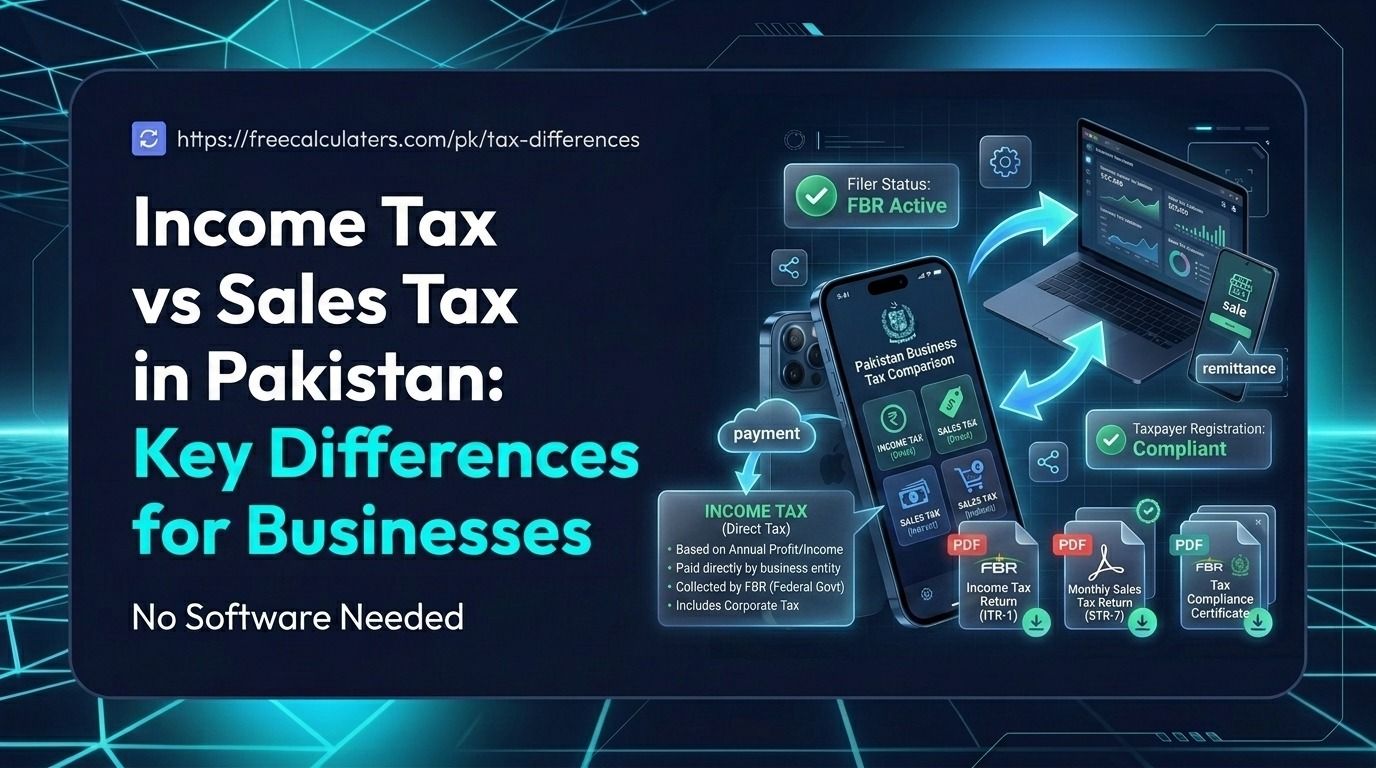
If you're running a business in Pakistan, you've probably filed both income tax and sales tax returns at some point — and maybe wondered why you're paying two different taxes on what feels like the same income. It's a fair question, and it trips up a lot of new business owners.
Income tax and sales tax are not the same thing, even though both eventually land in the government's treasury through the Federal Board of Revenue (FBR). One is charged on what your business earns. The other is charged on what your business sells. That distinction changes how each tax is calculated, who actually carries the burden, and what happens if you get it wrong.
This guide breaks down exactly how income tax and sales tax differ in Pakistan, who needs to register for what, and how to stay compliant without losing sleep over FBR notices.
What Is Income Tax in Pakistan?
Income tax is a direct tax — meaning it's charged directly on the income or profit earned by an individual or a business, and the person earning that income is the one who pays it. It's governed by the Income Tax Ordinance, 2001, and administered by the FBR through the IRIS portal.
For businesses, income tax applies to net profit — that is, revenue minus allowable business expenses. Pakistan uses a progressive slab system for individuals and sole proprietors, meaning higher income levels are taxed at higher rates. Companies, on the other hand, generally pay a flat corporate tax rate, alongside additional levies like super tax for very large incomes.
A simple way to think about it: income tax asks, "How much did you actually make this year?"
If you want to see exactly where your business falls on the current slabs, our income tax calculator gives you a quick, FBR-based estimate without needing to dig through the ordinance yourself.
What Is Sales Tax in Pakistan?
Sales tax works completely differently. It's an indirect tax — charged on the sale, supply, or import of goods and certain services, not on profit. The business collects it from the customer at the point of sale and then deposits it with the government. The customer, not the business, ultimately bears the cost.
Sales tax on goods is governed by the Sales Tax Act, 1990, and collected by the FBR. Sales tax on services, however, is a provincial matter — collected separately by the Punjab Revenue Authority (PRA), Sindh Revenue Board (SRB), Khyber Pakhtunkhwa Revenue Authority (KPRA), and Balochistan Revenue Authority (BRA), depending on where the service is rendered.
The current General Sales Tax (GST) rate on most goods in Pakistan sits around 18%, while sales tax on services varies by province, typically between 13% and 16%.
Put simply: sales tax asks, "How much did you sell, and how much tax did you collect on behalf of the government?"
You can check your exact liability using our Pakistan sales tax calculator, which is updated to reflect current FBR rates.
Income Tax vs Sales Tax: The Core Differences
Here's the comparison that matters most for business owners — laid out clearly so you can see exactly where each tax applies.
"Income tax is a direct tax, while sales tax is an indirect tax."
"Income tax is charged on net profit or income, while sales tax is charged on the sale of goods or services."
"Income tax is borne by the earner — the business or individual — while sales tax is ultimately borne by the end consumer."
"Income tax is governed by the Income Tax Ordinance, 2001, while sales tax is governed by the Sales Tax Act, 1990 for goods, and provincial acts for services."
"Income tax is collected by the FBR, while sales tax is collected by the FBR for goods and by PRA, SRB, KPRA, or BRA for services."
"Income tax follows a progressive slab structure for individuals and a flat rate for companies, while sales tax follows a fixed rate, currently around 18% on goods."
"Income tax is filed annually, while sales tax is filed monthly."
"Income tax requires registration for an NTN (National Tax Number), while sales tax requires registration for an STRN (Sales Tax Registration Number)."
"Income tax does not apply if there's a loss, since it's charged on profit, while sales tax applies on every sale regardless of profit or loss."
That last row is the one that surprises most new business owners: you can have a bad month, make zero profit, and still owe sales tax — because sales tax isn't about whether you made money, it's about whether you made a sale.
Why This Distinction Actually Matters for Your Business
Understanding the difference isn't just an academic exercise. It affects how you price your products, how you manage cash flow, and how you avoid penalties.
Cash flow planning. Sales tax is collected monthly and must be deposited regardless of your profit margin that month. Income tax, by contrast, is settled annually based on your actual year-end profit. Businesses that confuse the two often end up short on cash when a sales tax deadline hits, because they've been treating collected tax as their own revenue.
Pricing decisions. Since sales tax is passed on to the customer, it directly affects your final price. Income tax, however, comes out of your profit margin — it doesn't change your listed price, but it does change what you actually keep at year-end.
Compliance burden. Sales tax filing is monthly and detail-heavy, requiring input tax and output tax reconciliation on every invoice. Income tax filing is annual but requires a full picture of your income, expenses, and deductions for the entire tax year.
Registration timing. Many businesses register for an NTN when they start operating but delay sales tax registration until they hit a certain turnover threshold or realize they're supplying taxable goods. Missing this step can trigger penalties even if you weren't deliberately avoiding it.
Who Needs to Pay Income Tax?
Any individual, sole proprietor, partnership (AOP), or company earning taxable income in Pakistan is required to file an income tax return. This includes:
- Salaried employees above the exempt threshold
- Business owners and freelancers
- Companies, regardless of profit or loss (a "nil" return is still required)
- Property owners with deemed rental income
- Anyone who meets FBR's mandatory filing criteria (owns property above a certain size, holds a vehicle above a certain value, etc.)
Whether you're a filer or non-filer also matters here, since non-filers face higher withholding tax rates on banking transactions, property purchases, and vehicle registration. If you're not sure where you stand, our guide on filer vs non-filer status in Pakistan breaks down exactly what changes once you're on the Active Taxpayer List.
Who Needs to Pay Sales Tax?
Sales tax registration becomes mandatory once a business crosses specific turnover or activity thresholds, or if it deals in taxable goods and services by nature of its business — manufacturers, importers, wholesalers, distributors, and many retailers all fall under this requirement.
Service-based businesses need to check with their relevant provincial authority (PRA, SRB, KPRA, or BRA), since the rules and thresholds differ slightly by province. A shop in Lahore and a similar shop in Karachi may have different sales tax obligations purely based on provincial jurisdiction over services.
Once registered, a business must charge sales tax on every applicable sale, issue proper tax invoices, and file monthly returns — even in months where sales are low.
How Registration Works: NTN vs STRN
Both taxes start with registration, but they're two separate processes:
- Income Tax Registration (NTN): Done through the FBR's IRIS portal. You'll need your CNIC, business details, and bank account information. Once approved, you receive a National Tax Number, which becomes your permanent identifier for income tax purposes.
- Sales Tax Registration (STRN): Also done through IRIS, but requires additional details — business premises verification, utility bills, and sometimes a site visit by FBR officers. Once approved, you receive a Sales Tax Registration Number and must begin monthly filing.
If you haven't gone through FBR registration before, our detailed walkthrough on how to become a tax filer in Pakistan covers the IRIS registration process step by step, and our explainer on what the FBR IRIS portal actually does is a useful companion if the portal feels unfamiliar.
Penalties: What Happens If You Get It Wrong
Both taxes come with real financial consequences for non-compliance, and the FBR has significantly tightened enforcement in recent years through data-matching systems and automated notices via IRIS.
Income tax penalties:
- Late filing: Minimum penalty applies per day of default, or a percentage of tax payable, whichever is higher
- Concealment of income: Penalty of up to 200% of the tax evaded
- Non-filing entirely: Loss of Active Taxpayer status, leading to higher withholding tax on almost every transaction
Sales tax penalties:
- Failure to register: Fine ranging from Rs. 10,000 to Rs. 50,000, plus the unpaid tax liability
- Late filing of monthly return: Rs. 10,000 per month, or 5% of tax payable, whichever is higher
- Incorrect return: Penalty of up to 100% of the tax short-paid
- Failure to issue a proper tax invoice: Up to Rs. 25,000 per violation
- Fraud or deliberate evasion: Criminal prosecution, with imprisonment of up to three years in serious cases
The pattern is clear — sales tax penalties are more frequent because filing is monthly, while income tax penalties tend to be larger in scale because they're tied to annual concealment or non-filing.
A Practical Example
Let's say you run a small trading business in Rawalpindi.
- You sell goods worth Rs. 1,000,000 in a month. You charge 18% sales tax on that, collecting Rs. 180,000 from your customers. That entire Rs. 180,000 belongs to the government — you're just the collection agent. You deposit it, minus any input tax you've already paid on your own purchases.
- At year-end, after subtracting your business expenses (rent, salaries, utilities, cost of goods), your actual net profit might be Rs. 2,500,000 for the year. That profit is what your income tax is calculated on, based on the applicable slab or corporate rate.
Notice how the two numbers — Rs. 180,000 collected monthly in sales tax, and Rs. 2,500,000 in annual profit for income tax — are completely unrelated to each other. That's the core of why businesses need to track them separately in their books.
Common Misconceptions Business Owners Have
"If I'm not making a profit, I don't owe sales tax." Not true. Sales tax applies to the transaction, not your profitability. Even a loss-making business must collect and deposit sales tax on taxable sales.
"Income tax and sales tax are the same thing, just different names." Also not true — one is a direct tax on earnings, the other is an indirect tax on transactions, collected on the government's behalf.
"I only need to register for one of them." Many businesses need both. A retailer selling taxable goods, for instance, needs an NTN for income tax and an STRN for sales tax — they're not interchangeable.
"Filing a nil sales tax return isn't necessary if I had no sales." FBR generally still expects a nil return to be filed for the month, even with zero sales, to avoid a default notice.
If financial jargon like input tax, output tax, or withholding tax still feels confusing, our beginner's tax glossary is a good place to get comfortable with the terminology before diving deeper into compliance.
Frequently Asked Questions
What is the difference between income tax and sales tax in Pakistan? Income tax is a direct tax charged on a business's net profit and paid by the earner. Sales tax is an indirect tax charged on the sale of goods or services, collected from the customer, and deposited with the government by the business.
Who is required to pay income tax in Pakistan? Any individual, sole proprietor, partnership, or company earning taxable income above the exempt threshold must file an income tax return, including businesses reporting a loss or nil income for the year.
Who is required to pay sales tax in Pakistan? Businesses dealing in taxable goods or services, or those crossing specific turnover thresholds, must register for sales tax and charge it on applicable sales, then file monthly returns with FBR or the relevant provincial authority.
Is sales tax a direct or indirect tax? Sales tax is an indirect tax. The business collects it from the customer at the point of sale but doesn't ultimately bear its cost — the burden falls on the end consumer.
What is the current sales tax rate in Pakistan? The General Sales Tax rate on most goods is approximately 18%, while sales tax on services varies by province, generally between 13% and 16%, depending on the relevant provincial revenue authority.
Do small businesses need to register for both income tax and sales tax? It depends on the nature of the business. Every earning business needs an NTN for income tax. Sales tax registration is only mandatory if the business deals in taxable goods or services or crosses the relevant threshold.
What happens if a business fails to file sales tax returns? Penalties apply per month of default, calculated as either a fixed amount or a percentage of tax payable, whichever is higher. Repeated non-compliance can also trigger an FBR audit.
Can a business be exempt from sales tax but still pay income tax? Yes. Some goods and services are exempt from sales tax, but the business still generates profit from those sales, which remains subject to income tax regardless of the sales tax exemption.
Final Thoughts
Income tax and sales tax aren't competing obligations — they're two different lenses the government uses to measure your business activity. One looks at what you earned. The other looks at what you sold. Getting comfortable with that distinction is one of the simplest ways to avoid FBR penalties, keep your books clean, and plan your cash flow with more confidence.
If you'd like to see exactly where your business stands, run your numbers through our FBR tax calculator — it covers both income tax and sales tax scenarios based on current rates, so you can plan ahead instead of guessing at filing time.