
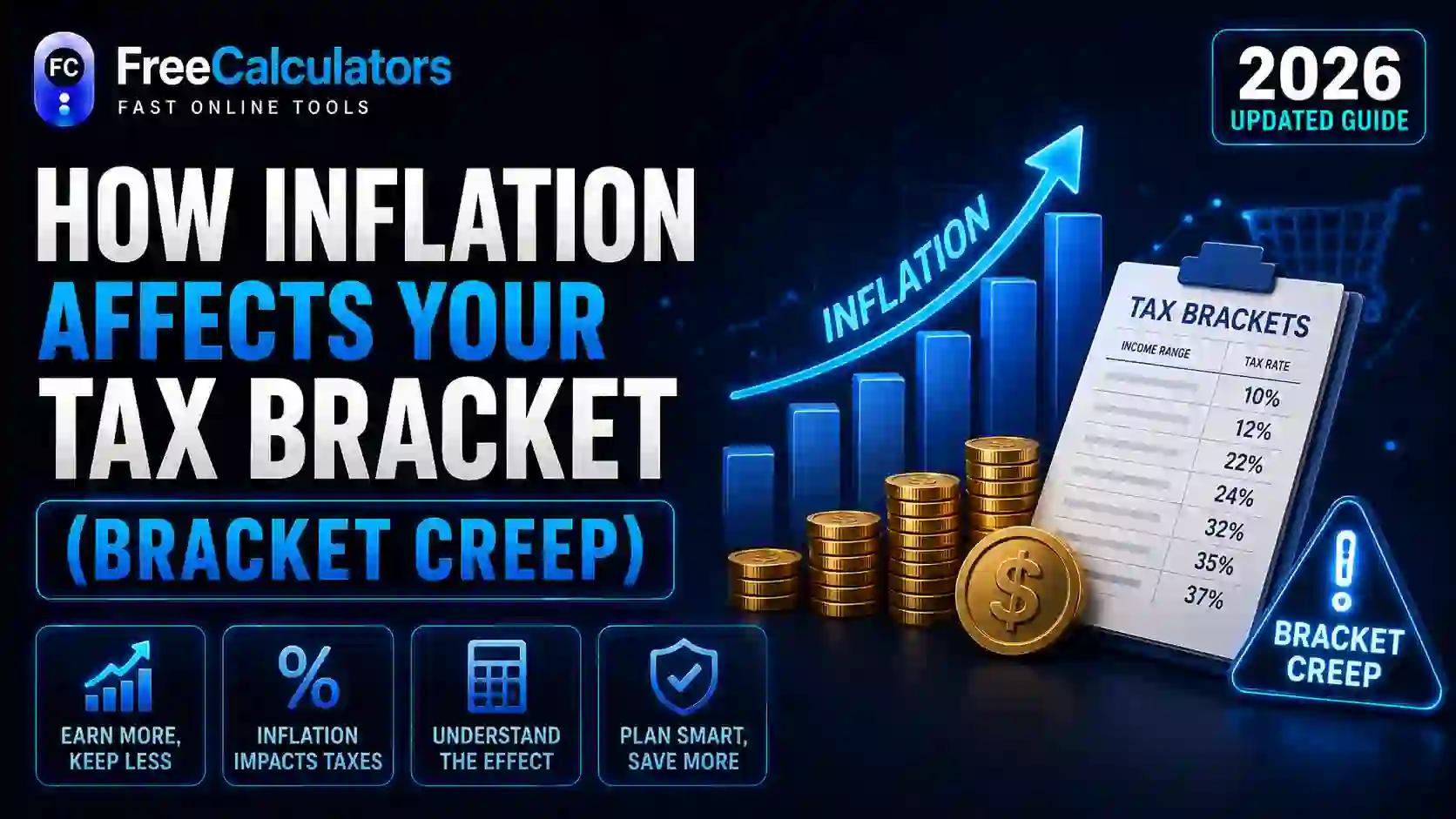
You got a raise, prices went up, and somehow it still feels like you're falling behind. There's a real reason for that feeling, and it has a name: bracket creep. When inflation pushes your salary higher just to keep pace with the cost of living, it can also nudge you into a higher tax bracket — even though your actual buying power hasn't improved at all.
This isn't a conspiracy theory or a Reddit myth. It's a documented feature of progressive tax systems, and understanding it can change how you plan raises, retirement withdrawals, and year-end tax moves. Below, we break down exactly how bracket creep works, how the IRS tries to counteract it, and what you can actually do about it.
What Is Bracket Creep?
Bracket creep happens when inflation, or general income growth, pushes a taxpayer's nominal income into a higher tax bracket, even though their real purchasing power hasn't actually increased. The Tax Foundation defines it precisely this way: bracket creep results in an increase in income taxes without a corresponding increase in real income.
Here's the plain-English version: if your salary goes up by 5% because prices went up by 5%, you haven't gotten richer. You can still only buy the same amount of stuff. But if that 5% raise pushes part of your income into a higher tax bracket, you now owe more tax on money that doesn't actually buy you anything extra. That's bracket creep in a nutshell.
A Simple Numeric Example
Imagine a single filer earning $47,000 in taxable income last year, comfortably inside the 22% bracket. Inflation runs at 4% for the year, and their employer gives a "cost of living" raise to match — bumping their salary to $48,880. On paper, that looks like progress. In reality, they can buy exactly the same basket of goods they could before, because prices rose by the same percentage.
If tax bracket thresholds stayed frozen while this happened, more of that extra $1,880 could get taxed at a higher marginal rate, shrinking the take-home raise even further. This is precisely why the IRS adjusts bracket thresholds every year — to prevent inflation-driven raises like this one from quietly increasing someone's tax burden.
Why This Happens: The Mechanics Behind Bracket Creep
Progressive tax systems, like the one used in the United States, tax different slices of your income at different rates. As your income rises, portions of it get pushed into higher brackets. That's the entire design of a progressive system — and it's meant to track real income growth, not inflation-driven nominal growth.
The problem arises when tax bracket thresholds don't move at the same pace as wages and prices. If the government keeps last year's thresholds unchanged while your salary rises to match inflation, you end up paying tax rates meant for someone genuinely earning more, even though you're not.
Economists sometimes call this effect "fiscal drag" — a broader term describing how inflation quietly increases government tax revenue without any new legislation being passed. Bracket creep is one specific, very visible form of fiscal drag.
How the IRS Adjusts Tax Brackets for Inflation
The good news for US taxpayers is that this isn't left to chance. Each year, the Internal Revenue Service adjusts more than 60 tax provisions for inflation specifically to prevent bracket creep. This annual update covers far more than just the seven tax rate brackets — it also touches the standard deduction, retirement contribution limits, and various credit phase-out thresholds.
For tax year 2026, this played out concretely. The IRS's Revenue Procedure 2025-32 raised the standard deduction to $32,200 for married couples filing jointly, and every bracket threshold moved upward to reflect roughly a 2.7% inflation adjustment. The seven tax rates themselves — 10%, 12%, 22%, 24%, 32%, 35%, and 37% — did not change; only the income levels at which each rate kicks in were adjusted upward.
This is the core mechanism protecting most US taxpayers from full bracket creep: the brackets move with inflation, so a purely inflation-driven raise is less likely to push you into a materially higher effective rate. It's not a perfect system, but it's a deliberate, annually recalibrated safeguard.
What Actually Gets Adjusted Each Year
- Tax bracket income thresholds — the dollar amount at which each rate applies
- Standard deduction — the flat amount subtracted from taxable income before rates apply
- Retirement contribution limits — 401(k), IRA, and HSA contribution caps
- Earned Income Tax Credit (EITC) thresholds — income limits for credit eligibility
- Alternative Minimum Tax (AMT) exemption amounts — thresholds for this parallel tax calculation
- Estate and gift tax exemptions — the amount excluded from federal estate tax
If you want to see exactly where your income lands after these adjustments, our income tax calculator applies current bracket thresholds automatically, and our salary tax calculator breaks down your effective versus marginal rate side by side.
Where Bracket Creep Still Slips Through
Even with annual indexing, bracket creep doesn't disappear entirely — it just shrinks. A few specific gaps still let it through.
Not every provision is indexed. Some tax thresholds, credits, and phase-out limits are fixed by statute and only change when Congress passes new legislation, rather than adjusting automatically each year. When those stay frozen for years while wages rise, taxpayers slowly drift into higher effective tax burdens on that specific provision.
Real wage growth still counts. Inflation indexing only protects you from nominal, inflation-matched raises. If your income grows faster than inflation — a genuine promotion or raise above cost-of-living adjustments — moving into a higher bracket is expected and appropriate, not a flaw in the system.
State-level indexing varies widely. Not every US state indexes its own income tax brackets to inflation the way the federal government does. In states with fixed, non-indexed brackets, residents can experience meaningful state-level bracket creep even while federal bracket creep is largely neutralized. Our guide on federal vs state income tax in the USA explains this layered structure in more depth.
Bracket Creep in the UK: A Frozen-Threshold Case Study
The UK offers one of the clearest real-world examples of deliberate bracket creep in action. Rather than adjusting thresholds for inflation, the UK government froze income tax thresholds for several consecutive years — a policy commonly referred to as a stealth tax increase, since no headline tax rate was ever raised, yet millions of taxpayers were pulled into higher brackets purely through wage inflation.
This frozen-threshold approach is fiscal drag in its most direct form: government revenue rises automatically as wages climb, without any politically visible vote to raise rates. If you're comparing how income tax interacts with other UK levies, our breakdown of council tax vs income tax in the UK and our UK National Insurance calculator both help map out the fuller UK tax picture.
Bracket Creep in Pakistan and India
Bracket creep isn't unique to Western economies — it shows up anywhere a progressive tax system meets meaningful inflation.
In Pakistan, income tax slabs administered by the FBR don't automatically adjust for inflation the way US federal brackets do. When salaries rise to keep pace with high inflation years, taxpayers can find themselves pushed into higher slabs without any real increase in purchasing power. Our detailed breakdown of the FBR tax slabs shows how these thresholds are currently structured, and the FBR tax calculator for Pakistan lets you check exactly where your income falls.
In India, income tax slabs are revised periodically through the annual budget rather than through automatic annual inflation indexing. This means slab adjustments depend on policy decisions rather than a fixed formula, and taxpayers can experience bracket creep during years when slabs remain unchanged despite rising nominal incomes. Our guide to India's income tax slabs for AY 2026-27 and our comparison of the old vs new tax regime both help clarify how current slab structures apply.
Real vs Nominal Income: Why This Distinction Matters for Taxes
Understanding bracket creep requires separating two concepts that get casually conflated: nominal income and real income.
Nominal income is the actual dollar amount on your paycheck or tax return — the number that doesn't account for inflation at all.
Real income is that same amount adjusted for what it can actually buy, accounting for how prices have changed.
Tax brackets are applied to nominal income, not real income. This is the entire root cause of bracket creep — the tax system taxes the dollar figure you earned, regardless of whether that dollar figure represents genuine additional purchasing power or just an inflation-matched cost-of-living bump. Annual inflation indexing is essentially the government's attempt to make the nominal-based tax system behave more like it's taxing real income growth.
Practical Strategies to Minimize Bracket Creep's Impact
While you can't personally control inflation or IRS indexing formulas, there are concrete moves that reduce how much bracket creep affects your actual tax bill.
1. Maximize pre-tax retirement contributions. Contributing to a traditional 401(k) or IRA reduces your taxable income directly, which can offset the portion of an inflation-driven raise that would otherwise push you into a higher bracket. Contribution limits themselves rise with inflation adjustments too, so check current limits each year.
2. Time major income events deliberately. If you have some control over when income lands — bonuses, freelance invoices, or capital gains — spreading them across tax years can help you avoid stacking extra income into a single year where it triggers a higher marginal rate.
3. Track your marginal rate, not just your average rate. Many people assume a raise pushes their entire income into a higher bracket, which isn't how progressive taxation works — only the income above each threshold gets taxed at the higher rate. Understanding this prevents unnecessary anxiety and helps with accurate planning.
4. Review your withholding annually. As bracket thresholds shift each year, your withholding elections from a prior year might no longer be optimized. A quick annual check prevents both underpayment penalties and unnecessarily large refunds that represent an interest-free loan to the government.
5. Use pre-tax benefit accounts fully. Health Savings Accounts, Flexible Spending Accounts, and transportation benefit accounts all reduce taxable income, and their contribution limits are inflation-indexed as well, meaning the shelter they provide against bracket creep grows slightly each year too.
For a full walkthrough of how deductions interact with your overall tax bill, our guide comparing the standard vs itemized deduction is a useful next step.
Who Actually Benefits From Bracket Creep?
This is worth stating plainly: bracket creep generates additional tax revenue for the government without requiring any legislature to vote for a tax increase. That's precisely why some economists and commentators refer to inflation itself as a "hidden tax" — it silently increases real tax burdens and government revenue as a side effect of rising prices, rather than through an explicit, publicly debated policy change.
This doesn't make inflation indexing meaningless — quite the opposite. Annual IRS bracket adjustments exist specifically because policymakers recognized this dynamic decades ago and built in a mechanism to counteract it. Countries or specific provisions that skip this indexing effectively choose to let bracket creep quietly boost their tax intake year after year.
How Business Owners and Freelancers Are Affected Differently
If you're self-employed, bracket creep interacts with your taxes in a slightly different way than it does for salaried employees. Self-employment income tends to fluctuate more year to year, and without automatic payroll withholding, freelancers and business owners must estimate quarterly tax payments themselves, based on projected income.
When freelance rates rise to match inflation, that income increase gets folded into estimated tax calculations exactly like salaried bracket creep — except the impact is often less visible in real time, since there's no single payslip clearly showing the extra withholding. Our US self-employment tax calculator accounts for current bracket thresholds so you can see the real impact of a rate increase before it surprises you at filing time.
Frequently Asked Questions
What is bracket creep? Bracket creep is when inflation or nominal income growth pushes a taxpayer into a higher tax bracket, even though their real purchasing power hasn't increased. It effectively raises someone's tax burden without any change in tax law or genuine income gain.
How does inflation affect my tax bracket? When your salary rises to match inflation, that raise counts as taxable income just like any other raise. If tax bracket thresholds don't rise at the same pace, part of that inflation-matched raise can get taxed at a higher marginal rate, even though you can't actually buy any more with it.
Does the IRS adjust tax brackets every year? Yes. The IRS adjusts more than 60 tax provisions annually for inflation, including all seven federal income tax bracket thresholds and the standard deduction, specifically to reduce the impact of bracket creep on taxpayers.
Why did my tax bracket change without a raise? If your income stayed flat but your bracket appears to have changed, it's more likely that the bracket thresholds themselves moved due to the annual inflation adjustment, effectively lowering your relative tax burden even without any change to your income.
What is fiscal drag in taxation? Fiscal drag is the broader economic term for how inflation and income growth increase government tax revenue over time without any new tax legislation. Bracket creep is the most common and visible form of fiscal drag within a progressive income tax system.
How can I avoid bracket creep? You can't eliminate bracket creep entirely, but maximizing pre-tax retirement contributions, using HSA and FSA accounts, and timing discretionary income carefully can reduce how much of an inflation-driven raise gets pushed into a higher marginal rate.
Does bracket creep affect the standard deduction too? Yes. The standard deduction is inflation-indexed alongside the tax brackets. If the deduction didn't rise with inflation, a larger share of nominal income would become taxable each year even without any real income growth, compounding the bracket creep effect.
Final Takeaway
Bracket creep is one of the more overlooked ways inflation quietly reshapes your finances — not through rising prices at the store, but through a higher tax bill on income that doesn't actually buy you anything extra. The IRS's annual inflation adjustments exist precisely to blunt this effect, but gaps remain, especially at the state level and in countries that don't index brackets automatically.
The most useful thing you can do is stop assuming every raise is a straightforward win and start checking where your income actually lands relative to current bracket thresholds. Run your numbers through our income tax calculator or salary tax calculator after any raise, promotion, or cost-of-living adjustment, so you know your real marginal rate — not just your new salary figure — before you plan your budget around it.