
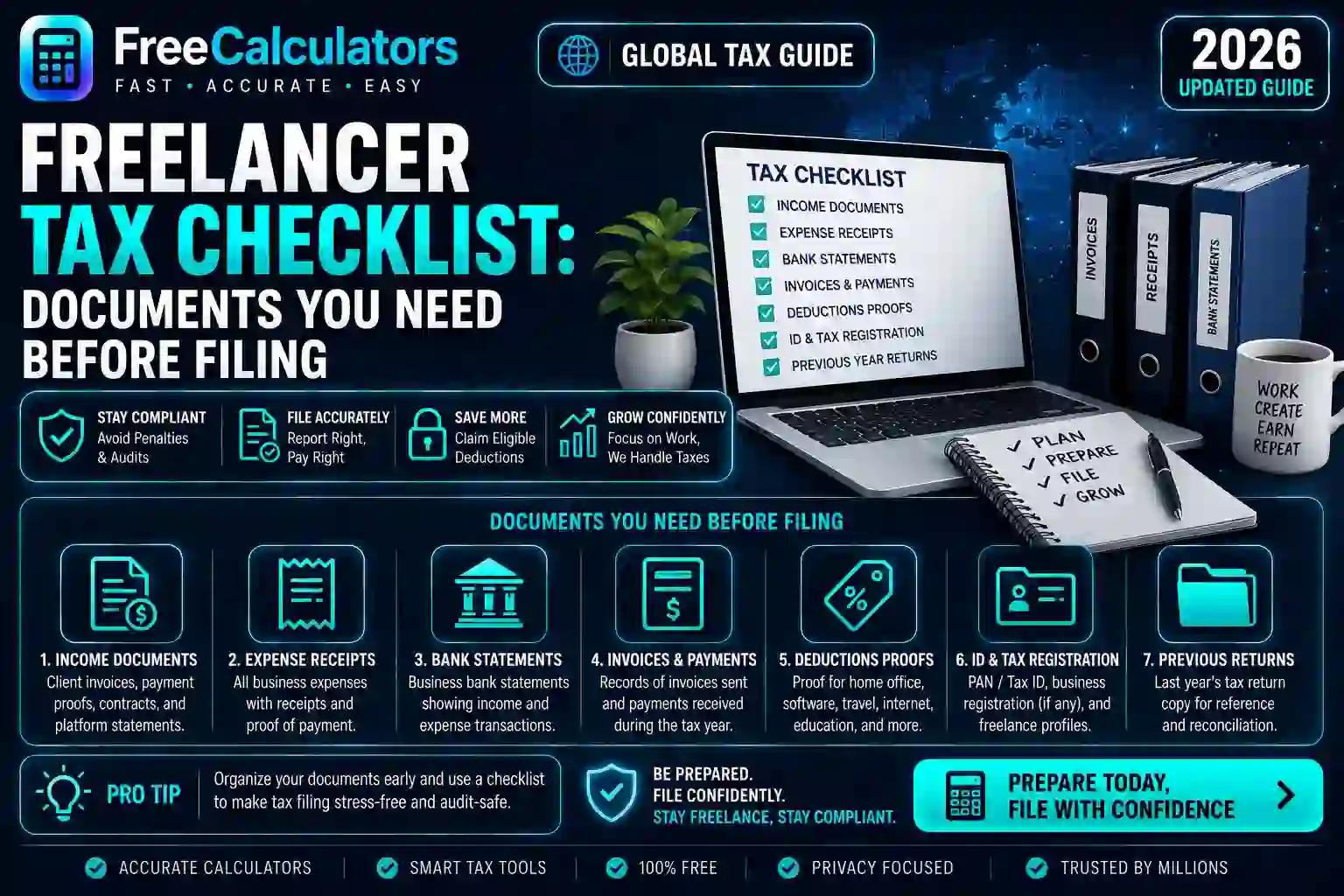
Tax season hits differently once you're freelancing. There's no single W-2 waiting in your mailbox, no employer withholding taxes automatically, and no HR department to answer questions when something doesn't add up. Instead, you're piecing together income from multiple clients, tracking expenses you paid for yourself, and trying to figure out which forms actually apply to your situation.
The self-employment tax rate sits at 15.3% on top of regular income tax, which makes accurate documentation more than a paperwork exercise — it directly affects how much you owe. This checklist walks through exactly what to gather before you file, why each document matters, and how to avoid the scramble that catches so many freelancers off guard every spring.
Quick-Reference Checklist: What You'll Need
Before diving into details, here's the full list at a glance:
- All 1099-NEC, 1099-K, and 1099-MISC forms from clients
- Bank and payment platform statements (PayPal, Stripe, Venmo business account)
- Invoices and payment records for income not reported on a 1099
- Business expense receipts (software, equipment, supplies)
- Home office measurements and related utility bills
- Mileage log for business-related driving
- Health insurance premium records (if self-employed)
- Retirement contribution records (SEP IRA, Solo 401(k))
- Prior year's tax return
- Estimated quarterly tax payment records (Form 1040-ES vouchers or confirmations)
- Business bank account and credit card statements
- EIN or Social Security Number documentation
- Any W-9 forms you've issued or received
Now let's break down why each of these matters and how to actually use them.
Income Documents: The Foundation of Your Filing
1099-NEC Forms
If you earned $600 or more from a single client during the tax year, that client is required to send you a 1099-NEC by January 31. This form reports nonemployee compensation and is the freelance equivalent of a W-2, though nothing is withheld from it automatically.
Keep every 1099-NEC you receive, even if the amounts seem small. The IRS receives copies of these directly from your clients, so any mismatch between what you report and what they've filed can trigger an automated notice.
1099-K Forms
If you're paid through platforms like PayPal, Stripe, or similar payment processors, you may receive a 1099-K instead of, or in addition to, a 1099-NEC. The reporting threshold for 1099-K has shifted in recent years, so even moderate platform income can now generate this form when it wouldn't have a few years ago.
Income Without a 1099
Here's something a lot of new freelancers don't realize: you're required to report all your income, even from clients who never sent you a 1099. If a client paid you $400 in cash or by direct bank transfer and simply didn't issue a form, that income is still taxable and still needs to appear on your return.
This is exactly why keeping your own invoices and payment records matters so much. Don't rely on client-issued forms as your only income record — treat them as a cross-check against your own bookkeeping, not a replacement for it.
Bank and Payment Platform Statements
Pull twelve months of statements from every account where client payments landed. This includes your business checking account, PayPal business balance, Stripe payouts, and any other platform you invoice through. These statements act as your backup documentation if a 1099 is missing, lost, or incorrect.
Expense Documentation: Where Freelancers Leave Money on the Table
Freelancers who don't track expenses carefully throughout the year often end up either underclaiming legitimate deductions or scrambling to reconstruct them from memory in April. Neither is a good position to be in.
Business Expense Receipts
Keep receipts for anything used primarily for your freelance work: software subscriptions, a new laptop, industry courses, client gifts, professional memberships, and office supplies. Digital receipts count just as much as paper ones — most accounting software lets you photograph and store them as you go, which beats digging through email inboxes in March.
Home Office Documentation
If you use part of your home exclusively and regularly for freelance work, you likely qualify for the home office deduction. You'll need the square footage of that dedicated space, the total square footage of your home, and a portion of your utility bills, rent, or mortgage interest if you're using the regular calculation method rather than the simplified flat-rate option.
Mileage Log
Driving to meet a client, pick up supplies, or attend a work-related event counts as deductible business mileage — but only if you have a log to prove it. Apps that automatically track trips are far more reliable than trying to reconstruct months of driving from memory, and the IRS specifically expects contemporaneous records if this deduction is ever questioned.
Co-Working Space and Professional Development
Membership fees for co-working spaces, conference tickets, and paid courses that maintain or improve skills used in your freelance work are generally deductible. Keep the payment confirmation and a brief note on how it relates to your business, especially for anything that could look personal at first glance.
Tax Forms You'll Actually Use as a Freelancer
Schedule C
Schedule C is where you report your freelance income and expenses, arriving at your net profit or loss. This form feeds directly into your Form 1040 and is the backbone of a freelancer's tax return. If you're filing for the first time, our self-employment tax guide walks through how Schedule C connects to the rest of your return.
Schedule SE
Schedule SE calculates your self-employment tax — the 15.3% that covers Social Security and Medicare contributions that would otherwise be split between an employer and employee. This is a separate calculation from your income tax and often catches new freelancers off guard because nothing was withheld throughout the year to cover it.
Form 1040-ES
If you expect to owe $1,000 or more in tax for the year, you're generally required to make quarterly estimated payments using Form 1040-ES. Keep records of every payment you've made throughout the year, since these get applied as credits against your total tax liability when you file.
Retirement and Health Insurance Records
SEP IRA or Solo 401(k) Contributions
Contributing to a retirement account as a freelancer isn't just about long-term savings — it directly reduces your taxable income. Keep contribution confirmations from your account provider, since these amounts get deducted on your return and can meaningfully lower what you owe.
Self-Employed Health Insurance Premiums
If you pay for your own health insurance and aren't eligible for a spouse's employer plan, you can typically deduct 100% of your premiums. Gather your annual premium statements from your insurance provider, as this deduction applies whether or not you itemize.
Business Structure Documents
EIN or Social Security Number
Most sole proprietor freelancers file using their Social Security Number, but if you've formed an LLC or plan to hire subcontractors, you'll need an Employer Identification Number (EIN). Keep this documentation accessible since it appears on multiple forms throughout your filing.
W-9 Forms
If you've hired subcontractors and paid any of them $600 or more, you're responsible for collecting a W-9 from each one and potentially issuing them a 1099-NEC of your own. Keep copies of every W-9 you've collected, since this becomes relevant if you need to prove you met your own reporting obligations.
Comparison: 1099-NEC vs. 1099-K vs. 1099-MISC
| Form | What It Reports | Who Issues It |
|---|---|---|
| 1099-NEC | Direct payments for services ($600+ threshold) | Clients who paid you directly |
| 1099-K | Payments through third-party platforms | Payment processors like PayPal, Stripe |
| 1099-MISC | Rent, royalties, prizes, and other miscellaneous income | Varies by income type |
Understanding which form applies to which income stream helps you catch missing forms before they become a filing problem. For a deeper look at how freelance income compares to traditional employment for tax purposes, see our breakdown of W-2 vs. 1099 tax calculation.
How Much Should Freelancers Set Aside for Taxes?
A commonly used rule of thumb is setting aside 25–30% of your net freelance income to cover both income tax and self-employment tax, though your actual rate depends on your total income, filing status, and deductions. This is exactly why running your numbers through a self-employment tax calculator periodically throughout the year is far more useful than guessing once at filing time.
Setting aside too little is the single most common freelance tax mistake, and it usually stems from treating gross income as if it were take-home pay. Every dollar that comes in needs a portion carved out before you spend it.
Standard Deduction vs. Itemizing for Freelancers
Freelancers can take the standard deduction and still claim all their Schedule C business expenses separately — these aren't mutually exclusive. The choice between standard and itemized deductions only affects your personal deductions (mortgage interest, medical expenses, charitable giving), not your business expense write-offs. Our comparison of standard vs. itemized deductions explains this distinction in more detail if you're weighing which approach fits your personal tax situation.
Organizing Your Documents Before Filing
Scrambling through a shoebox of receipts in April is avoidable with a system that takes minutes to set up:
- Create a dedicated folder (digital or physical) for the current tax year, separate from personal documents.
- Log income weekly, not just when a 1099 arrives, using a simple spreadsheet or bookkeeping app.
- Photograph receipts immediately rather than saving paper copies that fade or get lost.
- Reconcile bank statements monthly against your income log to catch missing payments early.
- Store quarterly payment confirmations in the same folder so you're not searching for them later.
Building this habit early in the year saves hours of stress later and reduces the chance of missing a deduction you actually earned.
Frequently Asked Questions
What documents do I need to file freelance taxes? You'll need all 1099 forms received, bank and payment platform statements, business expense receipts, mileage logs, home office details, retirement and health insurance contribution records, and your prior year's return for reference.
Do freelancers need a 1099 to file taxes? No. You're required to report all freelance income regardless of whether a client issues a 1099, so your own invoices and bank records serve as the backup documentation when a form is missing.
What if a client doesn't send me a 1099? Report the income anyway using your own records of invoices and payments received. The absence of a 1099 doesn't remove your obligation to report that income.
What expenses can freelancers write off? Common deductions include home office costs, business software and equipment, mileage, professional development, co-working space fees, and a portion of self-employed health insurance premiums.
How much should freelancers set aside for taxes? A general guideline is 25–30% of net freelance income, though the exact amount depends on your total income, deductions, and filing status.
Do freelancers need to pay quarterly taxes? Yes, generally if you expect to owe $1,000 or more for the year. Estimated payments are made using Form 1040-ES four times annually.
What's the difference between 1099-NEC and 1099-K? A 1099-NEC reports direct payments from clients for services, while a 1099-K reports payments processed through third-party platforms like PayPal or Stripe.
Do I need an EIN as a freelancer? Not necessarily. Most sole proprietors can file using their Social Security Number, though an EIN becomes useful or necessary if you form an LLC or hire subcontractors.
Final Takeaway
Freelance tax filing feels overwhelming mainly because the responsibility that used to sit with an employer now sits entirely with you — tracking income, estimating taxes, and documenting deductions all fall on your shoulders. But none of it requires guesswork once you have a system: collect every 1099 you receive, keep your own income records as backup, log expenses as they happen, and set aside a consistent percentage of every payment for taxes.
Before you file, run your projected numbers through a self-employment tax calculator to confirm what you owe, and keep a copy of this checklist handy for next year so document collection becomes a habit rather than an annual scramble. If any terms in this process still feel unfamiliar, our essential tax terms glossary is a solid reference to bookmark alongside your tax folder.
For official guidance on self-employment tax rates and Schedule C requirements, see the IRS Self-Employed Individuals Tax Center and IRS Schedule SE Instructions.