
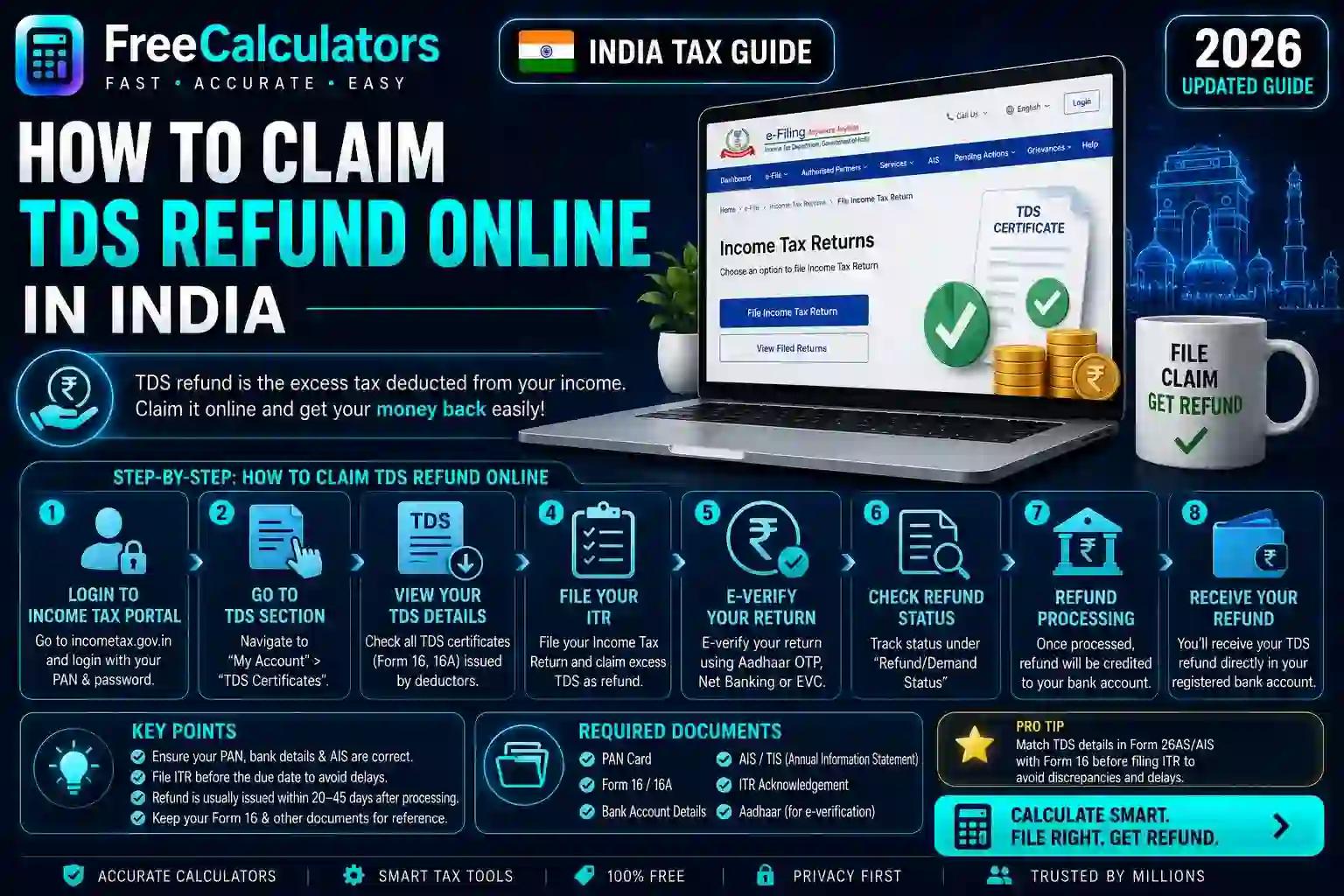
Every year, millions of taxpayers in India have more tax deducted from their salary, fixed deposit interest, or other income than they actually owe. When that happens, the excess amount deducted as TDS becomes refundable — but it doesn't land in your bank account automatically. You have to claim it.
This guide walks through the exact online process for claiming a TDS refund, how long it realistically takes, what to do if it's delayed, and a lesser-known path for avoiding excess deduction in the first place rather than chasing a refund after the fact.
What Is a TDS Refund?
TDS (Tax Deducted at Source) refund is the excess amount deducted from your income — by an employer, bank, or other payer — that gets returned to you after you file your Income Tax Return and the tax department confirms you overpaid. This typically happens when your total tax liability for the year is lower than what was deducted throughout the year, often because deductions, exemptions, or investments weren't accounted for at the time of deduction.
A common example: your bank deducts TDS on fixed deposit interest at a flat rate regardless of your actual income tax slab. If your total income falls in a lower bracket than the TDS rate applied, you're owed the difference back.
How to Claim TDS Refund Online: Step-by-Step
- Log in to the Income Tax e-filing portal at incometax.gov.in using your PAN as your user ID.
- Check Form 26AS and AIS to confirm the exact TDS amount deducted and deposited against your PAN for the relevant financial year.
- File your Income Tax Return (ITR) for the applicable assessment year, reporting your total income and claiming the TDS already deducted as a tax credit.
- E-verify your return within 30 days of filing, using Aadhaar OTP, net banking, or another available method — an unverified return is treated as not filed at all.
- Wait for processing — the Centralized Processing Center (CPC) processes returns and issues an intimation under Section 143(1) confirming the refund amount.
- Ensure your bank account is pre-validated on the portal, since refunds are only credited to a validated account linked with your PAN.
- Track your refund status directly through the e-filing portal or the NSDL refund status page using your PAN and assessment year.
This is the complete process for most salaried and individual taxpayers, and it's the same fundamental path whether you're claiming refund on salary TDS, bank interest TDS, or TDS deducted on a property transaction.
Documents Required for TDS Refund Claim
Keep these ready before you start filing, since missing documents are one of the most common causes of delayed or incorrect refund claims:
- PAN card (mandatory for the e-filing login itself)
- Form 16 (issued by your employer, showing salary TDS)
- Form 16A (issued by banks or other deductors for non-salary TDS)
- Form 26AS (your consolidated tax credit statement, downloadable from the e-filing portal)
- AIS (Annual Information Statement), which now supplements Form 26AS with a broader view of your reported financial transactions
- Bank account details (account number and IFSC code, matching your pre-validated account)
- Investment proofs for deductions claimed under sections like 80C, if not already reflected in your Form 16
Why Bank Account Pre-Validation Matters More Than People Realize
This step gets skipped or done incorrectly more often than almost any other part of the process, and it's one of the most common reasons refunds get stuck even after a return is successfully processed.
Your refund can only be credited to a bank account that is:
- Linked with your PAN
- Pre-validated on the income tax e-filing portal
- Active and in your own name (not a closed or third-party account)
To pre-validate, go to Profile > My Bank Account on the e-filing portal, add your account details, and complete the validation process, which typically confirms within a few hours to a couple of days. If your refund shows as "processed" but you still haven't received it, an unvalidated or mismatched bank account is one of the first things worth checking before assuming something else has gone wrong.
How Long Does TDS Refund Take in India?
For most straightforward returns, refunds are typically credited within 20 to 45 days after the ITR is processed and the Section 143(1) intimation is issued — not from the date you filed, but from the date of processing. More complex returns, or those flagged for scrutiny or verification, can take considerably longer, sometimes extending to several months.
If your refund hasn't arrived well beyond this window, the delay is worth investigating rather than simply waiting indefinitely, since several fixable issues commonly cause this.
How to Check TDS Refund Status Online
- Log in to the e-filing portal.
- Navigate to e-File > Income Tax Returns > View Filed Returns.
- Select the relevant assessment year to see the current status — options typically include "Processed," "Refund Issued," "Refund Failed," or "Under Processing."
- Alternatively, check status directly through the NSDL/Protean refund tracking page using your PAN and assessment year.
If the status shows "Refund Failed," this almost always points back to a bank account validation issue, and you'll need to submit a refund reissue request through the portal with corrected bank details rather than waiting for it to resolve on its own.
Why Is My TDS Refund Delayed?
Several common issues account for most delays:
- Bank account not pre-validated, or validated details not matching your PAN records
- Mismatch between Form 26AS and your ITR figures, often because the deductor hasn't deposited TDS correctly or filed their TDS return on time
- Return selected for scrutiny or additional verification, which extends processing time significantly
- Outstanding tax demand from a previous year, which the department can adjust against your current refund before releasing the remainder
- Errors in ITR filing itself, such as an incorrect bank account number or mismatched personal details
Checking Form 26AS carefully against what you're claiming before filing is the single best way to avoid the first two issues, which together account for a large share of delayed refunds.
Can I Claim TDS Refund Without Filing ITR?
This is a distinct scenario worth understanding separately, since it addresses avoiding excess deduction in the first place rather than reclaiming it afterward.
If your total income for the year is below the taxable threshold, you can submit Form 15G (for individuals below 60) or Form 15H (for senior citizens) to your bank or deductor, declaring that your income doesn't attract tax. This prevents TDS from being deducted in the first place on interest income, rather than requiring you to file a return later just to claim it back.
Separately, if you expect TDS to be deducted at a higher rate than your actual tax liability warrants, you can apply for a lower deduction certificate under Section 197 (commonly referred to using Form 13) from the Assessing Officer, authorizing the deductor to withhold tax at a reduced rate. This is particularly useful for freelancers, contractors, and NRIs who otherwise face TDS at standard rates regardless of their actual tax bracket.
That said, if TDS has already been deducted for a given financial year, filing an ITR remains the only route to reclaim it — Forms 15G/15H and lower deduction certificates only prevent future over-deduction, they don't refund tax already withheld.
Is TDS Refund Taxable?
No, the refunded principal amount itself is not taxable, since it's simply your own money being returned after being deducted in excess. However, any interest paid on the refund under Section 244A is taxable as "Income from Other Sources" in the year it's received, and must be reported in your subsequent year's ITR.
Interest on Delayed TDS Refunds: Section 244A
Under Section 244A of the Income Tax Act, taxpayers are entitled to interest on delayed refunds, generally calculated at 0.5% per month (effectively 6% annually) from the start of the relevant assessment year until the refund is issued, provided the delay isn't attributable to the taxpayer's own error or delay in filing. This interest is calculated automatically by the CPC and reflected in your refund amount — you don't need to apply for it separately.
TDS Refund on Fixed Deposit Interest
Banks deduct TDS on FD interest once it crosses a specified threshold in a financial year, applying a flat rate regardless of your personal income slab. If your total income (including FD interest) falls below the taxable limit, or your effective tax rate is lower than the TDS rate applied, you're entitled to claim the difference back through your ITR.
This is one of the most common refund scenarios for retirees and low-income earners, since flat-rate TDS on interest income frequently overshoots what someone in a lower tax bracket actually owes.
TDS Refund on Property Sale
When property is sold above a certain value, the buyer is required to deduct TDS on the transaction and deposit it against the seller's PAN. If the seller's actual capital gains tax liability (after accounting for exemptions like reinvestment under applicable sections) is lower than the TDS deducted, the seller can claim the excess back by filing an ITR reporting the capital gain and the TDS already deducted as a credit.
This scenario often involves larger refund amounts than salary or FD-related claims, so keeping the TDS certificate (Form 16B, in this specific case) and sale documentation organized is particularly important for a smooth claim.
Can NRIs Claim TDS Refund in India?
Yes. NRIs frequently face TDS at higher rates on Indian income — rental income, interest, or property sale proceeds — often exceeding their actual tax liability once treaty benefits or exemptions are factored in. NRIs can file an ITR in India to claim this excess back, following the same fundamental e-filing process, though they should also confirm their bank account details support NRI refund crediting (typically an NRO account) during the pre-validation step.
What Happens If I Don't Claim TDS Refund?
If you don't file an ITR at all, any excess TDS deducted simply remains with the government — it isn't automatically returned. There is a limited window for filing belated or updated returns even after the standard deadline passes, but beyond certain statutory time limits, unclaimed refunds can become permanently forfeited. It's generally far simpler to file on time than to rely on later corrective filing options.
TDS Refund vs. Income Tax Refund: What's the Difference?
These terms are often used interchangeably, and for good reason — a TDS refund is technically a subset of the broader income tax refund process. "Income tax refund" is the general term for any excess tax paid being returned, which can include excess advance tax or self-assessment tax payments in addition to excess TDS. When the excess specifically originated from tax deducted at source rather than tax you paid directly, it's commonly referred to as a TDS refund, though the claiming mechanism — filing an ITR — is identical either way.
Old Tax Regime vs. New Tax Regime: Does It Affect TDS Refund?
Yes, indirectly. Your choice of tax regime determines your final tax liability, which in turn determines whether TDS deducted throughout the year results in a refund, an additional payment due, or comes out roughly even. Since deductions like Section 80C investments aren't available under the new regime, someone with significant eligible deductions might see a larger refund under the old regime simply because their actual liability is lower. If you're unsure which regime results in a better outcome for your specific income and deduction profile, our detailed comparison of the old tax regime vs new tax regime in India breaks down exactly how to evaluate that choice before filing.
Frequently Asked Questions
How do I claim a TDS refund online? File your Income Tax Return through the e-filing portal, reporting your total income and claiming the TDS already deducted (as shown in Form 26AS) as a tax credit, then e-verify the return within 30 days.
How long does it take to get a TDS refund? Typically 20 to 45 days after the return is processed and a Section 143(1) intimation is issued, though complex or flagged returns can take longer.
Can I claim TDS refund without filing ITR? No, if TDS has already been deducted for a given year, filing an ITR is the only way to reclaim it. Forms 15G/15H and lower deduction certificates only prevent future over-deduction.
How do I check my TDS refund status? Log in to the income tax e-filing portal and check under "View Filed Returns," or use the NSDL refund status page with your PAN and assessment year.
Why is my TDS refund delayed? Common causes include an unvalidated bank account, a mismatch between your ITR and Form 26AS, the return being selected for additional verification, or an outstanding tax demand from a prior year being adjusted against the refund.
How do I pre-validate my bank account for TDS refund? Go to Profile > My Bank Account on the e-filing portal, enter your account and IFSC details, and complete validation — this typically confirms within a few hours to a couple of days.
Can NRIs claim TDS refund in India? Yes, NRIs can file an ITR to claim excess TDS back, though they should ensure their linked bank account supports NRI refund crediting during pre-validation.
Is TDS refund taxable? The refunded principal is not taxable, but any interest received on the refund under Section 244A is taxable as income in the year received.
Final Takeaway
Claiming a TDS refund isn't complicated once you understand the sequence: verify what was actually deducted against your Form 26AS, file your ITR accurately claiming that amount as credit, pre-validate your bank account before you file rather than after, and e-verify promptly. Most delays trace back to one of those steps being skipped or done incorrectly rather than any mysterious processing issue on the department's end.
Before filing, it's worth confirming which tax regime actually minimizes your liability using our India income tax calculator, and if you're unfamiliar with terms like Form 26AS, TAN, or assessment year, our essential tax terms glossary is a useful reference to keep open while you file.
For official guidance on refund rules and processing timelines, see the Income Tax Department of India's e-filing portal and the text of Section 244A of the Income Tax Act.