
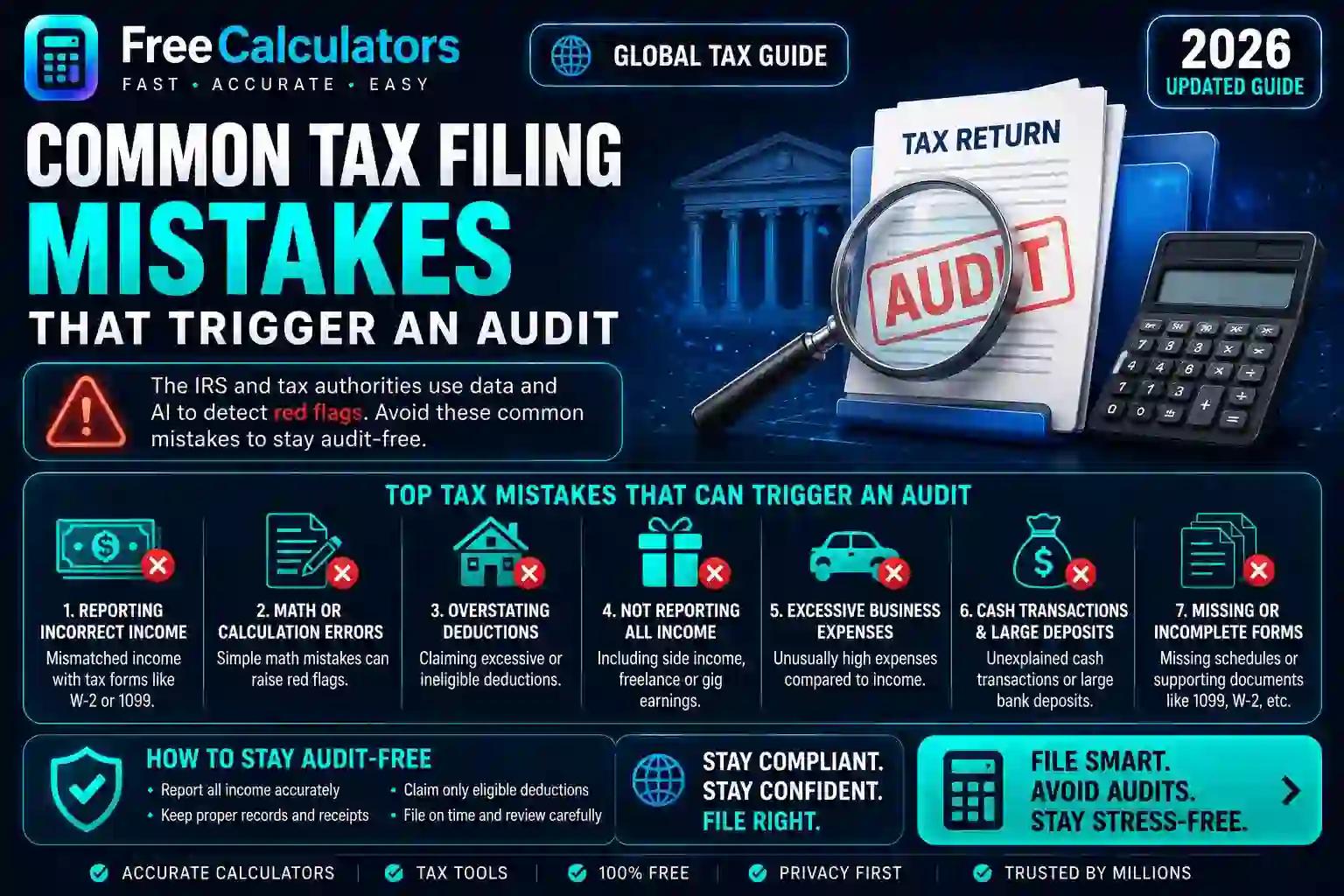
Nobody plans to get audited. Most audit letters land in mailboxes because of small, avoidable slip-ups — not because someone tried to pull a fast one on the IRS. A missed decimal point, a mismatched 1099, or a home office deduction that doesn't quite add up can be enough to get your return flagged for a closer look.
The good news is that most of these triggers are entirely within your control. This guide walks through the filing mistakes that most commonly draw IRS attention, what actually happens during an audit, and the practical steps you can take to keep your return clean year after year.
How the IRS Actually Selects Returns for Audit
Contrary to popular belief, the IRS doesn't pick returns at random most of the time. The agency uses a scoring system called the Discriminant Information Function (DIF), which compares your return against statistical norms for people with similar income, deductions, and filing status. If your numbers look unusual compared to that baseline, your DIF score rises — and so does your audit risk.
According to the IRS Data Book, less than 1% of individual tax returns are audited in a typical year, though that rate climbs noticeably for very high earners and for people who report no income at all despite claiming refundable credits. Small business owners and self-employed filers also face higher scrutiny simply because their returns involve more estimation and more room for error.
Understanding this scoring logic helps explain why certain mistakes — even innocent ones — draw attention far more often than others.
The Most Common Tax Filing Mistakes That Trigger an Audit
1. Underreporting or Unreported Income
This is the single biggest audit trigger, and it's often unintentional. Every W-2, 1099-NEC, 1099-MISC, 1099-K, and 1099-INT you receive is also sent directly to the IRS. If the income on your return doesn't match what the agency already has on file, an automated system flags the discrepancy almost immediately — no human auditor even needs to look at it first.
This is especially common among freelancers and gig workers who receive multiple 1099s from different platforms. Forgetting a single form, even a small one from a side project, can trigger a correspondence audit. If you're new to self-employment income, our self-employment tax guide walks through exactly what needs to be reported and how estimated taxes work.
2. Math Errors and Simple Data Entry Mistakes
Transposed numbers, incorrect Social Security numbers, and basic arithmetic errors are far more common than people assume, especially on paper returns. While the IRS often corrects small math errors automatically and sends a notice rather than launching a full audit, repeated inconsistencies across a return can push it toward manual review.
Double-checking that your reported income matches your W-2s and 1099s exactly, down to the cent, is one of the simplest ways to avoid this entirely.
3. Claiming a Home Office Deduction Incorrectly
The home office deduction is legitimate and valuable, but it's also one of the most misunderstood. The space must be used regularly and exclusively for business — a kitchen table that doubles as a dinner spot doesn't qualify, no matter how often you work there.
Filers sometimes calculate the deduction using the entire square footage of their home rather than the actual dedicated workspace, which inflates the deduction beyond what's reasonable. Using the simplified method (a flat rate per square foot, up to 300 square feet) is often safer and easier to defend than the regular method if your business use is modest.
4. Excessive or Unusual Business Expense Deductions
Self-employed filers and small business owners who report business expenses that seem disproportionately large relative to their income raise red flags fast. A freelance graphic designer claiming $40,000 in "business expenses" against $45,000 in revenue, for example, looks unusual next to typical filers in that same income bracket.
This doesn't mean legitimate expenses shouldn't be claimed — it means documentation matters. Keep receipts, mileage logs, and clear records for anything you deduct, particularly for categories the IRS watches closely like travel, meals, and vehicle use.
5. Rounding Numbers Instead of Reporting Exact Figures
Returns filled with suspiciously round numbers — $5,000 in charitable donations, exactly $3,000 in medical expenses, precisely $10,000 in business supplies — can look estimated rather than calculated from actual records. The IRS's scoring system is sensitive to patterns like this because real-world expenses rarely land on perfectly round figures.
Pull actual totals from your bank statements, receipts, or accounting software rather than estimating from memory.
6. Claiming the Earned Income Tax Credit (EITC) Incorrectly
The EITC is one of the most frequently audited credits because it's also one of the most frequently misfiled — through both innocent error and, less commonly, deliberate misuse. Eligibility depends on income, filing status, and qualifying children, and the rules around who counts as a "qualifying child" trip up more filers than almost any other section of the tax code.
If your income or family situation changed during the year, it's worth double-checking eligibility rules before claiming this credit, since the IRS dedicates significant audit resources specifically to EITC claims.
7. Large Charitable Contributions Relative to Income
Charitable giving is encouraged and fully deductible when properly documented, but a deduction that looks large compared to your reported income can trigger a second look. Someone reporting $60,000 in income with $15,000 in charitable deductions, for instance, sits well outside the statistical norm for that income bracket.
Non-cash donations over $500 require Form 8283, and donations over $5,000 typically need a qualified appraisal. Skipping this documentation is a common and entirely avoidable mistake.
8. Misclassifying Workers as Independent Contractors
Small business owners who classify workers as 1099 contractors when they function more like employees — set hours, company equipment, ongoing exclusive work — face real audit risk. The IRS uses a behavioral and financial control test to determine proper classification, and getting it wrong can trigger both an income tax audit and a separate employment tax audit.
If you're unsure how a worker should be classified, or how contractor income compares to employee wages on your own return, our comparison of W-2 vs 1099 tax treatment breaks down the practical tax differences between the two.
9. Cash-Based Business Income Discrepancies
Businesses that deal heavily in cash — restaurants, salons, contractors, and similar service businesses — face closer scrutiny because cash income is harder to verify against third-party records. Reported income that seems low relative to the size and type of the business, or that doesn't align with typical margins for that industry, can prompt an audit.
Keeping detailed daily records, even for cash transactions, gives you a paper trail that protects you if questions ever come up.
10. Failing to Report Foreign Accounts or Cryptocurrency
Foreign Bank Account Reporting (FBAR) requirements and cryptocurrency reporting have both become major IRS enforcement priorities in recent years. Every major tax software and every Form 1040 now includes a direct question asking whether you received, sold, exchanged, or otherwise disposed of digital assets during the year.
Answering this question inaccurately, or failing to report crypto gains that exchanges have already reported to the IRS, is treated as a serious audit trigger — not a minor oversight.
11. Claiming Dependents Incorrectly
Claiming a dependent who doesn't meet the IRS's relationship, residency, age, or support tests — or having two separated parents both claim the same child — is a common trigger, particularly after divorce or a change in custody arrangements. The IRS's system automatically flags duplicate dependent claims across different returns.
12. Missing Signatures or Incomplete Forms
It sounds minor, but an unsigned return, a missing schedule, or an incomplete form can delay processing and sometimes prompt further review, especially if it happens alongside other inconsistencies. This is one of the easiest mistakes to eliminate simply by reviewing your return fully before submission.
Standard Deduction vs. Itemized Deductions: Which Carries More Audit Risk?
| Factor | Standard Deduction | Itemized Deductions |
|---|---|---|
| Documentation required | Minimal | Extensive (receipts, records, forms) |
| Audit risk | Lower | Higher, especially with large claims |
| Best suited for | Simple returns, fewer deductible expenses | Homeowners, high medical costs, large charitable giving |
| Common mistakes | Few | Overstated expenses, missing documentation |
Itemizing isn't inherently risky — it's simply that unsupported or inflated itemized deductions are what typically draw attention. If your itemized deductions genuinely exceed the standard deduction and you have the records to back them up, itemizing remains the right financial choice. Our detailed breakdown of standard vs. itemized deductions can help you figure out which approach fits your situation before you file.
Correspondence Audit vs. Field Audit vs. Office Audit
Not all audits look the same, and understanding the type you're dealing with changes how you should respond.
- Correspondence audit — The most common type, handled entirely by mail. The IRS requests documentation for a specific item, such as a mismatched 1099 or an unverified deduction.
- Office audit — Requires an in-person meeting at a local IRS office, typically for more complex issues involving multiple deductions or income sources.
- Field audit — The most thorough type, where an IRS agent visits your home or business. These are generally reserved for business returns or high-dollar discrepancies.
Most individual filers who get audited will only ever experience a correspondence audit, which is far less intimidating than the term "audit" tends to suggest.
How Far Back Can the IRS Audit You?
The standard statute of limitations is three years from the date you filed your return. However, this window extends to six years if you underreported income by more than 25%, and there's no time limit at all if the IRS determines a return was fraudulent or if no return was filed in the first place.
This is one of the strongest arguments for keeping tax records — receipts, income statements, and supporting documents — for at least seven years, even though most audits happen well within the standard three-year window.
What to Do If You Receive an IRS Audit Notice
- Read the notice carefully. It will specify exactly which items are being questioned and what documentation is needed.
- Don't ignore it or delay. Response deadlines are typically 30 days, and missing them can result in the IRS adjusting your return without your input.
- Gather the specific documentation requested — not everything from that tax year, just what's relevant to the flagged items.
- Respond in writing for correspondence audits, keeping copies of everything you send.
- Consider professional representation for office or field audits, or for any audit involving significant dollar amounts.
How to Reduce Your Chances of an IRS Audit
- Report every 1099 and W-2 exactly as issued, even for small amounts you might be tempted to skip.
- Use exact figures, not rounded estimates, pulled directly from receipts and statements.
- Keep thorough documentation for every deduction claimed, especially home office and business expense deductions.
- File on time, since late or amended returns can sometimes draw additional scrutiny.
- Double-check dependent claims, particularly after a divorce, custody change, or a dependent turning 18 or moving out.
- Use tax software or a qualified preparer to catch math errors before submission — a reliable income tax calculator is a useful first check before you finalize your numbers.
- Keep records for at least seven years, well beyond the standard three-year audit window.
Frequently Asked Questions
What triggers an IRS audit? Unreported income, inconsistent 1099 or W-2 reporting, unusually large deductions relative to income, math errors, and claiming credits like the EITC incorrectly are the most common triggers.
What percentage of tax returns get audited each year? Less than 1% of individual returns are audited annually, though audit rates rise significantly for very high-income filers and certain refundable credit claims.
Does the IRS audit self-employed people more often? Yes. Self-employed filers and small business owners face higher audit rates because their income and deductions involve more estimation and less third-party verification than a standard W-2 employee return.
What happens if I make an honest mistake on my taxes? Simple math errors are often corrected automatically by the IRS, resulting in a notice rather than a full audit. Larger discrepancies, especially involving unreported income, are more likely to prompt a closer review.
How long does the IRS have to audit you? Generally three years from your filing date, extending to six years for substantial underreporting, and indefinitely in cases of fraud or unfiled returns.
Can claiming too many deductions trigger an audit? It's less about the number of deductions and more about whether they're unusually large relative to your income and properly documented. Well-supported deductions, even numerous ones, are far less risky than a single inflated or undocumented claim.
Does the IRS flag round numbers on a tax return? Yes. Consistently round figures across multiple deduction categories can appear estimated rather than calculated, which raises your DIF score.
Are cash-based businesses audited more frequently? Cash-heavy businesses do face additional scrutiny because their income is harder to verify against third-party records, making thorough recordkeeping especially important.
Final Takeaway
Most tax audits trace back to something fixable: a missed 1099, a rounded number, an unsupported deduction, or a dependent claim that didn't quite fit the rules. None of that requires guesswork to avoid — it requires accurate records, exact figures, and a return that matches what third parties have already reported to the IRS.
Before you file, run your numbers through a dependable salary tax calculator or self-employment tax calculator to catch inconsistencies early, and keep your supporting documents organized for at least seven years. If terminology throughout this process feels unfamiliar, our tax terms glossary for beginners is a useful reference to keep handy while you prepare your return.
For official guidance on audit procedures and current enforcement priorities, see the IRS Audit Techniques Guides and the IRS Data Book.