
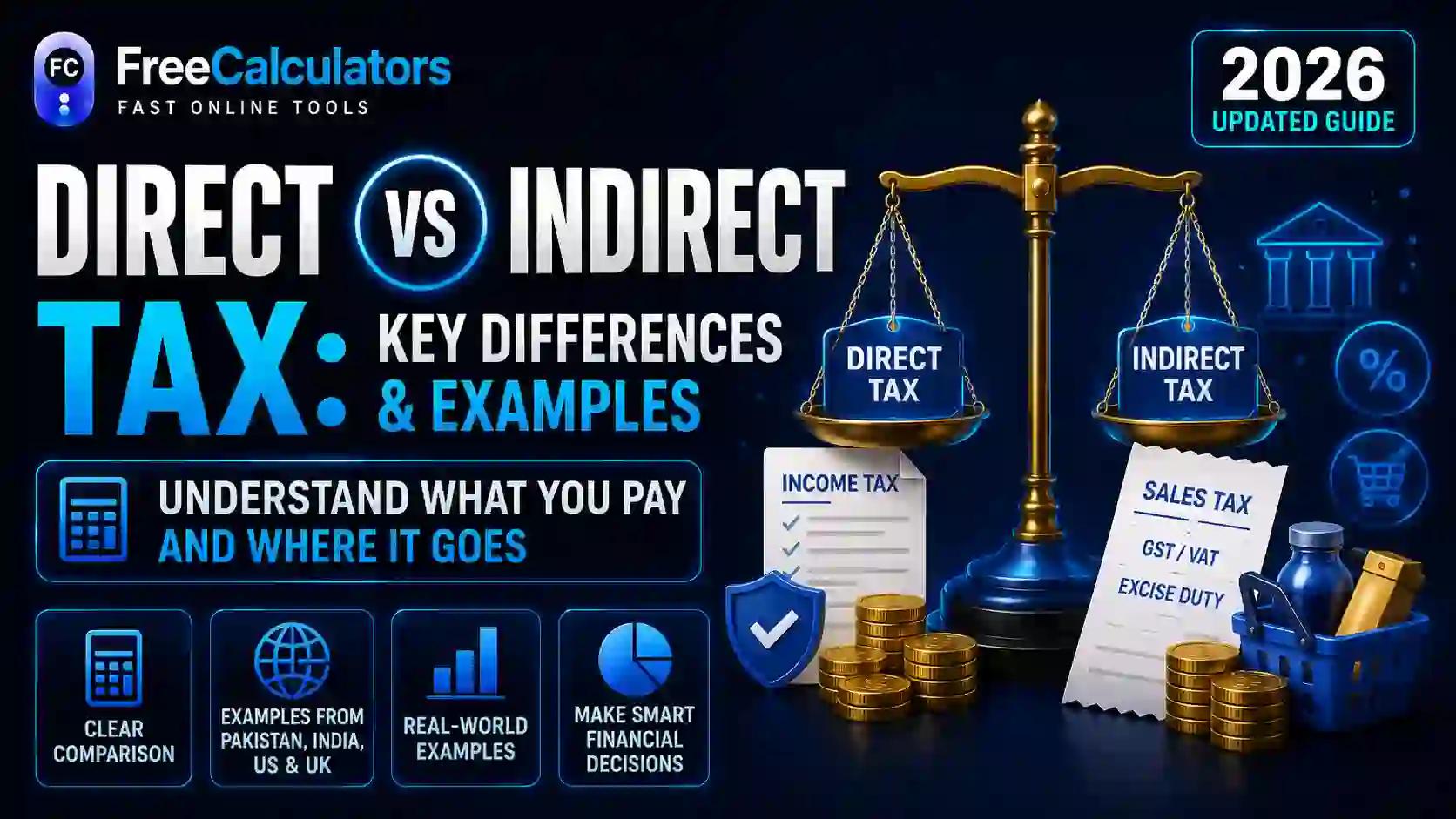
Most people pay both direct and indirect taxes every single week without ever labeling them that way. Your salary gets taxed before it hits your bank account — that's direct. Then you buy groceries, fuel, or a new phone, and tax gets added at checkout — that's indirect. Understanding the difference isn't just trivia for accountants; it shapes how much you actually take home, how prices behave, and how governments fund everything from roads to hospitals.
This guide breaks down direct tax vs indirect tax in plain language, with real examples from Pakistan, India, the US, and the UK, so you can see exactly which taxes hit your paycheck and which ones hide inside your shopping receipt.
What Is Direct Tax?
A direct tax is a tax you pay straight to the government, based on your own income, profits, or property, and it cannot legally be passed on to anyone else. According to the IRS's own taxpayer education materials, a direct tax is one that the taxpayer pays directly to the government, and these taxes cannot be shifted to any other person or group.
That last part is the key distinction. If you earn a salary and income tax is deducted from it, you — and only you — bear that cost. A business can't quietly shift its corporate income tax bill onto a customer the way it can with a sales tax.
Common Examples of Direct Tax
- Income tax — deducted from salaries, freelance income, or business profits
- Corporate tax — paid by companies on their net profits
- Property tax — charged on land or buildings you own
- Capital gains tax — applied when you sell an asset like stock or real estate for a profit
- Wealth tax — levied on total net assets in countries that still impose it
If you want to see this in action rather than just reading about it, our income tax calculator shows exactly how much of your salary goes toward direct tax before you even see the money.
What Is Indirect Tax?
An indirect tax is collected by an intermediary — a shop, manufacturer, or service provider — and then passed on to the government, while the actual financial burden lands on the end consumer. The IRS describes it plainly: an indirect tax is one that can be shifted to another person or group by the business that technically owes it.
Think about buying a cup of coffee. The café charges you sales tax at the counter, but the café itself is just the middleman — it collects that tax from you and forwards it to the tax authority. You never file paperwork for it, yet you paid it.
Common Examples of Indirect Tax
- Sales tax — added at checkout on most retail purchases
- Value-Added Tax (VAT) — charged at each stage of production and passed to the final buyer
- Goods and Services Tax (GST) — India's unified indirect tax on goods and services
- Excise duty — applied to specific goods like fuel, tobacco, and alcohol
- Customs duty — charged on imported goods entering a country
Countries like Pakistan and India rely heavily on this category. If you're trying to understand how it applies locally, our breakdown of GST in India and our guide to sales tax on services in Pakistan both walk through real calculation examples.
Direct Tax vs Indirect Tax: Side-by-Side Comparison
| Factor | Direct Tax | Indirect Tax |
|---|---|---|
| Who pays it | The individual or entity directly | Passed from business to consumer |
| Can it be shifted? | No | Yes |
| Based on | Income, profit, or property value | Consumption of goods and services |
| Progressive or regressive | Usually progressive (higher earners pay more) | Usually regressive (same rate regardless of income) |
| Visibility to taxpayer | High — you see the deduction clearly | Low — often hidden in the final price |
| Collection method | Filed and paid directly by the taxpayer | Collected by sellers/manufacturers on the government's behalf |
| Ease of tax evasion | Harder to hide (tied to records, filings) | Easier to evade at small-business level, but broad-based |
This table alone answers the most common search query on this topic, but the real value comes from understanding why these differences matter in daily life — which is what the next sections cover.
Why the Difference Actually Matters to You
It's tempting to treat this as an academic distinction, but the practical impact is significant.
Direct tax hits your income before you spend it. If you're salaried, your employer withholds income tax automatically, so your take-home pay is already net of this cost. This is why two people earning the same gross salary in different tax brackets can have noticeably different lifestyles — the direct tax burden scales with income.
Indirect tax hits your spending, not your earning. A minimum-wage worker and a millionaire pay the exact same sales tax rate on a loaf of bread. This is precisely why economists classify most indirect taxes as regressive — they take a proportionally larger bite out of lower incomes, since lower earners spend a bigger share of what they make on everyday consumption.
Governments balance both deliberately. Relying only on direct tax makes government revenue vulnerable to economic downturns, since income and profits shrink in a recession. Indirect tax tends to be more stable because people keep buying essentials even when incomes dip. That's part of why most modern tax systems — Pakistan's FBR framework, India's GST regime, and the US federal-plus-state model — use a blend of both.
Real-World Examples Across Different Countries
Seeing how these categories play out in practice makes the concept click faster than any definition.
Pakistan
In Pakistan, direct tax primarily comes through income tax on salaries and business profits, administered by the FBR. Indirect tax shows up through GST on goods, provincial sales tax on services, and federal excise duty on items like cigarettes and beverages. If you want to see your own numbers, our FBR tax calculator for Pakistan handles the direct-tax side, while our Pakistan sales tax calculator covers the indirect side. For a deeper dive into how these two interact, our article comparing income tax vs sales tax in Pakistan is worth a read.
India
India consolidated most of its indirect taxes into a single Goods and Services Tax system back in 2017, replacing a patchwork of state-level levies. Direct tax in India still runs through income tax slabs that vary by income bracket and whether you choose the old or new regime. Our GST calculator for India and our comparison of the old vs new income tax regime make this easier to work through with actual numbers rather than theory.
United States
The US layers federal, state, and sometimes local taxes on top of each other. Federal income tax is direct and progressive, while sales tax — which varies significantly by state and even by zip code — is indirect and set locally. Some states, like Texas, charge no state income tax at all but make up for it through higher sales tax rates. Our US state income tax calculator and US sales tax calculator by zip code let you compare both sides for your specific location.
United Kingdom
The UK combines income tax (direct) with National Insurance contributions and VAT (indirect) on most goods and services. Council tax, a local property-based charge, is often confused with income tax but functions quite differently. Our guide on council tax vs income tax in the UK clears up exactly where each one applies, and the UK National Insurance calculator shows how that direct-tax-adjacent contribution is calculated.
Advantages and Disadvantages of Direct Tax
Advantages:
- Scales with ability to pay, since higher earners are typically taxed at higher rates
- Transparent — taxpayers know exactly what they owe and why
- Acts as an automatic economic stabilizer, rising during boom periods and easing during downturns
- Harder to evade at scale since it's tied to documented income and filings
Disadvantages:
- Can discourage extra work, investment, or business expansion at very high marginal rates
- Requires more administrative infrastructure to track, file, and enforce
- Compliance burden falls heavily on the individual or business, requiring recordkeeping and filing
Advantages and Disadvantages of Indirect Tax
Advantages:
- Simple and efficient to collect, since businesses do the collecting on the government's behalf
- Broad-based, generating steady revenue even during economic slowdowns
- Harder for individuals to avoid entirely, since almost everyone consumes taxed goods
- Can be used deliberately to discourage harmful consumption, such as higher excise duty on tobacco
Disadvantages:
- Regressive by nature — the same fixed rate weighs more heavily on lower-income households
- Less transparent, since the tax is baked into the price rather than shown as a separate deduction
- Can contribute to inflation when rates increase, since businesses typically pass the cost straight to consumers
Which One Is "Better"? (There's No Simple Answer)
This question comes up constantly, and the honest answer is that neither system is inherently superior — they solve different problems. Direct tax supports fairness through progressive rates tied to income. Indirect tax supports revenue stability and administrative simplicity.
Most functioning economies use both deliberately, not by accident. A government relying solely on direct tax would see its revenue swing wildly with every economic cycle. One relying solely on indirect tax would place a disproportionate burden on lower-income citizens. The blend is the point.
Can a Single Tax Be Both Direct and Indirect?
Not exactly, but some taxes sit in a gray area depending on how they're structured. Payroll tax, for instance, is technically deducted directly from wages (making it feel direct), yet in some systems the employer's portion functions more like a cost passed through the business, similar to how indirect taxes behave. Property tax is almost universally classified as direct since it's tied to ownership, not a transaction — though the money to pay it often comes from rental income, which blurs the line for landlords passing costs to tenants.
For a fuller vocabulary of terms like these, our beginner's glossary of essential tax terms is a useful reference to keep handy.
A Practical Example: Buying a Car
Let's trace both tax types through one purchase, since this is where the distinction becomes concrete.
Say you buy a car for $20,000. Sales tax (indirect) gets added at the point of sale — the dealership collects it and forwards it to the state. Later, many regions also charge an annual vehicle or token tax, which functions more like a direct, recurring property-style tax on ownership. If you financed the car and later sell it for a profit, that gain could trigger capital gains tax — a direct tax on you personally.
One purchase, three different tax touchpoints, two different tax categories. This is exactly why understanding the distinction helps you anticipate the real cost of major purchases rather than being surprised at each stage. If you're budgeting for a vehicle purchase specifically, our vehicle token tax calculator helps estimate that recurring cost in advance.
How Businesses Handle Both Tax Types Differently
For business owners, the operational difference between these two tax categories is significant. Direct tax — corporate income tax — is calculated once, typically annually, based on net profit after all expenses. It requires forecasting, deductions, and often professional accounting support.
Indirect tax, by contrast, is a continuous administrative task. Every sale potentially triggers a tax collection obligation, meaning businesses must track, collect, file, and remit these amounts regularly, sometimes monthly. Getting this wrong doesn't just cost money — it can trigger audits and penalties, since tax authorities monitor consumption tax compliance closely given how much government revenue depends on it.
If you're self-employed or run a small business, understanding both sides isn't optional. Our guide on calculating your tax before meeting an accountant walks through how to estimate both obligations ahead of time so nothing catches you off guard.
Frequently Asked Questions
What is the main difference between direct tax and indirect tax?
Direct tax is paid straight to the government by the person who owes it and can't be shifted to someone else — income tax is the clearest example. Indirect tax is collected by a business at the point of sale and passed on to the consumer through the price of goods or services, such as sales tax or VAT.
What are examples of direct taxes?
The most common examples are income tax, corporate tax, property tax, capital gains tax, and wealth tax. All of these are based on an individual's or entity's income, profit, or asset ownership rather than on a purchase transaction.
What are examples of indirect taxes?
Sales tax, Value-Added Tax (VAT), Goods and Services Tax (GST), excise duty, and customs duty are the most widely used indirect taxes. They're added to the price of goods and services and collected by sellers on the government's behalf.
Is GST a direct tax or an indirect tax?
GST is an indirect tax. It's charged on the sale of goods and services, collected by the seller at the point of transaction, and ultimately passed on to the government, rather than being paid directly by the taxpayer based on income.
Which tax is better, direct or indirect?
Neither is universally better — they serve different purposes. Direct tax supports fairness by scaling with income, while indirect tax provides governments with stable, broad-based revenue that doesn't fluctuate as sharply during economic downturns. Most countries deliberately use a mix of both.
Who pays direct tax and who pays indirect tax?
Direct tax is paid by the individual or business that earns the income or owns the asset being taxed, and it cannot legally be transferred to someone else. Indirect tax is technically owed by the seller or manufacturer, but the cost is passed on to the end consumer through the purchase price.
How is direct tax calculated?
Direct tax is generally calculated as a percentage of taxable income, profit, or asset value, often using progressive tax brackets where higher income levels are taxed at higher rates. Deductions, exemptions, and credits typically reduce the final amount owed.
Final Takeaway
The distinction between direct and indirect tax isn't just terminology — it explains why your payslip and your shopping receipt behave so differently, and why governments deliberately lean on both. Direct tax scales with what you earn; indirect tax scales with what you spend. Neither one tells the whole story of your tax burden on its own.
If you want to see exactly how both categories apply to your own income and spending, start with our income tax calculator to check your direct tax liability, then use our salary tax calculator to see your full take-home breakdown. Once you understand both sides of the equation, budgeting for major purchases and planning your annual taxes becomes far less of a guessing game.