
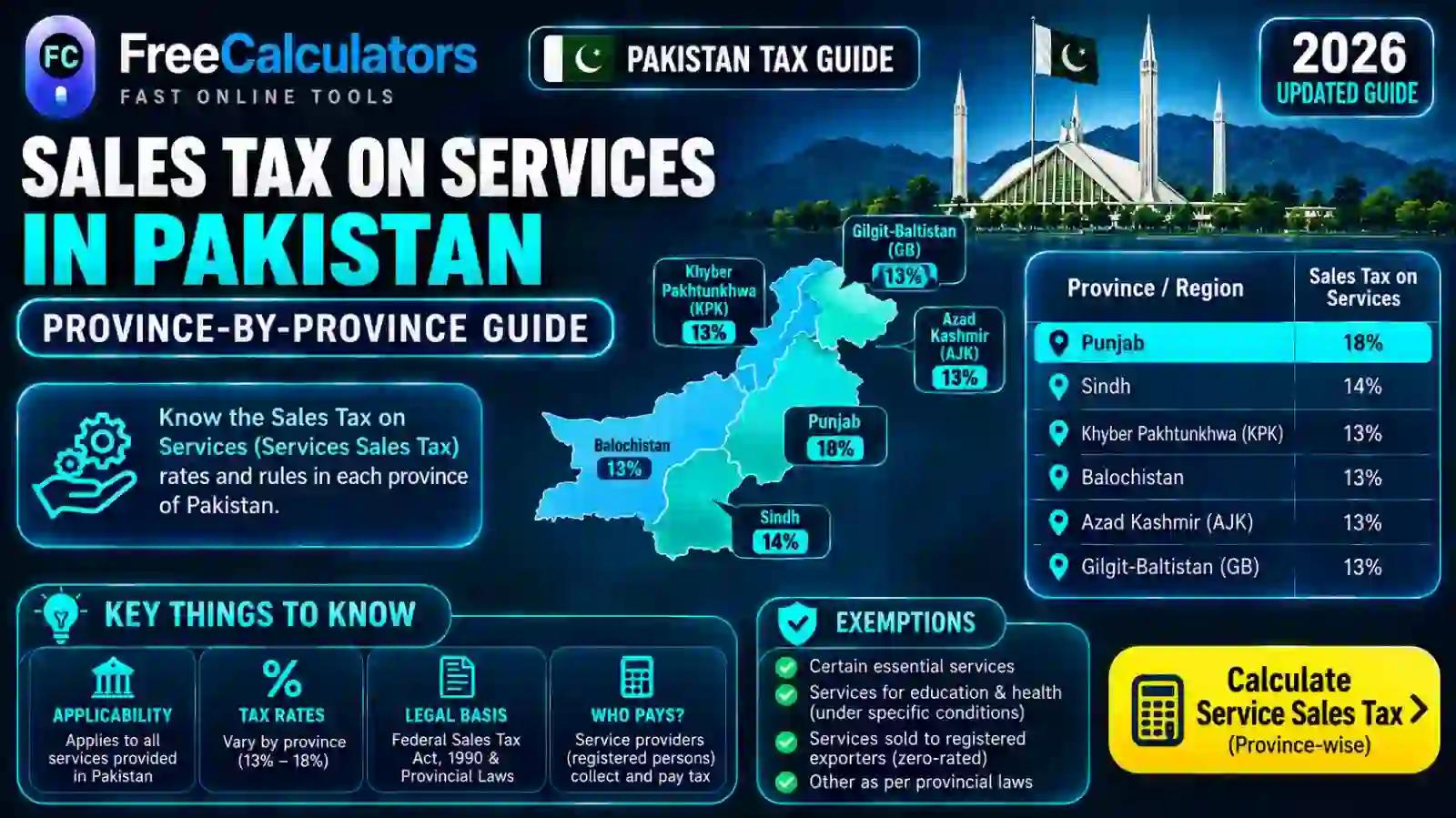
If you run a service business anywhere in Pakistan, sales tax probably confuses you more than income tax does — and that's not your fault. Unlike sales tax on goods, which the Federal Board of Revenue (FBR) collects under one law nationwide, sales tax on services is a provincial subject. Each province set up its own revenue authority after the 18th Constitutional Amendment, and each one runs its own rates, rules, and filing deadlines.
So the short answer, right up front: Punjab (PRA) and Islamabad (FBR-ICT) charge a standard 16% on most services, while Sindh (SRB), Khyber Pakhtunkhwa (KPRA), and Balochistan (BRA) charge 15%, with telecom services taxed at 19.5% almost everywhere. But the exceptions matter more than the headline rate — and that's what this guide breaks down province by province, with real numbers, real examples, and a practical registration roadmap.
Why Sales Tax on Services Became a Provincial Matter
Before 2010, the FBR collected sales tax on both goods and services under one federal law. The 18th Amendment changed that by moving the power to tax services to the provinces. Sindh moved first, establishing the Sindh Revenue Board (SRB) in 2011. Punjab followed with the Punjab Revenue Authority (PRA) in 2012, Khyber Pakhtunkhwa set up KPRA soon after, and Balochistan's BRA became operational in 2015. Islamabad Capital Territory never got its own authority — services there are still taxed federally by the FBR under the Islamabad Capital Territory (Tax on Services) Ordinance, 2001.
This is why a restaurant in Lahore, a marketing agency in Karachi, and a consultancy in Islamabad each deal with a completely different tax office, a different portal, and sometimes a different rate — even though, on the surface, they're all just "paying sales tax."
Master Comparison Table: Sales Tax on Services by Province
| Province / Territory | Authority | Standard Rate | Telecom Rate | Portal |
|---|---|---|---|---|
| Punjab | Punjab Revenue Authority (PRA) | 16% | 19.5% | pra.punjab.gov.pk |
| Sindh | Sindh Revenue Board (SRB) | 15% | 19.5% | e.srb.gos.pk |
| Khyber Pakhtunkhwa | KP Revenue Authority (KPRA) | 15% (varies 2%–15% by sector) | 19.5% | kpra.kp.gov.pk |
| Balochistan | Balochistan Revenue Authority (BRA) | 15% | 19.5% | bra.gob.pk |
| Islamabad (ICT) | Federal Board of Revenue (FBR) | 15%–16% | 19.5% | iris.fbr.gov.pk |
Rates change through each province's annual Finance Act, so treat this table as a snapshot rather than a permanent reference — always cross-check against the current year's notification before filing. If you'd rather not do the math by hand every time, our Pakistan Sales Tax Calculator applies the correct provincial rate automatically once you select your service location.
Punjab: Punjab Revenue Authority (PRA)
Punjab runs the largest provincial services tax base in the country, and the Punjab Sales Tax on Services Act, 2012 is the law behind it. The standard rate is 16% on most taxable services listed in the Act's Second Schedule.
A few things make Punjab distinct from the other provinces:
- Telecommunication services are taxed at 19.5%, the highest rate in the province, covering calls, SMS, internet (wireless, landline, or satellite), tracking, paging, and security services.
- Reduced rates of 3%, 5%, and 8% apply to specific sectors — for example, hospitals and clinics often fall into the 3% bracket, while general construction services and civil works are commonly taxed at 5% without the right to claim input tax adjustment.
- Carriage of goods by rail or road is taxed at 15%.
- Businesses paying reduced or zero rates generally cannot claim input tax credit against those supplies — a detail that trips up a lot of new registrants who assume reduced rate automatically means reduced paperwork.
If you're a freelancer, consultant, IT company, restaurant, or marketing agency operating out of Punjab, you register with PRA using your NTN as the base, then obtain a Sales Tax Registration Number (STRN) specific to PRA. Our guide on what an STRN is and how to get one walks through that process in more detail, and our PRA tax registration guide covers Punjab-specific documentation requirements.
Sindh: Sindh Revenue Board (SRB)
Sindh was the pioneer here — the first province to actually collect a services tax of its own, under the Sindh Sales Tax on Services Act, 2011. For years, Sindh's standard rate sat at 13%, but that changed with the Sindh Finance Act, which raised the standard rate to 15%, aligning it more closely with the general federal sales tax trend.
Key details for Sindh:
- Standard rate: 15% on most professional, commercial, and consumer services.
- Telecommunication services: 19.5%, matching Punjab's telecom rate.
- Restaurants, marriage halls, professional services (lawyers, doctors, accountants), insurance, and advertising are generally taxed at the standard 15% rate.
- Hospitals and clinics often qualify for a reduced rate around 3%, subject to conditions.
- Distribution services carry a notified deemed value of 8% of the distributor's gross margin, taxed at the standard rate — though pharmaceutical distribution gets a beneficial reduced rate of 5%.
- SRB has also tightened enforcement: the time limit for assessment proceedings was reduced from eight years to five, and non-compliance with e-invoicing can attract penalties of up to Rs. 1 million.
Karachi-based service businesses — everything from IT firms to logistics companies — deal with SRB directly. If you're comparing Sindh's rules against Punjab's before deciding where to register a multi-city operation, our dedicated piece on SRB sales tax rules goes deeper into sector-specific carve-outs.
Khyber Pakhtunkhwa: KP Revenue Authority (KPRA)
KPRA administers services tax under the Khyber Pakhtunkhwa Sales Tax on Services Act, 2022 (which replaced the earlier 2013 framework). KP's structure is the most tiered of the five jurisdictions:
- Standard rate: 15% for most services under the Second Schedule.
- Actual rates for individual sectors range from 2% to 15%, depending on the category — the Second Schedule is unusually granular here.
- IT and IT-enabled services get a notably favourable rate — historically around 2.5% for IT services and 5% for IT consultancy, part of KP's push to support its growing tech sector.
- Government-funded construction under ADP/PSDP or hydropower projects is taxed at 4% without input adjustment (2% for older projects approved before mid-2025).
- KPRA has also cut rates for ride-hailing services like Careem and Uber in recent years, reflecting a broader policy tilt toward supporting digital-economy platforms.
- Telecommunication services: 19.5%, consistent with the rest of the country.
KPRA has been on a strong collection growth trajectory, reporting year-on-year increases north of 20% in recent fiscal years — a sign that enforcement and digital return filing are becoming harder to avoid, even for smaller service providers in Peshawar, Abbottabad, and Mardan.
Balochistan: Balochistan Revenue Authority (BRA)
BRA is the newest of the four provincial authorities, formed under the Balochistan Sales Tax on Services Act, 2015, effective from July 1, 2015. Its standard rate is 15%, applying to the majority of taxable services listed under the Act.
Notable specifics:
- Telecommunication: 19.5%.
- IT and IT-enabled services get a reduced rate of around 6% under tariff heading 9868.000 — a deliberate incentive to attract tech investment to the province.
- Rent-a-car and automobile rental services were brought into the tax net relatively recently at a flat 8% rate, with mandatory registration for all operators in that sector.
- Businesses register with BRA through documentation including CNIC, NTN, business address proof, and recent utility bills, then file monthly returns using Challan Form BST-04.
Balochistan's tax base is smaller than the other three provinces, but BRA has been actively expanding coverage — the rent-a-car example shows how quickly a previously untaxed service category can become taxable, so businesses shouldn't assume a service stays exempt indefinitely just because it wasn't taxed last year.
Islamabad Capital Territory: Federal Board of Revenue (FBR)
Islamabad never got its own provincial-style revenue authority. Services rendered in the capital are taxed federally under the Islamabad Capital Territory (Tax on Services) Ordinance, 2001, and administered by the FBR — the same body that handles sales tax on goods nationwide.
- Standard rate: 15%–16%, depending on the service category, generally mirroring Punjab's rate since ICT effectively sits inside Punjab geographically.
- Telecommunication: 19.5%.
- IT and IT-enabled services got a significant break: they were taxed at 16% starting in 2015, then reduced to 5% in 2018 — a rate that has stuck around because Pakistan has been actively trying to keep its IT export sector price-competitive.
Because ICT services fall under the FBR rather than a provincial authority, businesses already registered with FBR for income tax or goods sales tax sometimes assume they're automatically covered for ICT services tax too. They're not — it's a separate registration requirement even though it's the same agency. Our explainer on the FBR IRIS portal and tax filing covers how ICT services registration fits alongside standard FBR filings.
"Place of Provision": The Rule That Confuses Almost Everyone
This is the single most common source of errors for service businesses operating across more than one city or province, and it deserves its own section rather than a passing mention.
The general principle is that sales tax on services applies based on where the service is rendered or consumed — not necessarily where your office is registered. In practice, this plays out a few different ways:
- A Lahore-based marketing agency serving a Karachi client may need to apply Sindh's SRB rate for that specific engagement and potentially register with SRB, even though the agency's head office sits in Punjab.
- A consultant physically present in a client's Islamabad office for a project is generally providing the service in ICT, regardless of where the consultant lives.
- Digital and remote services (IT, IT-enabled services, SaaS, freelance work) get treated somewhat differently across provinces — KP and Balochistan, for example, apply notably lower rates to IT services specifically to avoid discouraging remote and export-oriented work.
Here's a concrete example to make the math tangible: a marketing agency invoices Rs. 500,000 for services delivered to a client in Punjab. Applying PRA's 16% standard rate, the sales tax due is Rs. 80,000. If the exact same invoice had gone to a Sindh-based client instead, SRB's 15% rate would apply, producing Rs. 75,000 in tax — a real difference that depends entirely on where the service was actually provided, not where the agency is headquartered.
Getting this wrong isn't just an accounting inconvenience. If you charge the wrong provincial rate or file with the wrong authority, you can end up under-collected, over-collected, or facing a notice from an authority you didn't even think you owed anything to.
Sector-Specific Rate Exceptions Worth Knowing
Standard rates only tell half the story. A handful of sectors get treated differently almost everywhere, and it's worth knowing these upfront rather than discovering them during an audit:
- Telecommunication services — taxed at 19.5% in every province and in Islamabad, making it the highest-taxed service category nationwide.
- IT and IT-enabled services — consistently discounted across jurisdictions (5% in Islamabad, roughly 2.5%–5% in KP, around 6% in Balochistan) as a deliberate policy to protect Pakistan's software export competitiveness.
- Healthcare (hospitals and clinics) — often reduced to single-digit rates, sometimes as low as 3%, in Punjab and Sindh.
- Construction and civil works — commonly taxed at reduced rates (4%–5%) without input tax adjustment, particularly for government-funded projects.
- Restaurants and food services — generally taxed at the standard provincial rate, with no special discount in most provinces.
- Advertising services — typically taxed at the standard rate, though withholding rules sometimes apply depending on who's paying whom.
If your business straddles more than one of these categories — say, an IT company that also does some consulting and occasional advertising work — you may need to apply different rates to different line items on the same invoice. That's a common compliance trap for growing businesses that started simple and diversified.
Sales Tax on Services vs. Sales Tax on Goods: What's Actually Different
People often use "GST" and "sales tax" interchangeably in Pakistan, which causes real confusion. Here's the practical distinction:
- Goods are taxed federally under the Sales Tax Act, 1990, administered by the FBR, at a standard rate of 18%.
- Services are taxed provincially (except in ICT) under each province's own Sales Tax on Services Act, at rates generally between 15% and 16%, with telecom as the notable exception at 19.5%.
- A business that sells both goods and services — a restaurant that also caters events with equipment rental, for instance — may need separate registrations: one with the FBR for goods, and one with the relevant provincial authority for services.
- Input tax adjustment works differently too. A registered goods dealer can typically claim input tax against purchases more broadly than a services provider taxed at a reduced rate, who often can't claim input credit at all on that reduced-rate portion.
For a side-by-side breakdown of how these two systems interact — especially useful if you're trying to figure out whether your business needs one registration or two — see our guide on income tax vs. sales tax in Pakistan.
How to Register: A Practical Walkthrough
Registration mechanics are broadly similar across all four provincial authorities, with small procedural differences. Here's the general sequence:
- Get your NTN first. Every provincial registration builds on your National Tax Number issued by the FBR through the IRIS portal. If you don't have one yet, our guide on what an NTN is and how to get it covers that first step.
- Identify your correct authority (or authorities). Based on where you render services — not necessarily where you're headquartered — determine whether you need PRA, SRB, KPRA, BRA, FBR-ICT, or a combination.
- Gather documentation. Typically: CNIC, NTN certificate, business address proof, a recent utility bill (usually within the last three months), bank account details, and a description of the services you provide along with estimated revenue.
- Apply through the relevant e-portal. Each authority runs its own digital registration system (e-PRA, e-SRB, KPRA's online portal, or BRA's facilitation portal).
- Receive your provincial STRN. This is separate from your FBR STRN if you also deal in goods.
- File monthly returns by the applicable deadline, and stay on your authority's Active Taxpayer List — falling off it usually means losing eligibility for reduced withholding rates and other compliance benefits. Our FBR Active Taxpayer List guide explains why ATL status matters even for provincially-registered businesses.
What Happens If You Operate in More Than One Province
This is increasingly common — remote consulting, e-commerce fulfilment, and multi-city service chains mean plenty of businesses now touch two or three jurisdictions at once. If that's you, expect to:
- Register separately with each authority where you actually render services, not just where clients happen to be billed from.
- Track invoices by province so you apply the correct rate to each transaction — mixing this up is one of the most common triggers for provincial tax notices.
- File separate monthly returns with each authority, since there's currently no single unified provincial return for cross-province service businesses (though FBR and the provincial authorities have started coordinating a Single Sales Tax Return for certain sectors, like oil and gas companies and microfinance banks, as a pilot toward broader harmonisation).
- Watch for double-taxation risk. In principle, place-of-provision rules should prevent the same service from being taxed twice, but disputes do happen when two authorities both claim jurisdiction over the same transaction — usually resolved through the authorities' coordination mechanisms or, in persistent cases, through appeal.
Frequently Asked Questions
What is the sales tax rate on services in Punjab? Punjab's standard rate under the PRA is 16%, with telecommunication services taxed higher at 19.5% and select sectors like healthcare and construction taxed at reduced rates of 3%–8%.
What is the sales tax rate on services in Sindh? Sindh's SRB charges a standard rate of 15%, raised from the previous 13%, with telecom services taxed at 19.5% and reduced rates available for hospitals, clinics, and pharmaceutical distribution.
Who administers sales tax on services in Khyber Pakhtunkhwa? The Khyber Pakhtunkhwa Revenue Authority (KPRA) administers services tax in KP under the Khyber Pakhtunkhwa Sales Tax on Services Act, 2022, with rates ranging from about 2% to 15% depending on the service category.
Do freelancers need to register for provincial sales tax on services? Yes, in most cases. Provincial authorities generally apply regardless of business size, so freelancers offering digital or professional services from Punjab, Sindh, KP, or Balochistan are typically required to register, though IT-based freelance services often qualify for reduced rates.
Can a business be registered with more than one provincial revenue authority? Yes. Businesses that render services in multiple provinces commonly hold separate registrations with each relevant authority, since sales tax on services is determined by where the service is provided, not solely by head office location.
Is sales tax on services the same across all provinces? No. Rates and rules differ meaningfully — Punjab and Islamabad generally sit at 16%, while Sindh, KP, and Balochistan generally sit at 15%, and sector-specific exceptions (telecom, IT, healthcare, construction) vary even further between provinces.
The Bottom Line
Sales tax on services in Pakistan isn't one system — it's five separate ones running in parallel, each with its own authority, portal, and rate schedule. The core numbers are simple enough to remember (16% in Punjab and Islamabad, 15% in Sindh, KP, and Balochistan, 19.5% for telecom almost everywhere), but the real compliance risk lives in the details: which province actually gets to tax a given service, which sectors qualify for reduced rates, and whether your growing business now needs a second or third registration you haven't set up yet.
If you're not sure where your invoices should be landing, start by mapping every service you provide against where it's actually delivered, then check that against the authority responsible for that location. And if you just need a fast, accurate number for an invoice or a quote, run it through our Pakistan Sales Tax Calculator — it takes the province-guessing out of the equation so you can focus on the work itself. For general background on how Pakistan's broader sales tax system fits together, the Federal Board of Revenue's official portal remains the authoritative source for federal-level rules and notifications.