
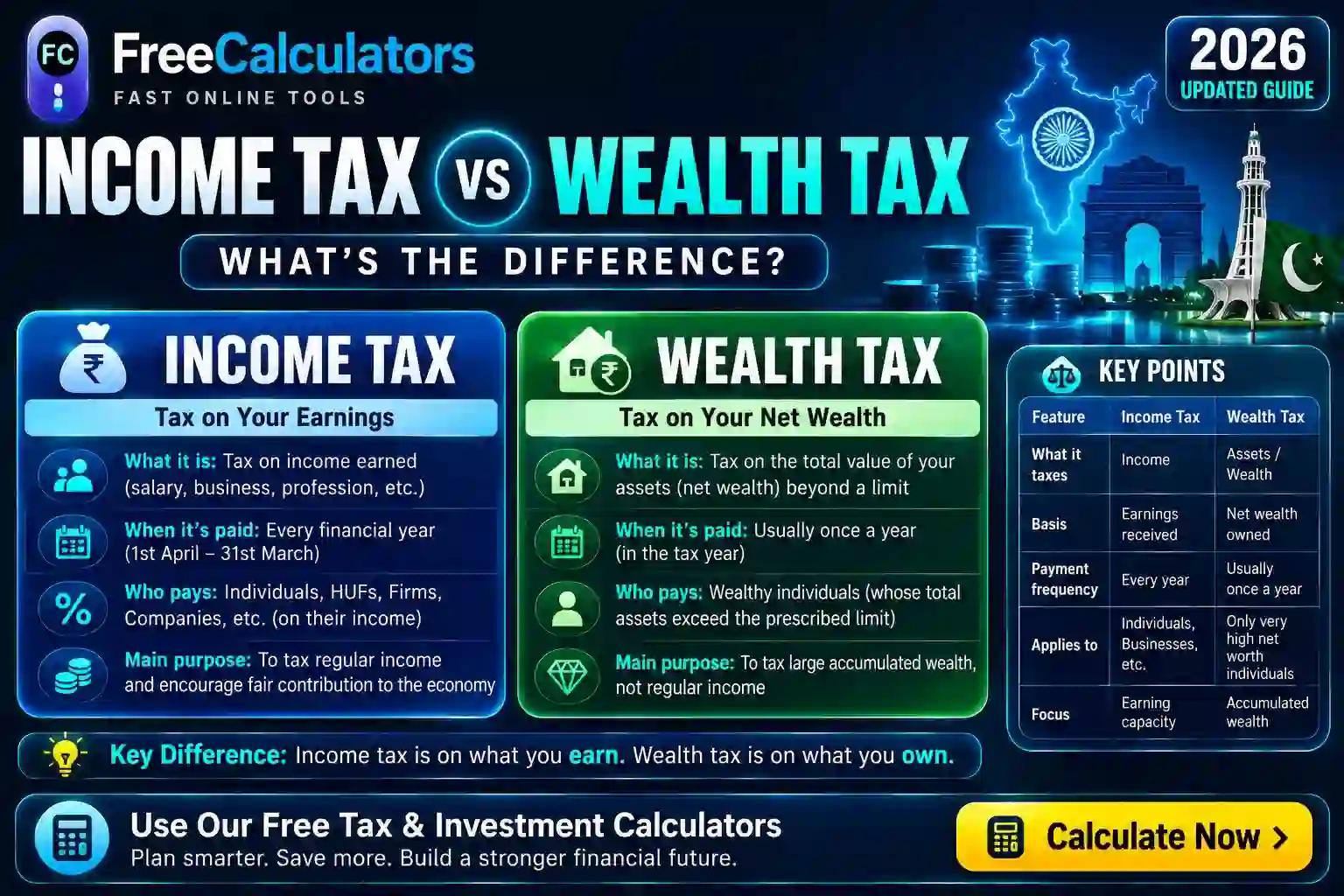
Income tax is charged on the money you earn — your salary, business profits, or investment returns — every year. Wealth tax, on the other hand, is charged on what you already own — your total net worth, including property, cash, and investments — regardless of how much you earned that year. Most countries, including the United States at the federal level, rely almost entirely on income tax, while only a handful of nations like Norway, Spain, and Switzerland still apply a recurring wealth tax.
Understanding the difference matters more than it might seem, especially if you're planning your finances, comparing tax systems across countries, or just trying to make sense of political debates around taxing the ultra-wealthy. This guide breaks down exactly how each system works, who actually pays them, and why one has become far more common globally than the other.
What Is Income Tax?
Income tax is a direct tax levied on the earnings an individual or business generates within a tax year. This includes wages, salaries, business profits, rental income, dividends, and interest earned on investments.
Most income tax systems are progressive, meaning the tax rate increases as income rises. In the United States, for example, federal income tax is split into brackets, so someone earning more moves into higher brackets only for the portion of income within that range — not their entire earnings. India follows a similar bracket-based structure, and Pakistan applies its own slab system through the FBR.
Key characteristics of income tax:
- Calculated annually based on total earnings for the year
- Applies to salary, self-employment income, capital gains, and passive income sources
- Usually allows deductions and exemptions (retirement contributions, mortgage interest, business expenses)
- Filed through a tax return, typically due once a year
If you want to see exactly what you'd owe based on your own earnings, an income tax calculator gives you a precise figure instead of estimating from raw bracket tables. For salaried employees specifically, a salary tax calculator factors in standard deductions automatically, which tends to be more accurate than manual math.
What Is Wealth Tax?
Wealth tax works completely differently. Instead of taxing what you earn, it taxes what you own — your net worth, calculated as total assets minus liabilities. This includes real estate, bank savings, stocks, business ownership stakes, and sometimes even personal property like art or yachts, depending on the country's rules.
A wealth tax is typically:
- Calculated on net assets, not income
- Applied annually in countries that still use it (a recurring tax, not a one-time levy)
- Subject to an exemption threshold — most systems only tax net worth above a certain amount
- Far less common globally than income tax, and increasingly rare even where it once existed
Here's a distinction people often miss: earning $200,000 a year but having no savings means a high income tax bill and zero wealth tax. Someone else might earn very little but hold $5 million in inherited real estate — under a wealth tax system, they'd owe tax on that wealth even with minimal annual income. That's the core difference in practice, not just in theory.
Income Tax vs Wealth Tax: Side-by-Side Comparison
| Factor | Income Tax | Wealth Tax |
|---|---|---|
| What's taxed | Money earned during the year | Total net worth (assets minus debts) |
| Frequency | Annual, based on earnings | Annual, based on asset value on a specific date |
| Who typically pays | Nearly everyone with taxable income | Only individuals above a net worth threshold |
| Common examples | Salary, business profit, dividends | Real estate, cash, stocks, business equity |
| Global adoption | Nearly universal | Rare — used in a small number of countries |
| Example countries | United States, UK, India, Pakistan | Norway, Spain, Switzerland |
Why Most Countries Rely on Income Tax, Not Wealth Tax
Income tax dominates globally for a few practical reasons. It's tied directly to cash flow — someone paying tax on a salary has the cash on hand to pay it. Wealth tax doesn't have that built-in convenience, since someone might be "asset-rich" (owning a valuable home) but "cash-poor" (with little liquid income to pay a tax bill on that asset's value).
There's also the administrative side. Valuing income is relatively straightforward — it shows up on pay stubs, business ledgers, and investment statements. Valuing wealth is messier. How do you price a private business, an art collection, or an overseas property every single year? This valuation challenge is one of the biggest practical reasons wealth taxes have struggled to scale.
Several countries that once had wealth taxes have scrapped them. France repealed its wealth tax in 2018 after data suggested it was driving high-net-worth individuals to relocate and take their capital with them — a phenomenon widely discussed as "capital flight." Germany suspended its wealth tax back in 1997 after a constitutional court ruling found part of it unequal in application. This pattern — countries adopting wealth taxes and later stepping away from them — is a recurring theme in tax policy history, and it's part of why global bodies like the OECD track wealth tax design so closely across member countries.
Countries That Currently Have a Wealth Tax
As of 2026, the list of countries with an active, recurring wealth tax is short:
- Norway — applies a wealth tax on net assets above a set threshold, with rates varying by municipality
- Spain — has both a national wealth tax and regional variations, with some autonomous communities offering exemptions
- Switzerland — applies wealth tax at the cantonal level, meaning rates differ significantly depending on where you live within the country
Compare that to countries relying purely on income-based taxation. The U.S. federal system, the UK, India, and Pakistan are major examples where wealth isn't taxed on an annual recurring basis nationally, even though state-level wealth tax proposals occasionally surface in places like California and Washington. If you're comparing how different U.S. states handle income tax specifically, this breakdown of states with no income tax is a useful companion read, since state-level differences often get confused with the federal-vs-wealth-tax debate.
Does the United States Have a Wealth Tax?
No — not at the federal level. The U.S. taxes income, capital gains when realized (meaning when you sell an asset for a profit), and estates upon death, but there's no annual tax simply for holding wealth. Several state-level wealth tax proposals have been floated over the years, but none has passed into law as of 2026.
This is an important nuance: capital gains tax and wealth tax are often confused, but they're not the same thing. Capital gains tax applies only when you sell an asset and realize a profit. Wealth tax would apply to the asset's value whether you sell it or not — which is exactly why it's controversial, since it can tax "paper wealth" that hasn't actually generated cash. For a closer look at how U.S. federal rules interact with individual state rules, this piece comparing federal vs. state income tax in the USA breaks down where the overlaps and gaps actually sit.
Income Tax vs Other Related Taxes
Because tax terminology overlaps so much, it helps to separate income tax and wealth tax from similar-sounding taxes:
Income tax vs. capital gains tax — Capital gains tax is technically a subset of income taxation in most systems; it applies specifically to profit from selling an asset (stocks, property, business shares), rather than regular earnings like salary.
Wealth tax vs. estate tax — Estate tax (sometimes called inheritance tax) is a one-time tax applied when wealth transfers after death. Wealth tax, by contrast, is recurring and applies while the person is still alive, year after year.
Wealth tax vs. property tax — Property tax is typically a local, recurring tax on real estate specifically. Wealth tax is broader, covering total net worth across all asset types, not just real estate. If property tax specifically is what you're trying to work out, this guide to the Pakistan property tax calculator or the wider Pakistan property tax guide covers that calculation in more depth.
Getting these distinctions right matters, especially for anyone doing tax planning, since each type has different triggers, rates, and reporting requirements. If you're building out a broader tax vocabulary, the essential tax terms glossary is a good reference for exactly this kind of terminology confusion.
Real-World Example: Comparing the Two Systems
Consider two people to see how differently these systems treat wealth versus income:
Person A earns $150,000 a year as a corporate executive but has modest savings and no major property. Under income tax, they'd owe a substantial annual bill based on their salary bracket. Under a wealth tax system, they'd likely owe little to nothing, since their net worth doesn't clear typical exemption thresholds.
Person B inherited a $4 million property portfolio and earns a modest $40,000 salary from a part-time role. Under income tax alone, they'd pay relatively little given their low earnings. Under a wealth tax system, they could owe a meaningful annual amount based purely on the value of what they own, regardless of their modest income.
This is exactly why wealth tax debates get politically charged — critics argue it penalizes illiquid asset holders (people whose wealth is tied up in property or business equity, not cash), while supporters argue it's the only way to meaningfully tax accumulated wealth that income tax alone never touches.
Pros and Cons: A Balanced Look
Arguments for wealth tax:
- Targets accumulated wealth that income tax structurally misses, including inherited assets and unrealized gains
- Seen by supporters as a tool to reduce long-term wealth inequality
- Applies regardless of how income is structured, closing loopholes some high earners use to minimize taxable income
Arguments against wealth tax:
- Difficult and expensive to administer accurately, especially for valuing private businesses or illiquid assets
- Can force asset sales just to cover the tax bill (a house-rich, cash-poor retiree, for example)
- Historical evidence from France and other countries suggests it can drive wealthy individuals and their capital elsewhere
Arguments for income tax:
- Simple to calculate and verify against pay stubs, business records, and bank statements
- Tied directly to cash flow, so taxpayers generally have the liquidity to pay what's owed
- Nearly universal adoption means there's decades of policy precedent and infrastructure supporting it
Arguments against income tax:
- Doesn't touch wealth that isn't actively generating income (like an appreciating but unsold property)
- Can be seen as disproportionately burdening earners over inheritors, since someone living off accumulated assets pays comparatively little
Which System Is "Better"?
Neither system is objectively superior — they solve different problems. Income tax is efficient, predictable, and administratively simple, which is why nearly every functioning tax system in the world uses some version of it. Wealth tax attempts to address a gap income tax leaves open — namely, that someone can be extraordinarily wealthy while reporting relatively little taxable income in a given year.
Most economists and policy bodies, including the OECD, note that the two aren't mutually exclusive; many countries layer capital gains tax, estate tax, and property tax on top of income tax rather than adopting a standalone wealth tax, since these hybrid approaches tend to be easier to administer while still reaching accumulated wealth in some form.
Frequently Asked Questions
What is the difference between income tax and wealth tax? Income tax is charged on money earned during the year — salary, business profit, or investment income. Wealth tax is charged on total net worth — everything you own minus what you owe — regardless of how much you earned that year.
Does the United States have a wealth tax? No, not at the federal level. The U.S. taxes income, realized capital gains, and estates after death, but there's no annual federal tax on simply holding wealth, though some states have proposed one.
Which countries currently impose a wealth tax? Norway, Spain, and Switzerland are the most prominent examples with active, recurring wealth taxes as of 2026. Many other countries, including France and Germany, have repealed wealth taxes in past decades.
Is wealth tax paid every year? Yes, in countries where it exists, wealth tax is typically assessed annually based on your net worth on a specific valuation date, similar to how property tax is billed yearly.
What assets count toward wealth tax? Real estate, cash and bank deposits, stocks and investments, and business ownership stakes are common examples, though specific rules and exemption thresholds vary significantly by country.
Why is wealth tax considered controversial? It can tax "paper wealth" that hasn't generated any actual cash, potentially forcing asset sales to cover the bill, and historical data suggests it can encourage wealthy individuals to relocate their assets or residency elsewhere.
Final Takeaway
Income tax and wealth tax solve fundamentally different problems — one taxes what flows in each year, the other taxes what's already accumulated. Most of the world runs on income tax because it's simpler to calculate and tied directly to cash flow, while wealth tax remains a policy tool used by only a small number of countries due to valuation challenges and capital flight concerns.
If you want to see exactly where you stand under your own country's income tax rules rather than relying on general brackets, try the income tax calculator or, if you're comparing regimes in India specifically, the old vs. new regime calculator for a side-by-side breakdown of which structure actually saves you more.