
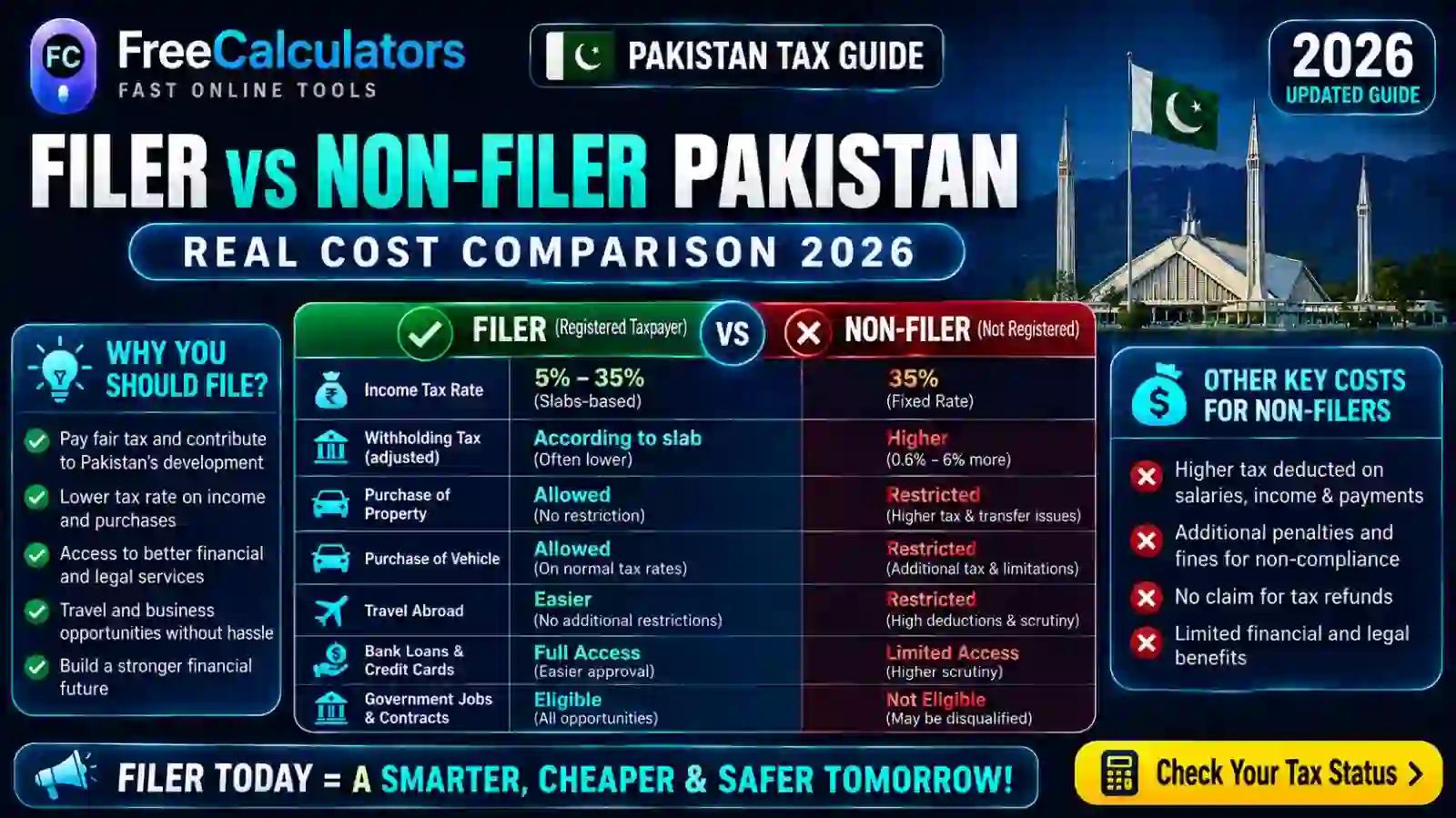
A filer in Pakistan is someone listed on the FBR's Active Taxpayer List (ATL) after filing an income tax return, while a non-filer isn't on that list and pays noticeably higher withholding tax rates on property transactions, vehicle purchases, banking transactions, and dividends. In many cases, non-filers pay close to double what filers pay on the same transaction — and that gap has only grown as FBR has tightened enforcement heading into 2026.
If you've ever wondered whether it's actually worth the paperwork to become a filer, this is the article that answers it with real numbers, not vague generalities. We'll walk through exactly where the cost difference shows up, how much it typically adds up to, and what the process of becoming a filer actually involves.
What Does Filer and Non-Filer Actually Mean in Pakistan?
A filer is a person or business registered with the Federal Board of Revenue (FBR) who has filed an income tax return for the relevant tax year and appears on the Active Taxpayer List (ATL). Being on the ATL isn't automatic just because you have an NTN (National Tax Number) — you need to have actually submitted a return.
A non-filer is anyone who hasn't filed a return, whether they have an NTN or not, and therefore doesn't appear on the ATL. This includes people who've simply never registered, as well as people who registered years ago but stopped filing annual returns.
There's also a middle category worth knowing: a late filer, someone who missed the annual filing deadline but files afterward. Depending on the tax year and FBR's current rules, late filers may face a waiting period before appearing on the ATL, meaning they can be taxed at non-filer rates temporarily even after submitting their return.
Why the Cost Gap Exists
Pakistan's tax system leans heavily on withholding tax — tax collected upfront at the point of a transaction rather than only at year-end filing. FBR uses the filer/non-filer distinction as a built-in enforcement mechanism: instead of chasing down people who avoid filing, it makes non-filing expensive at the transaction level, on everything from buying a car to withdrawing cash from a bank.
This design means the cost of being a non-filer isn't a single penalty — it's spread across dozens of everyday financial activities, which is exactly why the gap is easy to underestimate until you actually add it up.
Filer vs Non-Filer: Real Cost Comparison by Transaction Type
Below is a breakdown of where filers and non-filers see the most significant cost differences. Exact percentages are revised periodically by FBR through the Finance Act, so always confirm current rates through the FBR Iris portal or a Pakistan withholding tax calculator before making a major purchase.
| Transaction Type | Filer Treatment | Non-Filer Treatment | Typical Gap |
|---|---|---|---|
| Property purchase (withholding tax) | Standard rate | Substantially higher rate | Often close to double |
| Vehicle registration/token tax | Standard rate | Higher rate, sometimes tiered by engine size | Can be 2–3x on larger vehicles |
| Bank cash withdrawal (above threshold) | Typically exempt or minimal | Withholding tax applies | Direct cost non-filers alone bear |
| Profit on savings/bank deposits | Standard withholding rate | Elevated withholding rate | Meaningfully higher |
| Dividend income | Standard rate | Elevated rate | Noticeably higher |
| Vehicle purchase (advance tax) | Standard rate | Higher rate | Can add a significant lump sum |
The property and vehicle categories tend to create the biggest one-time cost differences, since these are large-value transactions where even a few percentage points translate into real money. For a detailed breakdown specific to vehicles, this guide on filer vs non-filer vehicle tax in Pakistan walks through province-specific token tax differences in more depth.
Property Transactions: Where the Gap Hits Hardest
Buying property is where filer status matters most financially. Non-filers pay elevated withholding tax rates on both purchase and, in many cases, sale of property, and beyond the tax rate itself, non-filers have historically faced restrictions on purchasing property above certain value thresholds altogether, depending on the specific rules in force for a given tax year.
For someone buying a mid-range property, the difference between filer and non-filer withholding tax can run into hundreds of thousands of rupees — money that's simply avoidable by registering and filing before the transaction happens, not after. If you're planning a property purchase, running the numbers through a Pakistan property tax calculator before you commit is the practical way to see the actual rupee difference for your specific purchase price.
Vehicle Purchases and Token Tax
Vehicle-related costs are where a lot of people first discover the filer/non-filer gap, usually when registering a new car. Non-filers pay higher advance tax at the time of registration, and annual token tax also differs by filer status in several provinces.
This applies whether you're buying new or transferring an existing vehicle, and the gap widens as engine capacity increases — larger vehicles see proportionally bigger tax differences between filers and non-filers. A vehicle token tax calculator or the province-specific versions for Punjab, Sindh, or Islamabad will give you the exact figure rather than a rough estimate, since token tax rules vary meaningfully by province.
Banking and Cash Transactions
This is the category that surprises people most, because it applies to routine financial activity rather than a one-time purchase. Non-filers face withholding tax on cash withdrawals above a certain threshold in a single day, something filers are typically exempt from or pay at a much lower rate.
Profit earned on bank deposits and savings accounts is taxed at a higher withholding rate for non-filers too, meaning the gap isn't limited to spending — it applies to saving money as well. Over a full year, someone regularly withdrawing cash or holding significant savings can lose a meaningful amount purely to non-filer banking withholding tax, on top of everything else.
Dividend and Capital Gains Tax Differences
For anyone holding investments, filer status affects dividend income and capital gains on stocks. Non-filers are taxed at elevated rates on dividend distributions, and the same pattern holds for capital gains realized on the sale of listed securities. For a deeper look at how this plays out specifically for property and stock market gains, this guide on capital gains tax on property and stocks in Pakistan breaks down the filer-specific rules in more detail.
This matters more than people expect if they're actively investing — the tax drag from staying a non-filer compounds every time a dividend is paid or a position is sold at a profit.
How to Become a Filer in Pakistan (Step-by-Step)
Becoming a filer isn't complicated, but it does require a few concrete steps through FBR's systems:
- Register for an NTN through the FBR Iris portal if you don't already have one. This requires your CNIC, a valid phone number, and an active email address.
- Log into the Iris portal using your registered credentials.
- File your income tax return for the relevant tax year, declaring your income sources accurately.
- Submit your wealth statement if required based on your income category — this is a standard part of the filing process for most individual filers.
- Wait for ATL update. FBR updates the Active Taxpayer List periodically; your name typically appears within a set window after successful filing, though this can take longer during peak filing season.
- Verify your status on the ATL directly through FBR's online verification tool before assuming you're covered by filer rates on your next transaction.
For a more detailed walkthrough of this exact process, this complete guide to becoming a tax filer in Pakistan covers document requirements and common registration issues in more depth. If you're unsure whether Iris or a manual calculation is more reliable for estimating what you'll owe, this comparison of FBR's tax calculator vs. the Iris portal is worth reading first.
How to Check If You're Already a Filer
Before assuming your status, it's worth verifying directly rather than guessing based on when you last filed:
- Visit FBR's online ATL verification tool and search by CNIC or NTN.
- Alternatively, send an SMS to FBR's designated verification number with your CNIC, a method that works well if you don't have reliable internet access at the moment.
This matters because your status can lag behind your actual filing — if you just submitted a return, it may take time to reflect on the ATL, and transactions made during that gap could still be taxed at non-filer rates.
Is It Worth Becoming a Filer in 2026?
For most people who own property, drive a vehicle, or maintain meaningful bank balances, the answer is a clear yes. The filing process itself — even with professional help — typically costs far less than what a single non-filer property or vehicle transaction adds in extra withholding tax.
The math tends to favor filing especially for:
- Anyone planning to buy property or a vehicle within the next year
- Salaried individuals with income above the taxable threshold who are already legally required to file
- Freelancers and overseas Pakistanis with local bank accounts or investments
- Anyone with dividend income or a brokerage account trading listed securities
The exceptions are narrower — someone with minimal banking activity, no plans to buy property or a vehicle, and income below the taxable threshold might see limited practical benefit from filing purely on a cost basis, though there are also non-financial reasons (like avoiding scrutiny or penalty notices) that make filing worthwhile regardless.
Penalties for Staying a Non-Filer
Beyond the transaction-level cost gap, FBR has enforcement tools specifically aimed at non-filers, including the authority to issue notices, freeze certain transactions, and in some cases restrict specific financial activities for individuals who meet income thresholds but haven't filed. These penalties exist separately from the withholding tax differences and can compound the financial downside of remaining unregistered.
Frequently Asked Questions
What is the difference between a filer and non-filer in Pakistan? A filer is registered with FBR and appears on the Active Taxpayer List after submitting an income tax return, while a non-filer hasn't filed and pays higher withholding tax rates on property, vehicles, banking transactions, and dividends.
How much extra tax does a non-filer pay in Pakistan? It varies by transaction type, but non-filers often pay close to double the filer rate on property and vehicle transactions, plus additional withholding tax on cash withdrawals and bank profits that filers are frequently exempt from.
How can I become a filer in Pakistan? Register for an NTN through the FBR Iris portal, file your income tax return along with any required wealth statement, and verify your Active Taxpayer List status once your return is processed.
Can a non-filer buy property in Pakistan? Yes, but non-filers pay significantly higher withholding tax on the purchase, and depending on current FBR rules, may face additional restrictions on high-value property transactions.
What are the penalties for being a non-filer in Pakistan? Beyond higher withholding tax rates across property, vehicles, and banking, non-filers can receive FBR notices and face restrictions on certain financial transactions if their income exceeds the taxable threshold.
Is it worth becoming a filer in Pakistan in 2026? For most people planning to buy property or a vehicle, or who maintain regular banking activity, yes — the filing cost is typically far lower than the extra withholding tax paid on even one non-filer transaction.
Final Takeaway
The filer-non-filer gap in Pakistan isn't a minor administrative distinction — it's a real, ongoing cost that shows up every time you buy property, register a vehicle, withdraw cash, or earn investment income. For anyone with regular financial activity, the paperwork involved in becoming a filer is almost always cheaper than continuing to pay non-filer rates transaction after transaction. Before your next major purchase, run the numbers through the Pakistan withholding tax calculator to see exactly what filer status would save you, and verify your current ATL status directly with FBR before assuming either way.