
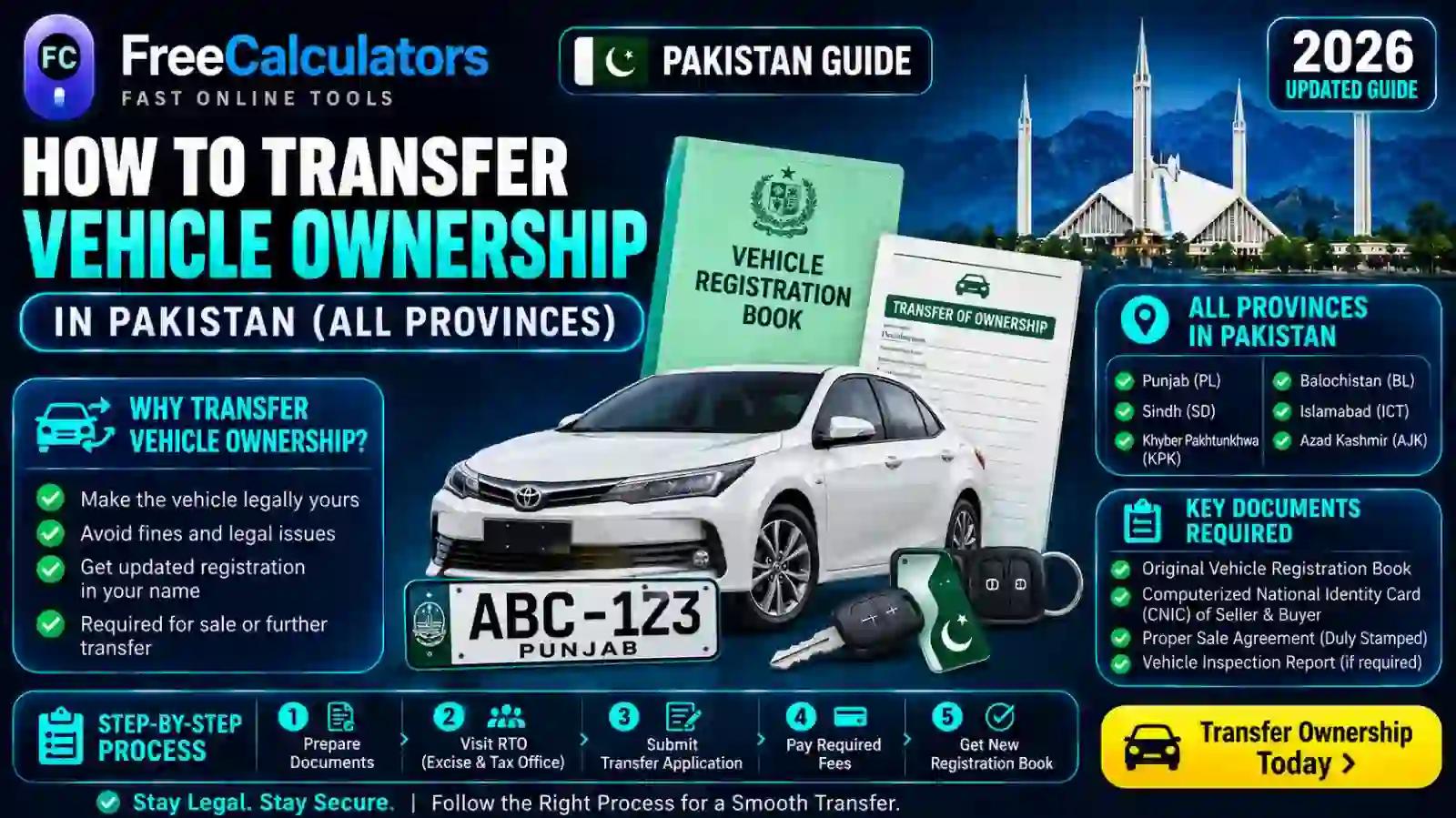
If you've just bought or sold a car or bike in Pakistan, the sale receipt alone doesn't make it legal. Vehicle ownership transfer in Pakistan is completed by submitting a Transfer Order (T.O.) form, both parties' CNICs, the original registration book or smart card, and biometric verification to your provincial Excise and Taxation Department — typically within 7 to 30 days depending on the province and whether you apply online or in person.
That's the short answer. But the actual process — and the paperwork, fees, and digital tools involved — differs enough between Punjab, Sindh, Khyber Pakhtunkhwa, Balochistan, and Islamabad that a generic checklist won't get the job done. This guide breaks the process down province by province, explains why an "open transfer letter" is riskier than most people realize, and shows you exactly what to prepare before you walk into an Excise office — or open your phone to do it online.
Why Vehicle Transfer Actually Matters (Not Just Paperwork)
A huge number of used vehicles in Pakistan change hands through what's locally called an "open letter" — a signed but blank transfer form the buyer holds onto instead of formally registering the vehicle. It's faster and avoids a trip to the Excise office. It's also a legal liability waiting to surface.
Here's what stays attached to the original registered owner until an official transfer is completed:
- Traffic challans and fines generated against the vehicle
- Token tax arrears, which keep accumulating in the seller's name
- Legal disputes, including any criminal case where the vehicle is later involved
- Loan or leasing complications, if the vehicle was ever financed
If a vehicle sold on an open letter gets into an accident or is used in a crime, the paperwork trail points straight back to the last legally registered owner — not whoever is actually driving it. Buyers lose out too: without a completed transfer, you can't get a duplicate smart card if the original is lost, and reselling the vehicle later becomes harder because your name never appeared in the chain of ownership.
The General Vehicle Transfer Process (Applies Across Provinces)
While fee structures and portals vary, the core mechanics of transferring ownership are broadly similar everywhere in Pakistan:
- Verify the vehicle first. Before any money changes hands, check the vehicle's registration status through your provincial Excise portal to confirm the seller is the genuine registered owner and that there's no outstanding token tax, theft flag, or legal dispute.
- Fill out the Transfer Order (T.O.) form. This is the core application document, signed by both the seller and buyer, often in the presence of two witnesses.
- Complete biometric verification. Most provinces now require fingerprint verification through NADRA e-Sahulat centres or a mobile app, for both the seller and buyer, to confirm identity and prevent fraudulent transfers.
- Submit CNIC copies and the original registration certificate. The registration book (or smart card) must show updated token tax payment.
- Pay the applicable transfer fee, which is generally tied to the vehicle's engine capacity and, in some provinces, whether the buyer is an active tax filer.
- Collect the updated registration document — either a new smart card or an updated registration certificate — once the Excise department processes the application.
Now let's look at what changes province to province.
Vehicle Transfer Process in Punjab
Punjab has moved the furthest toward full digitization. The Punjab Excise, Taxation and Narcotics Control Department now allows sellers to complete biometric verification for a vehicle transfer directly through the Pak-ID mobile app, replacing the older requirement of visiting a NADRA e-Sahulat agent in person. Once verification and fee payment are done, transfers are typically processed within 48 hours.
Documents Required in Punjab
- Transfer Order (T.O.) form, filled and signed
- Photocopy of seller's CNIC
- Photocopy of buyer's CNIC
- Photocopies of two witnesses' CNICs
- Original registration certificate with updated token tax
- Original registration file, if the vehicle falls under the File Return Scheme
How to Pay and Apply in Punjab
Punjab's IT board (PITB) has enabled online fee payment for vehicle transfers through the e-Pay Punjab platform, so you can generate a payment slip and pay via mobile banking without visiting a bank branch. You can verify a vehicle's registration history and ownership status any time through the MTMIS Punjab portal, which is the department's central vehicle database.
Since transfer fees in Punjab scale with engine capacity and change periodically through provincial finance bills, it's worth running your specific vehicle through a Punjab token tax calculator before you budget for the transaction — this gives you a current estimate rather than relying on an outdated number from an old blog post. For a deeper look at how token tax obligations shift once ownership changes hands, see this Punjab vehicle tax calculator guide for 2026.
Vehicle Transfer Process in Sindh (Including Karachi)
Sindh's Excise, Taxation and Narcotics Control Department has rolled out mandatory biometric verification in phases — starting with new vehicle registrations, then extending to purchases, and eventually requiring both buyer and seller to verify biometrically for any transfer. This was introduced specifically to reduce fraud in a province with one of the country's largest used-vehicle markets.
What Makes Sindh's Process Different
- Sindh has offered periodic amnesty windows allowing vehicle transfers to proceed without the original seller's biometric verification, aimed at helping owners who bought vehicles years ago on open letters and can no longer trace the seller.
- If the seller genuinely cannot be located, Sindh's process allows a unilateral transfer after a public notice period (commonly around 15 days) with no objections raised, following physical inspection of the vehicle at a designated Excise yard.
- Commercial vehicle transfer fees in Sindh are periodically revised by notification — recent updates standardized commercial vehicle registration and transfer charges regardless of vehicle weight, so always check the latest notified rate rather than assuming last year's fee still applies.
Documents and Verification in Sindh
You'll need the same core set — T.O. form, both parties' CNICs, original registration book, and witness details — plus biometric confirmation through a NADRA e-facilitation centre or district Excise office. You can check a vehicle's registration and tax status beforehand through the Sindh Excise Department's official portal or the MTMIS Sindh system before committing to a purchase.
Since Sindh and Punjab calculate token tax differently, if you're relocating a vehicle or simply want to estimate ongoing costs after transfer, a Sindh car token tax calculator is far more reliable than applying Punjab's rate structure by assumption.
Vehicle Transfer Process in Islamabad (ICT)
Islamabad falls under the Motor Registration Authority (MRA), administered through the Excise & Taxation Officer for the Islamabad Capital Territory, and the process is slightly more paperwork-heavy than Punjab's mobile-first approach, though it can still largely be tracked online.
Steps for Islamabad Vehicle Transfer
- Submit an application for transfer of ownership addressed to the Motor Registration Authority / Excise & Taxation Officer, Islamabad.
- Deposit the required fee at the designated Excise Department window.
- Get your documents verified by the assigned Excise Inspector.
- Collect your receipt from the Data Entry Operator once processing is confirmed.
If the registered owner cannot appear in person, supporting documents must be attested by a Class-I officer, along with a photocopy of that officer's CNIC and their official contact number. For a vehicle still under a bank or leasing company's name, you'll also need an NOC or transfer letter from that institution before the Excise department will process the change. An affidavit confirming the vehicle isn't stolen or under legal dispute is also part of the standard Islamabad documentation set.
Note that vehicles registered for less than five years in Islamabad are subject to advance tax at the time of transfer, which is a detail many first-time sellers overlook when calculating their net proceeds from a sale.
Before heading to the office, it helps to check current Islamabad Excise office timings so you're not turned away, and to review this Excise and Taxation Islamabad guide for a full documentation checklist. You can also estimate your post-transfer token tax obligation using the Islamabad token tax calculator, and compare current rates against older ones through this old vs. new token tax Islamabad 2026 comparison.
Vehicle Transfer Process in Khyber Pakhtunkhwa (KP)
The Khyber Pakhtunkhwa Department of Excise and Taxation, headquartered in Peshawar, handles vehicle registration and ownership transfer for the province under its own Motor Vehicle Rules. The documentation requirements largely mirror Punjab's — T.O. form, CNIC copies, original registration certificate, and biometric verification — though KP's digital infrastructure for online transfers has historically lagged behind Punjab and Sindh, meaning more transactions still require an in-person visit to your district Excise office.
If you're transferring a vehicle in KP, it's worth calling ahead or checking with your district office about current biometric requirements, since provinces have been updating these rules independently and at different speeds over the past two years.
Vehicle Transfer Process in Balochistan
Balochistan's Excise and Taxation Department follows a broadly similar structure to KP — provincial motor vehicle legislation, a T.O. form-based transfer application, and CNIC-based identity verification. Digital services here are the least developed of the five jurisdictions covered in this guide, so plan for an in-person Excise office visit as the default rather than the exception, particularly outside Quetta.
Province-by-Province Comparison
| Province/Territory | Managing Authority | Biometric Method | Online Transfer Available |
|---|---|---|---|
| Punjab | Excise, Taxation & Narcotics Control Department | Pak-ID mobile app (or NADRA e-Sahulat) | Yes — largely digitized |
| Sindh | Excise, Taxation & Narcotics Control Department | NADRA e-facilitation centres | Partial — verification online, some steps in-person |
| Islamabad (ICT) | Motor Registration Authority | In-person at Excise office | Partial — application tracking online |
| Khyber Pakhtunkhwa | KP Department of Excise and Taxation | Mostly in-person | Limited |
| Balochistan | Balochistan Excise and Taxation Department | In-person | Limited |
Since exact fee schedules are revised periodically through provincial finance bills, treat this table as a process comparison rather than a source for current rupee figures — always confirm the latest fee against your province's vehicle token tax calculator or official portal before paying.
Transfer Letter vs. Full Ownership Transfer: What's the Real Difference?
This is where a lot of confusion happens in the used-vehicle market. A transfer letter (open letter) is a signed statement of intent to sell — it's not a legal change of registered ownership. A full ownership transfer is the completed process through the Excise department that actually updates the government's vehicle record and issues a new smart card in the buyer's name.
Relying on an open letter feels convenient because it skips paperwork and biometric visits, but it leaves the vehicle legally tied to the previous owner indefinitely. If you're buying a used vehicle that's changed hands multiple times on open letters, you may end up needing signatures or NOCs from several previous owners just to complete one legitimate transfer — a genuinely painful process that's far more time-consuming than doing it correctly the first time.
For a closer look at how provinces have been tightening rules around identity verification specifically to close this loophole, see this breakdown of the NADRA e-Sahulat biometric vehicle transfer requirement.
Does It Matter If You're a Tax Filer or Non-Filer?
Yes — and this affects more than just annual token tax. In several provinces, withholding tax rates applied at the time of vehicle registration and transfer are explicitly higher for non-filers than for active taxpayers listed on the FBR's Active Taxpayer List. Punjab's recent finance proposals, for instance, have adjusted withholding tax percentages on vehicle registration and transfer transactions based on invoice value, with filers paying a lower rate than non-filers.
Practically, this means two people transferring an identical vehicle on the same day can end up paying meaningfully different amounts, purely based on their FBR filer status. If you're not sure where you stand, this comparison of filer vs. non-filer vehicle tax in Pakistan explains the practical cost difference and why becoming a filer before a major vehicle transaction is often worth the effort.
Special Cases: Inheritance, Gifting, and Company-Owned Vehicles
Inherited vehicles require additional documentation beyond a standard sale-based transfer — typically a succession certificate or legal heir documentation alongside the standard CNIC and registration paperwork, since there's no sale transaction to base the transfer on.
Gift transfers between family members still go through the same Excise department process, though some provinces apply reduced or waived transfer fees for transfers between direct family members (spouse, parent, child) — this varies by province and is worth confirming directly with your local office rather than assuming it applies uniformly.
Company-owned or leased vehicles need an NOC or transfer letter from the bank or leasing company before the Excise department will process a change of ownership, since the vehicle's registration is typically encumbered until the lease is fully paid off or formally released.
Common Mistakes That Delay or Invalidate a Transfer
- Skipping the pre-purchase verification step. Buyers who don't check MTMIS or the equivalent provincial portal before paying often discover unpaid token tax or a legal flag only after the deal is done.
- Assuming an open letter is "good enough." It isn't — and it becomes a real problem the moment the vehicle is involved in any incident.
- Not updating token tax before applying for transfer. Most provinces require the registration certificate to reflect current token tax payment before they'll process an ownership change.
- Missing witness signatures or CNIC copies. Incomplete T.O. forms are one of the most common reasons applications get bounced back at the counter.
- Ignoring biometric requirements when the seller is unavailable. If the original owner can't appear in person, most provinces require Class-I officer attestation instead — skipping this step stalls the application indefinitely.
Frequently Asked Questions
What documents are needed to transfer vehicle ownership in Pakistan? You'll generally need a filled Transfer Order (T.O.) form, CNIC copies of both the buyer and seller, two witnesses' CNIC copies, the original registration certificate with updated token tax, and biometric verification through NADRA or the relevant provincial app.
How much is the vehicle transfer fee in Punjab, Sindh, KP, and Balochistan? Transfer fees are based on engine capacity, vehicle type, and filer status, and they're revised periodically through provincial finance bills. Rather than relying on a fixed figure, check your province's official Excise portal or use a token tax calculator for a current estimate before budgeting.
Can I transfer a vehicle without going to the Excise office in person? In Punjab, yes — the Pak-ID app allows sellers to complete biometric verification remotely, with transfers processed within about 48 hours. Sindh allows partial online steps but often still requires an in-person visit for physical inspection. Islamabad, KP, and Balochistan currently rely more heavily on in-person processing.
How long does it take to transfer car ownership in Pakistan? Punjab's digitized process can complete a transfer in as little as 48 hours after successful verification and payment. Other provinces, particularly where more steps require in-person visits, typically take anywhere from a few days to a couple of weeks depending on office workload and document completeness.
Is a transfer letter (open letter) enough to legally transfer a vehicle? No. An open transfer letter is only a signed statement of intent — it does not update the government's vehicle registration record. Legal ownership only changes once the Excise department processes a full transfer and issues an updated registration document in the buyer's name.
What happens if a vehicle is never formally transferred after sale? Traffic challans, token tax arrears, and any legal complications remain tied to the original registered owner, regardless of who is actually using the vehicle. This creates ongoing liability for the seller and makes future resale or duplicate documentation harder for the buyer.
Can vehicle ownership be transferred online in Pakistan? Punjab offers the most complete online transfer experience through the Pak-ID app and e-Pay Punjab for fee payment. Sindh, Islamabad, and other provinces offer partial online services — typically verification and application tracking — while final processing may still require an office visit.
Final Takeaway
Vehicle ownership transfer in Pakistan follows the same basic backbone everywhere — a T.O. form, CNIC verification, biometric confirmation, and a fee payment tied to engine capacity — but the actual experience ranges from a same-day mobile app process in Punjab to a multi-step in-person visit in Balochistan. Skipping the formal transfer to save time with an open letter almost always costs more later, whether that's unpaid challans surfacing under your name or a buyer discovering they can't resell a vehicle that was never properly registered to them.
Before you finalize any vehicle sale or purchase, verify the vehicle's status through your province's official Excise portal, confirm current transfer fees using an updated token tax calculator, and complete the full biometric transfer process rather than relying on a signed piece of paper. It's a few extra steps upfront that save you from a genuinely painful paper trail down the road.