
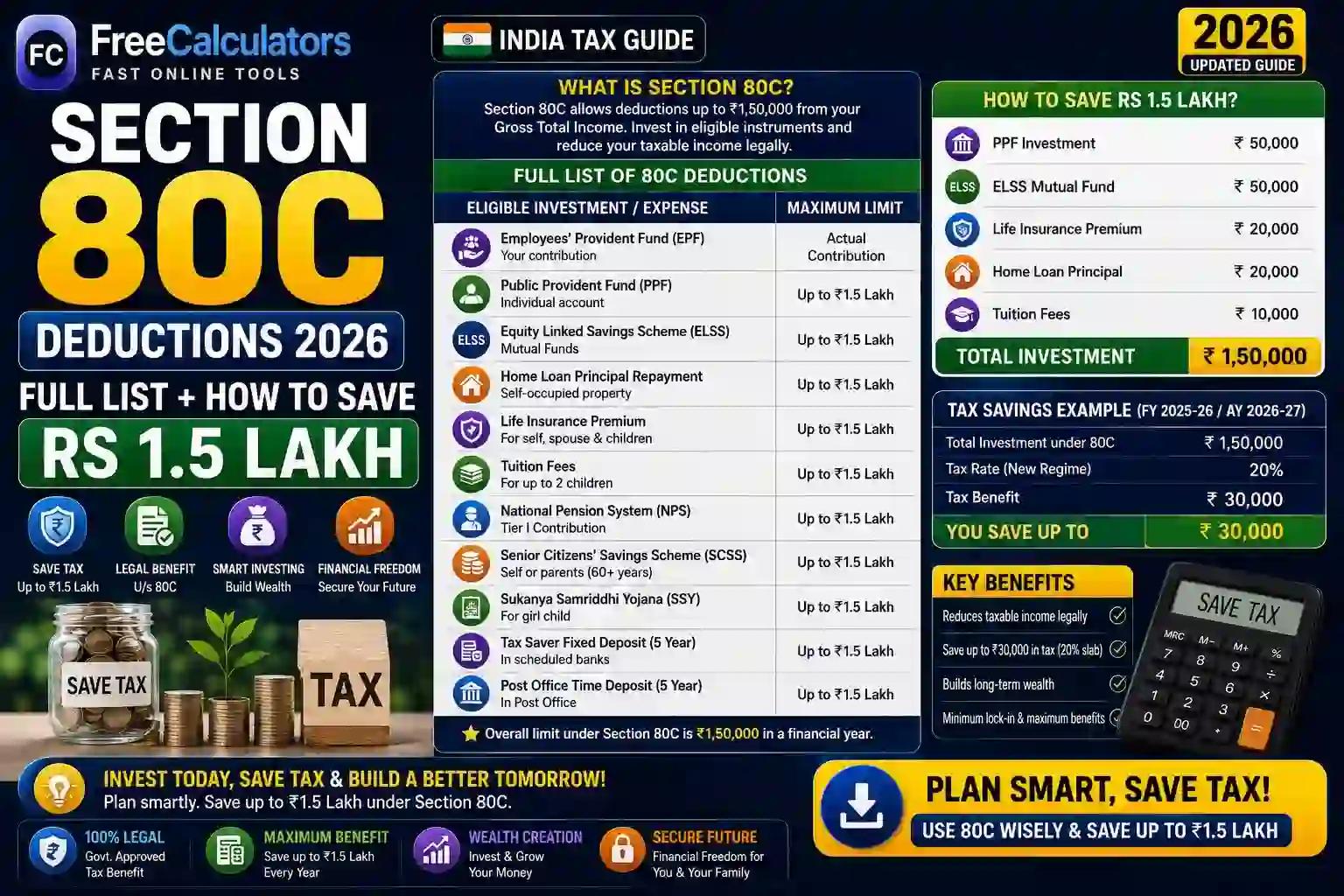
Section 80C lets you reduce your taxable income by up to ₹1.5 lakh a year by investing in specific instruments — PPF, ELSS, EPF, life insurance, NSC, and several others — but only if you're filing under the old tax regime, since this deduction isn't available under the new one. From April 2026, the Income Tax Act, 2025 also renumbers this as Section 123, though the ₹1.5 lakh limit and eligible instruments remain unchanged for now. This guide covers the complete list of what qualifies, how to actually split your ₹1.5 lakh across instruments, and the one qualifier that determines whether any of this applies to you at all.
What Section 80C Actually Covers
Section 80C of the Income Tax Act, 1961 allows individuals and Hindu Undivided Families (HUFs) to claim a deduction on specified investments and expenses, up to a combined cap of ₹1.5 lakh per financial year. It's the single most widely used tax-saving provision in India, largely because it covers such a broad range of instruments — from pure investment products to expenses you're probably already paying, like life insurance premiums or your child's tuition fees.
The critical qualifier that most generic articles bury or skip entirely: Section 80C is only available under the old tax regime. If you've opted for the new tax regime — which has become the default since recent budget changes — none of the deductions below apply to your taxable income calculation. Before reading further, it's worth confirming which regime you're actually on, since that single fact determines whether this entire article is relevant to your tax planning or not. Our old vs new tax regime comparison guide walks through exactly how to tell which one benefits you more.
The Complete Section 80C Eligible Instruments List
Here's every major instrument and expense that qualifies for Section 80C deduction, along with the practical details that actually matter when choosing between them.
This table is genuinely the core of what most people are searching for when they look up "80C deduction list" — but the returns and risk profile matter just as much as eligibility, since not every qualifying instrument is worth choosing purely because it saves tax.
Breaking Down the Major Instruments
PPF (Public Provident Fund) remains the most popular pure-safety option under 80C, currently offering 7.1% annually with full EEE (Exempt-Exempt-Exempt) tax treatment — meaning the contribution, the interest earned, and the maturity amount are all tax-free. The 15-year lock-in is longer than most other 80C instruments, though partial withdrawals are permitted starting from year 7. If you want the full mechanics of how PPF returns and maturity taxation work, our dedicated guide on NPS vs PPF covers this in depth alongside how it stacks up against NPS specifically for retirement planning.
ELSS (Equity Linked Savings Scheme) is the only 80C instrument with meaningful equity exposure and, correspondingly, the shortest lock-in period among all options — just 3 years per investment. This makes it attractive for investors who want higher growth potential and don't need the full 15-year commitment that PPF demands, though returns aren't guaranteed and carry genuine market risk. Long-term capital gains above ₹1.25 lakh are taxed at 12.5%, which is still meaningfully lower than most income tax slab rates.
EPF (Employee Provident Fund) is automatic for most salaried employees — 12% of your basic salary gets deducted and contributed monthly, and this contribution counts toward your 80C limit whether you actively choose it or not. This is worth flagging because many salaried employees don't realize their EPF contribution alone might already be eating into a significant chunk of their ₹1.5 lakh cap, leaving less room for other instruments like PPF or ELSS.
Life insurance premiums qualify for 80C, but only up to specific limits tied to the policy's sum assured (generally 10% of the sum assured for policies issued after April 2012). It's worth remembering that pure term insurance — which most financial advisors recommend over traditional endowment plans — also qualifies, and tends to be a far more cost-efficient way to use this particular sub-limit than combined insurance-investment products.
NSC (National Savings Certificate) works similarly to a tax-saver FD — a 5-year fixed-return government instrument, with interest that compounds annually but is only paid out at maturity. One nuance often missed: the interest earned each year on NSC, while not received in cash, is itself eligible for further 80C deduction in that year (except in the final year), effectively creating a partial compounding tax benefit that few other instruments offer.
Home loan principal repayment counts toward your 80C limit, separate from the interest deduction claimed under Section 24(b). This means homeowners repaying a loan often use up a meaningful portion of their ₹1.5 lakh limit through EMI payments alone, without needing to actively invest anything extra.
Tuition fees for up to two children, paid to any school, college, or university in India, qualify under 80C — though this covers only the tuition component, not development fees, transport, or other charges bundled into school payments.
What's Included vs What's Commonly Confused
A lot of confusion around Section 80C stems from people assuming certain popular tax-saving instruments belong here when they actually fall under different sections entirely. Here's the clarification that resolves most of that confusion:
- NPS (Section 80CCD) is a related but separate deduction, not part of core Section 80C — though your own NPS contribution under 80CCD(1) shares the same combined ₹1.5 lakh ceiling as 80C, while the additional ₹50,000 under 80CCD(1B) sits outside that cap entirely.
- Health insurance premiums fall under Section 80D, a completely separate deduction with its own limits based on age and family structure — not 80C.
- Sovereign Gold Bonds do not qualify for Section 80C deduction on purchase, though they do carry other tax advantages, particularly on capital gains if held to maturity.
- Atal Pension Yojana (APY) contributions are covered under Section 80CCD, not directly under core 80C.
If you're also exploring NPS as part of your tax-saving strategy, it's worth understanding how the two interact — our detailed comparison in NPS vs PPF 2026 breaks down exactly which deduction sections apply to each and how they combine.
How to Actually Split ₹1.5 Lakh Across 80C Instruments
Theory aside, here's a practical worked example of how someone might realistically allocate the full ₹1.5 lakh limit:
Example: A salaried employee with an existing home loan
- EPF (automatic, via salary): ₹60,000
- Home loan principal repayment: ₹40,000
- ELSS investment: ₹30,000
- Life insurance premium (term plan): ₹20,000
- Total: ₹1,50,000 — full limit utilized without needing a large lump-sum investment, since EPF and home loan repayment already cover most of it passively.
Example: A self-employed individual with no home loan
- PPF: ₹70,000
- ELSS: ₹50,000
- Tax-saver FD: ₹30,000
- Total: ₹1,50,000 — a mix balancing PPF's safety, ELSS's growth potential, and FD's shorter commitment.
The right split depends entirely on what you're already paying toward (EPF, home loan) versus what you need to actively invest to reach the cap. Before finalizing your allocation, running your numbers through an income tax calculator shows exactly how much tax each additional ₹10,000 of 80C investment actually saves you at your specific income level — the savings scale with your marginal tax rate, so someone in the 30% bracket saves considerably more per rupee invested than someone in the 5% bracket.
Section 80C vs 80CCD vs 80D: Clearing Up the Confusion
These three sections get mixed up constantly because they're all commonly discussed together as "tax-saving deductions," but they work quite differently:
The practical upshot: if you max out your ₹1.5 lakh combined 80C/80CCD(1) limit, NPS's extra ₹50,000 under 80CCD(1B) is genuinely additional room, not something you're double-counting. Health insurance under 80D is entirely separate and doesn't compete with your 80C allocation at all.
Is Section 80C Available Under the New Tax Regime?
No — and this is worth stating plainly because it's the single qualifier that makes or breaks whether this entire article applies to your tax filing. The new tax regime, introduced to simplify tax filing by offering lower slab rates in exchange for giving up most deductions, does not permit Section 80C claims at all. Neither does it allow 80D, HRA exemption, or most other itemized deductions salaried taxpayers have historically relied on.
If you're on the new regime, your tax-saving strategy looks fundamentally different — it's less about maximizing deduction claims and more about simply having lower effective slab rates from the start. Our complete guide to income tax slabs for AY 2026-27 lays out both regimes' bracket structures clearly, which is genuinely the first thing to check before planning any 80C investments — there's no point locking money into a 15-year PPF account for tax savings you're not eligible to claim.
What Happens If You Don't Use the Full ₹1.5 Lakh Limit?
Nothing penalizes you directly for not maxing out Section 80C — it's an optional deduction, not a requirement. But leaving it partially unused means paying more tax than necessary if you had genuine capacity to invest. Since the deduction directly reduces your taxable income (not just your tax bill), the actual rupee value of unused 80C room depends on your tax slab:
- In the 30% bracket, an unused ₹50,000 of 80C capacity represents roughly ₹15,600 in avoidable tax (including cess).
- In the 20% bracket, that same ₹50,000 gap costs roughly ₹10,400 in avoidable tax.
- In the 5% bracket, it's a more modest ₹2,600.
This is why reviewing your 80C utilization mid-year, rather than scrambling in March, tends to produce better decisions — you have time to choose instruments that actually fit your goals rather than whatever's fastest to purchase before the financial year closes.
How to Claim Section 80C Deduction While Filing ITR
The mechanics are straightforward once you understand the sequence:
- Gather proof of all 80C investments and expenses made during the financial year — PPF passbook entries, ELSS investment statements, life insurance premium receipts, home loan principal certificate from your bank, and tuition fee receipts.
- Declare these to your employer during the investment declaration period (typically at the start of the financial year, with proof submission around January–February) so TDS is calculated correctly on your salary.
- Report the total claimed amount under the relevant section in your ITR form when filing, cross-checking against Form 16 if you're salaried.
- Retain all proof documents for at least the assessment period, in case of scrutiny — the deduction claim itself doesn't require uploading documents with the ITR, but they need to be available if requested.
For a full walkthrough of how this fits into your overall salary tax calculation, our guide on calculating income tax for salaried employees in India covers exactly how 80C deductions flow into your final tax liability, step by step.
Frequently Asked Questions
What is the maximum limit under Section 80C? The maximum combined deduction under Section 80C is ₹1.5 lakh per financial year, covering all eligible investments and expenses together, not ₹1.5 lakh per individual instrument. This limit has remained unchanged for several years and applies only under the old tax regime.
What investments qualify for Section 80C deduction? Eligible instruments include PPF, ELSS, EPF, life insurance premiums, NSC, 5-year tax-saver FDs, ULIPs, Sukanya Samriddhi Yojana, Senior Citizens Savings Scheme, home loan principal repayment, tuition fees for up to two children, and stamp duty/registration charges in the year of home purchase.
Is Section 80C available under the new tax regime? No. Section 80C deductions are only available if you file under the old tax regime. The new tax regime does not permit this deduction, along with most other itemized deductions like 80D and HRA exemption.
Which is the best 80C investment option? There's no single best option — it depends on your risk tolerance and time horizon. PPF suits conservative savers wanting guaranteed returns, ELSS suits those comfortable with market risk seeking the shortest lock-in and highest growth potential, and a mix of both is common among balanced investors.
Can I claim 80C deduction for home loan principal? Yes, principal repayment on a home loan qualifies under Section 80C, separate from the interest deduction claimed under Section 24(b). This often significantly reduces how much additional investment homeowners need to make to reach the full ₹1.5 lakh limit.
Does EPF count towards the 80C limit? Yes, your mandatory EPF contribution (typically 12% of basic salary) counts toward the ₹1.5 lakh combined 80C cap automatically, without requiring any separate declaration. This often uses up a substantial portion of the limit for salaried employees before they make any additional investments.
Bottom Line
Section 80C remains one of the most flexible tax-saving provisions available to old-regime taxpayers, precisely because it covers such a wide range of instruments — from pure safety plays like PPF to growth-oriented options like ELSS to expenses you're likely already paying, like EPF and home loan principal. The real skill isn't just knowing the list; it's mapping your existing obligations against the ₹1.5 lakh cap first, then filling any remaining gap with instruments that actually match your risk tolerance and timeline, rather than defaulting to whatever's easiest to buy in March.
Before finalizing your 80C strategy for this financial year, confirm which regime you're actually filing under and calculate your specific tax savings using our income tax calculator — the exact rupee benefit depends entirely on your slab, and there's no reason to lock money into a 15-year instrument based on a generic assumption rather than your real numbers.
For the official, current list of eligible instruments and any updates tied to the Income Tax Act, 2025 transition, the Income Tax Department's official portal remains the authoritative source to verify against.