
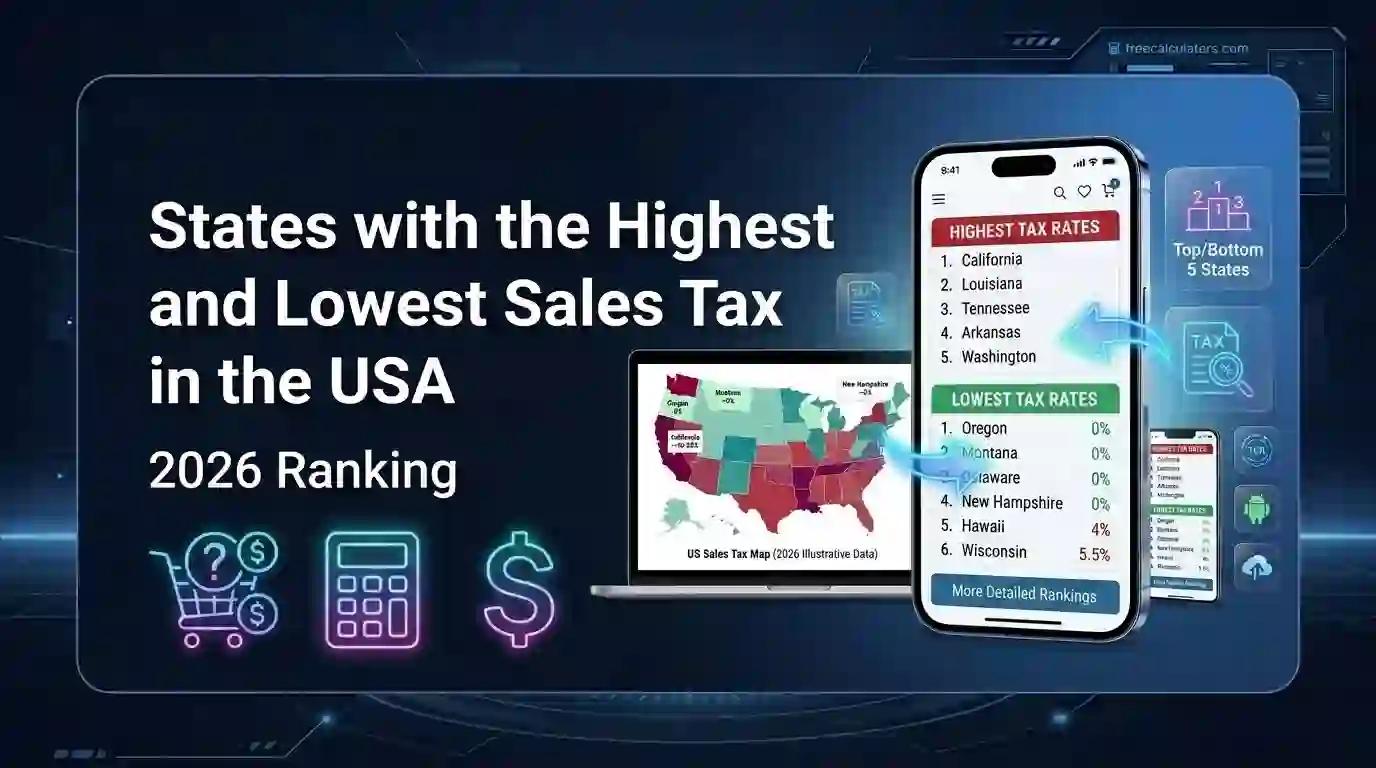
If you've ever wondered why a purchase costs more in one state than another, sales tax is usually the answer. As of 2026, Louisiana has the highest combined state and local sales tax rate in the country at just over 10%, while Alaska has the lowest combined rate among states that charge any sales tax at all, at under 2%. Meanwhile, five states, Alaska, Delaware, Montana, New Hampshire, and Oregon, charge no statewide sales tax whatsoever.
This guide breaks down the states with the highest and lowest combined sales tax rates in 2026, why the gap between them is so wide, and what it actually means for your wallet depending on where you live, shop, or plan to relocate.
What Is Sales Tax, and How Is the "Combined Rate" Calculated?
Sales tax is a percentage added to the price of most goods and services at the point of purchase. Almost every state that levies a sales tax also allows counties, cities, and special taxing districts to add their own local sales tax on top of the state rate. When people talk about the "combined sales tax rate," they mean the state rate plus the average local rate layered on top of it.
This is why two people in the same state can pay noticeably different sales tax rates depending on which city or county they're shopping in. According to the Tax Foundation, three states (California, Utah, and Virginia) also require a mandatory statewide local add-on tax that gets folded into their base state rate, which adds another layer of complexity to comparing states directly.
States with the Highest Sales Tax in 2026
Here are the states with the highest average combined state and local sales tax rates in 2026, based on Tax Foundation data:
| Rank | State | Combined State + Local Sales Tax Rate |
|---|---|---|
| 1 | Louisiana | 10.11% |
| 2 | Tennessee | 9.61% |
| 3 | Washington | 9.57% |
| 4 | Arkansas | 9.48% |
| 5 | Alabama | 9.46% |
Louisiana has consistently topped this list in recent years, driven largely by high local sales taxes layered on top of its state rate. Alabama also stands out for having the highest average local sales tax rate on its own, at 5.46%, even though its combined rate lands just outside the top four.
It's worth noting that California has the highest base state-level sales tax rate in the country at 7.25%, even though its combined rate (once local taxes are factored in) doesn't put it at the very top of the overall ranking. This distinction, state rate versus combined rate, is one of the more commonly confused points in this topic, so it's worth keeping the two separate when comparing states.
States with the Lowest Sales Tax in 2026
On the other end, several states either charge no sales tax at all or keep their local add-ons minimal:
| Rank | State | Combined State + Local Sales Tax Rate |
|---|---|---|
| 1 | Oregon | 0% |
| 2 | New Hampshire | 0% |
| 2 | Montana | 0% |
Alaska is a special case worth explaining. It has no state-level sales tax, but some local municipalities do levy their own small sales taxes, which is why its combined average isn't a flat 0% like the other four. Among states that impose any sales tax at all, Alaska's combined average remains the lowest in the country.
States with No Sales Tax at All
Four states charge no sales tax whatsoever, at either the state or local level:
- Oregon
- New Hampshire
- Montana
- Delaware
Alaska is often grouped with this list informally, but as noted above, it does allow local sales taxes even though it has no statewide rate.
How Do States with No Sales Tax Make Up the Revenue?
This is one of the most common questions people have, and the honest answer is: it varies significantly by state.
- Oregon and Montana rely heavily on income tax to fund state government, since neither has a broad sales tax to draw from.
- New Hampshire has no state income tax on wages either, relying instead heavily on property taxes, which tend to run higher than the national average as a result.
- Delaware leans on corporate franchise taxes and fees, since it's home to a large share of US-incorporated businesses.
- Alaska is unique in that it has substantial oil revenue, which historically has reduced its reliance on both income and sales tax; it also has no state income tax.
The takeaway here is important: a state with no sales tax isn't automatically a "low tax" state overall. It just means the tax burden shows up somewhere else, income tax, property tax, or specific fees, rather than at the checkout counter.
Sales Tax vs. Income Tax: The Bigger Picture
Sales tax is only one piece of a state's overall tax structure, and looking at it in isolation can be misleading. Tennessee, for example, has one of the highest combined sales tax rates in the country, but it has no state income tax on wages. Oregon is the mirror image: no sales tax at all, but among the higher state income tax rates nationally.
If you're comparing states for a move, a job offer, or general cost-of-living planning, it's worth looking at the full picture rather than just one tax type. Our guide on federal vs. state income tax in the USA is a useful next step if you want to understand how income tax obligations stack on top of, or instead of, sales tax depending on where you live. We've also covered states with no income tax in detail, which pairs naturally with this ranking since the states that skip income tax and the states that skip sales tax are rarely the same ones.
Are Groceries and Clothing Taxed the Same as Everything Else?
Not usually. Most states that charge sales tax carve out exemptions or reduced rates for specific categories:
- Groceries (unprepared food): Many states exempt grocery items entirely or tax them at a reduced rate, though a handful of states still apply the full rate.
- Prescription drugs: Almost universally exempt across states that charge sales tax.
- Clothing: A small number of states, including Pennsylvania and Minnesota, exempt most clothing purchases from sales tax entirely.
These exemptions matter because they affect how much a state's "headline" sales tax rate actually impacts day-to-day spending. A state with a high combined rate but a full grocery exemption may cost less in practice for a typical household than a state with a moderate rate but no exemptions at all.
Why Do Sales Tax Rates Change So Often?
Local sales tax rates shift more frequently than most people expect, since cities, counties, and special districts can adjust their own portion independently of the state legislature. According to the Tax Foundation's midyear 2026 data, several states saw local rate adjustments between January and July 2026, including North Carolina, Georgia, Washington, California, and Vermont, while Wyoming was the only state to see its combined rate decrease over that period, due to several local jurisdictions reducing their local option tax rates.
This is why combined sales tax rankings can shift slightly even within the same year, and why it's worth checking current figures before making a purchase decision, especially a large one like a vehicle, based on assumed rates.
Calculating Your Own Sales Tax Burden
Since your actual sales tax rate depends heavily on your specific city and county, not just your state, a general ranking only tells part of the story. If you want to check the exact combined rate for your specific location, our US Sales Tax Calculator by Zip Code gives you a precise, location-specific figure rather than a statewide average, which is especially useful if you're budgeting for a major purchase or comparing costs between two specific cities.
For a broader walkthrough of how US sales tax works in practice, including how nexus and online sales tax rules affect what you pay, our Sales Tax Calculation Guide for the USA covers the mechanics in more depth.
Frequently Asked Questions
Which state has the highest sales tax in the US? Louisiana has the highest average combined state and local sales tax rate in 2026, at 10.11%, followed closely by Tennessee at 9.61%.
Which state has the lowest sales tax in the US? Among states that charge any sales tax at all, Alaska has the lowest combined average rate, at 1.82%, since it has no state-level tax but allows limited local sales taxes.
Which states have no sales tax at all? Oregon, New Hampshire, Montana, and Delaware charge no sales tax at either the state or local level. Alaska has no state sales tax but permits some local sales taxes.
How is the combined sales tax rate calculated? It's the state's sales tax rate plus the average local sales tax rate (city, county, and special district taxes) weighted by population, giving a realistic estimate of what shoppers typically pay statewide.
Do sales tax rates change every year? Yes, though usually only in small increments. Local jurisdictions can adjust their own rates independently of the state, so combined rates and rankings can shift multiple times within a single year.
Are groceries taxed differently than other goods? In most states, yes. Many states exempt groceries entirely or tax them at a reduced rate, though this varies significantly, so it's worth checking your specific state's rules.
Final Thoughts
Sales tax varies more dramatically across the US than most people realize, from a combined rate of over 10% in Louisiana to 0% in four states outright. But the full picture only comes into focus when you look at sales tax alongside income tax, property tax, and grocery exemptions, since states without a sales tax almost always make up the revenue somewhere else. If you're relocating, budgeting, or just curious how your state stacks up, checking your exact local combined rate, rather than relying on a statewide average, gives you the most accurate answer.
Want to check your own state's exact rate down to the zip code, or see how sales tax compares to income tax where you live? Try our US Sales Tax Calculator by Zip Code, or explore more free tools at Free Calculators to plan your finances with confidence.
Sales tax figures referenced above reflect Tax Foundation data as of midyear 2026. Local rates within a state can vary significantly by city and county, and rankings can shift as local jurisdictions adjust their rates throughout the year, so always confirm current figures via the Tax Foundation or your state's Department of Revenue before making financial decisions based on them.