
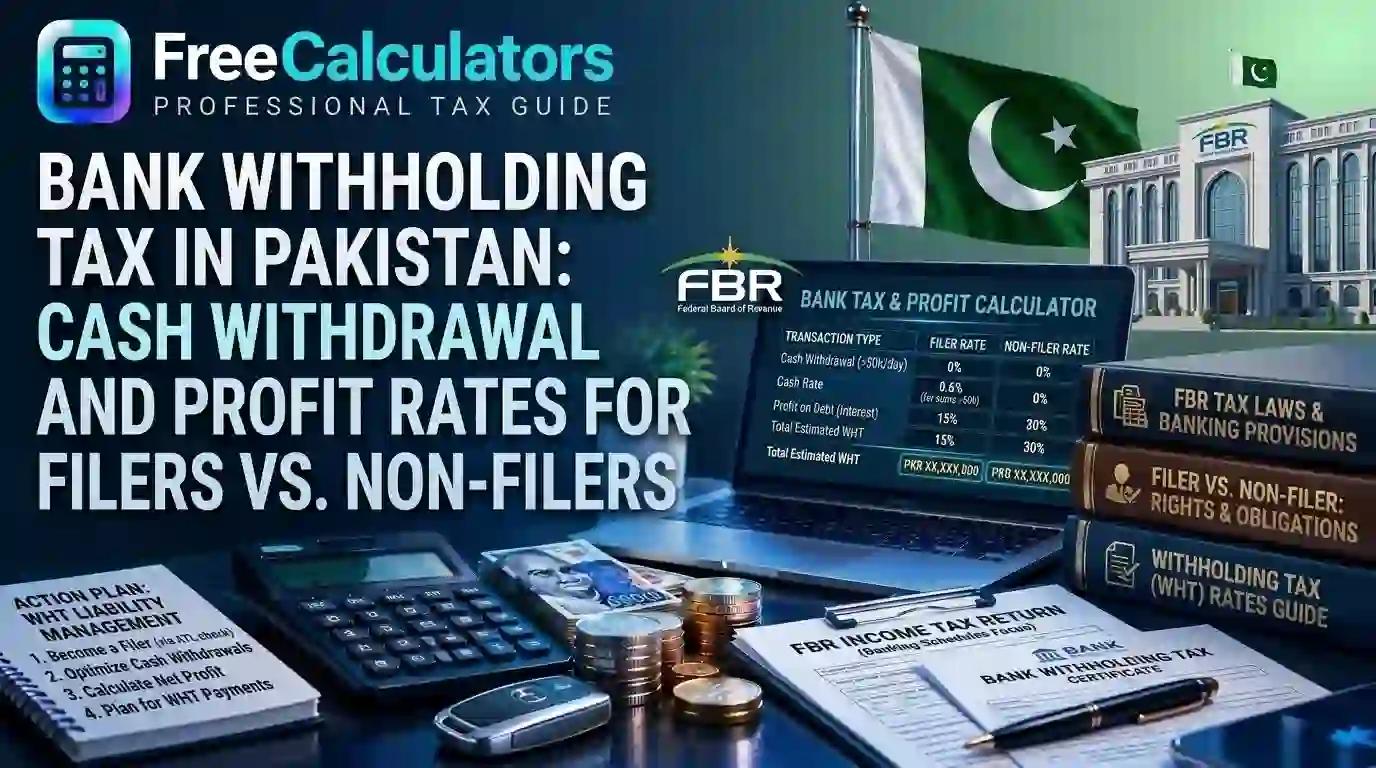
You take out a big wad of cash , and the bank slowly chips away at it . Or your monthly savings benefit shows up in your account and it’s less than you thought. It is not a bank error either. Both are withholding taxes and the amount you pay is based on one factor – whether you are on the Active Taxpayer List.
It's not a minor difference. A non-filer can pay twice the tax as a filer on the same bank profit. For substantial cash withdrawals, the filer pays nothing.
This article covers both in simple English, including 2026-27 rates, worked examples and practical procedures to check and cut what the bank takes. You will also discover free calculators to test your own numbers.
What Is Bank Withholding Tax in Pakistan?
Bank withholding tax is income tax that banks deduct at source under the Income Tax Ordinance, 2001. Two deductions matter most for account holders in Tax Year 2027 (July 2026 to June 2027).
- Cash withdrawals (Section 231AB): Non-filers pay 0.8% when their cash withdrawals in a single day exceed Rs. 50,000. Filers pay 0%.
- Bank profit (Section 151): Filers pay 20% and non-filers pay 40% on profit from ordinary bank deposits.
Both deductions depend on Active Taxpayer List (ATL) status, and your bank checks it at the time of deduction.
What Is Bank Withholding Tax in Pakistan?
Withholding tax is pay as you go system. Instead of waiting for you to pay tax at year end, government requires some payers deduct tax in advance and submit it to FBR. The bank is the withholding entity.
This is seen at two moments. The tax is deducted from the profit before it is credited to you by the bank. So if you go and withdraw a huge quantity of cash, the bank will take the tax out of the withdrawal.
The amount you claim is a credit against your final tax bill, depending on the section you are in and the sort of taxpayer you are. The tax on cash withdrawals is paid in advance and is adjusted against your annual tax. Debt profit is more nuanced, which we’ll examine below.
If terms like "adjustable," "final tax," or "withholding agent" feel unfamiliar, our essential tax terms glossary explains them without jargon. For a wider view of how withholding works across other payments, read Pakistan withholding tax explained.
Why This Matters More Than It Looks
Small percentages hide big rupee amounts. Three reasons this deserves attention:
- It compounds quietly. A deduction on every profit credit or large withdrawal adds up over twelve months.
- It can double or vanish based on one status. Filer or non-filer changes the outcome more than any other factor you control.
- It affects your real return. A deposit that earns 10% on paper delivers far less after tax, and the gap between filer and non-filer is wide.
The same status also shapes taxes outside banking. For example, vehicle registration tax triples for non-filers, which we cover in filer vs non-filer vehicle tax in Pakistan. For the general picture, see filer vs non-filer in Pakistan.
The Two Bank Deductions at a Glance
| Cash withdrawal tax | Bank profit tax | |
|---|---|---|
| Section | 231AB | 151 |
| Applies to | Cash you withdraw | Profit on deposits |
| Filer (ATL) | 0% | 20% |
| Non-filer (non-ATL) | 0.8% | 40% |
| Trigger | Daily cash above Rs. 50,000 | Every profit credit |
| Who deducts | Your bank | Your bank |
Keep this table in mind. The rest of the article explains each column in detail.
Cash Withdrawal Tax in Pakistan (Section 231AB)
What It Is
Banks are required under Section 231AB to deduct advance tax from those not on the Active Taxpayer List (ATL) when they withdraw cash. Section 231AB is applicable solely to non-ATL persons and the rate is 0.8% if cash withdrawals in a single day crosses Rs. 50,000.
It has a history too. Finance Act, 2021 has deleted an earlier clause on cash withdrawal, which was Section 231A. The Finance Act 2023 then brought back the tax on cash withdrawals for non-filers through a new Section 231AB at 0.6% which was increased from 1 July 2025 by the Finance Act 2025 to 0.8%.
Did Anything Change for 2026-27?
No. A review of the Finance Act 2026 found no mention of Section 231AB, and FBR's rate card updated to 30 June 2026 still shows 0.80% in the non-ATL column and nothing for ATL. So for Tax Year 2027 the rule is the same as last year: 0.8%, Rs. 50,000 a day, non-filers only.
How the Rs. 50,000 Threshold Really Works
Most people get this wrong, so read carefully.
- It's a daily total. All cash taken out on the same day is added together across counter, ATM, and card withdrawals, including across accounts at that bank. Three withdrawals of Rs. 20,000 count the same as one Rs. 60,000 withdrawal.
- It isn't a free allowance. Once the day's total passes Rs. 50,000, the 0.8% applies to the whole amount withdrawn, not only to the excess.
- Exactly Rs. 50,000 is safe. The tax starts when the day's total exceeds Rs. 50,000.
Cash Withdrawal Tax Examples (Non-Filer)
| Cash withdrawn in one day | Tax at 0.8% | Filer pays |
|---|---|---|
| Rs. 40,000 | Rs. 0 | Rs. 0 |
| Rs. 50,000 | Rs. 0 | Rs. 0 |
| Rs. 60,000 | Rs. 480 | Rs. 0 |
| Rs. 100,000 | Rs. 800 | Rs. 0 |
| Rs. 250,000 | Rs. 2,000 | Rs. 0 |
| Rs. 500,000 | Rs. 4,000 | Rs. 0 |
A non-filer who withdraws Rs. 200,000 in cash every month pays Rs. 1,600 each time, or Rs. 19,200 over a year. It's not dramatic on its own, but it's completely avoidable.
Is Cash Withdrawal Tax Refundable?
Not as a direct refund, but it's not lost either. The section treats it as advance adjustable tax, which means you can claim it against your tax bill when you file a return. If you're a non-filer who later files, you can use the deducted amount as a credit toward your liability.
Try the numbers on the Pakistan withholding tax calculator. For the broader concept, how advance tax is calculated in Pakistan explains why "advance" tax isn't an extra tax.
Tax on Bank Profit in Pakistan (Section 151)
What It Covers
Section 151 covers tax on profit on debt. For an ordinary customer, that means profit paid by a bank or financial institution on savings accounts, profit-bearing accounts, term deposits, and fixed deposits. You pay tax on the profit, not on your principal.
The 2026-27 Rates
For profit paid by a banking company or financial institution on an account or deposit, the withholding rate is 20% for a person on the ATL and 40% for a person not on it. FBR lists its Tax Year 2027 rate card as updated through 30 June 2026 under the Finance Act 2026.
| Taxpayer status | Bank deposit profit tax |
|---|---|
| Filer (ATL) | 20% |
| Non-filer (non-ATL) | 40% |
Why Some Pages Still Say 15%
You may see older articles quoting 15% for filers and 30% for non-filers. That was the earlier bank-deposit rate. The Finance Act 2025 moved bank deposits to 20%, while certain other categories, such as National Savings instruments and government securities, stayed at 15% for filers, with non-ATL treatment of 30% to 40% depending on the category.
So the rule of thumb is simple: identify the instrument before you pick the rate. A savings account and a government security aren't taxed the same way.
Bank Profit Tax Examples
| Gross profit | Filer tax (20%) | Non-filer tax (40%) | Extra cost of non-filer status |
|---|---|---|---|
| Rs. 50,000 | Rs. 10,000 | Rs. 20,000 | Rs. 10,000 |
| Rs. 100,000 | Rs. 20,000 | Rs. 40,000 | Rs. 20,000 |
| Rs. 250,000 | Rs. 50,000 | Rs. 100,000 | Rs. 50,000 |
| Rs. 500,000 | Rs. 100,000 | Rs. 200,000 | Rs. 100,000 |
What This Does to Your Real Return
Take a Rs. 3 million term deposit that earns an illustrative 10% a year, which is Rs. 300,000 in gross profit. The rate is only an example, since bank rates vary.
- Filer: Rs. 60,000 tax, Rs. 240,000 kept, so an effective return of 8%.
- Non-filer: Rs. 120,000 tax, Rs. 180,000 kept, so an effective return of 6%.
Same deposit, same bank, same profit rate. The only difference is Rs. 60,000 a year.
Is Bank Profit Tax Final or Adjustable?
This is where the answer depends on who you are. For individuals and AOPs with covered profit on debt up to Rs. 5 million, Sections 7B and 8 apply, and the tax is treated as final. Above Rs. 5 million, or for companies, the return treatment changes.
Don't assume the same rules apply to your case. Before claiming a credit or refund, confirm the treatment in your IRIS return or with a qualified professional. Our FBR IRIS income tax return guide shows where profit on debt goes in the return.
Zakat Is a Separate Deduction
If you see both zakat and tax on your statement, they aren't the same thing. Zakat is a religious obligation handled under its own rules, and income tax is governed by the Income Tax Ordinance. To understand the religious side, see how to calculate zakat on savings, gold, and business assets and the zakat nisab guide for 2026.
Filer vs Non-Filer: The Full Picture
Let's put both deductions together for one person over a year. Suppose someone earns Rs. 300,000 in annual bank profit and withdraws Rs. 200,000 in cash once a month.
| Item | Filer | Non-filer |
|---|---|---|
| Bank profit tax | Rs. 60,000 | Rs. 120,000 |
| Cash withdrawal tax (12 × Rs. 200,000) | Rs. 0 | Rs. 19,200 |
| Total bank withholding | Rs. 60,000 | Rs. 139,200 |
Difference: Rs. 79,200 a year, purely from ATL status.
That's before counting other costs. Non-filers also pay more on vehicles, property, and several other transactions. Our guide to filer vs non-filer in Pakistan covers the wider cost, and the Pakistan property tax calculator complete guide shows the same pattern in real estate.
How ATL Status Works at the Bank
Understanding timing saves money. Banks check your CNIC or NTN against the ATL database at the time of each deduction, not once a year. That means your status can change mid-year, for example if you file late or drop off the list.
Three practical consequences follow:
- Being on the list on the day matters. A withdrawal or profit credit is taxed according to your status when it happens.
- Filing a return and appearing on the ATL are related but separate. Don't assume the list updated the moment you filed. Verify it.
- Check before big transactions. If you're planning a large cash withdrawal or expect a profit payout, confirm your status first.
To confirm where you stand, use our ATL 2026 guide and the official FBR website.
How to Become a Filer (and Get Onto the ATL)
The process is simpler than most people fear.
- Get your NTN if you don't have one. Our guide to what an NTN is explains the number and how it works.
- Register and log in to FBR IRIS. Read what the FBR IRIS portal is if it's your first time.
- File your income tax return. Follow the FBR IRIS income tax return guide.
- Confirm your name appears on the ATL before your next large withdrawal or profit credit.
The full walkthrough is in how to become a tax filer in Pakistan. If you're a student, start with student FBR registration in Pakistan. Freelancers can also read the freelancer income tax rules in Pakistan.
Deadlines matter here. Individual returns have traditionally been due at the end of September, so check the latest position in our FBR tax filing deadline 2026 guide.
How to Check What Your Bank Deducted
Don't judge by the net amount in your account. Collect the paperwork:
- The bank's annual tax certificate or profit statement. Banks issue an annual certificate showing how much tax was deducted.
- Your monthly statements, which show gross profit, tax deducted, and net credited.
- Your IRIS records, so you can compare what the bank reported with what FBR shows against your CNIC or NTN.
If the numbers don't match, find out why before assuming an error. Common reasons include a CNIC or NTN mismatch, ATL status on the deduction date, or a different type of investment than you thought.
Claiming What You're Entitled To
Deducted tax isn't always a permanent loss. Here's the general approach:
- Report your bank profit and the tax deducted in your return. Don't skip it just because the bank already deducted tax.
- Claim credit for adjustable tax, such as Section 231AB cash withdrawal deductions, where the law allows it.
- Check the treatment of profit on debt. Up to Rs. 5 million for individuals it's generally final, but confirm for your situation.
- Keep every certificate. Without documents, you can't support a claim.
Not sure what to expect? Calculate your tax before meeting an accountant, and you'll get better advice from your tax professional. You can estimate your annual liability with the FBR tax calculator for Pakistan and the income tax calculator. Salaried readers can also use the salary tax calculator, and the FBR tax on salary 2026-27 guide explains what's deducted from your pay.
If you get a query from FBR after filing, see how to respond to an FBR tax notice in 2026.
Legitimate Ways to Reduce Your Bank Tax
You can't avoid withholding tax entirely, but you can avoid paying more than the law requires.
- Stay on the ATL. It's the biggest lever, cutting the profit tax rate from 40% to 20% and removing cash withdrawal tax completely.
- Withdraw less cash if you're a non-filer. Digital transfers and cheques don't trigger the cash withdrawal deduction.
- Split nothing artificially. The daily total is aggregated, so splitting withdrawals across counters and ATMs on the same day doesn't help.
- Compare instruments. Government securities and National Savings can carry a different rate than bank deposits, but the right choice depends on your goals, risk, and liquidity. Compare after-tax returns, not gross rates.
- Check exemptions. Some income and taxpayers qualify for relief. See FBR tax exemptions in Pakistan.
- Plan your slab. Knowing where you stand helps, so read the FBR tax slabs 2026-27 explained.
If you also invest in property or shares, remember that gains have their own rules. See capital gains tax on property and stocks in Pakistan.
Common Mistakes That Cost Account Holders Money
- Applying 20% to every investment. The rate depends on the instrument.
- Using an old rate chart. Always check the current FBR rate card.
- Assuming filing equals ATL status. Verify the list itself.
- Ignoring the tax certificate. It's the proof you need at return time.
- Skipping bank profit in the return. Report it even if tax was deducted.
- Confusing zakat with tax. They're separate deductions.
- Forgetting the daily total. Multiple small withdrawals in one day add up.
For a broader checklist, use the tax season checklist for Pakistan 2026.
Why Choose Free Calculators?
Withholding tax looks simple until you have several accounts, different instruments, and changing ATL status. A wrong assumption can cost thousands of rupees a year, and manual math invites errors.
That's why Free Calculators exists: to turn Pakistani tax rules into clear numbers, free of charge. For this topic, these tools work together:
- Pakistan withholding tax calculator for bank deductions
- FBR tax calculator for Pakistan for your overall liability
- Income tax calculator and salary tax calculator for your bracket
- Pakistan property tax calculator and vehicle token tax calculator to see how filer status affects big purchases
Browse the full tools hub or the blog library for more guides. Learn about the writer on the Noor Lodhi author page, read how to use our estimates in the disclaimer, and reach us on the contact page.
Want to see how our estimates compare with the official system? Read Pakistan tax calculator vs FBR IRIS.
Where to Keep Learning
Free and official:
- FBR Withholding Tax Rate Card for current rates
- Finance Act 2026 on FBR for the enacted law
- FBR IRIS portal to file returns and view your records
- FBR homepage for notifications and circulars
Paid, if you want personal help: a registered tax advisor or chartered accountant can check your ATL status, reconcile your bank certificates, and prepare your return, especially useful if your profit is above Rs. 5 million or you hold several instruments.
Frequently Asked Questions
What is bank withholding tax in Pakistan?
It's income tax that banks deduct at source, mainly on cash withdrawals by non-filers (Section 231AB) and on profit from deposits (Section 151). The bank acts as the withholding agent and sends the tax to FBR.
How much tax do banks deduct from profit in 2026-27?
On ordinary bank deposits, banks deduct 20% from filers and 40% from non-filers. Other instruments, such as some government securities and National Savings products, can carry different rates, so check the category.
What is the cash withdrawal tax for non-filers?
It's 0.8%, charged when a non-filer's total cash withdrawals in a single day exceed Rs. 50,000. The rate applies to the whole withdrawal. Filers pay nothing.
Do filers pay tax on cash withdrawals?
No. Under Section 231AB, filers appearing on the Active Taxpayer List have no cash withdrawal deduction, no matter how much cash they take out.
Is bank profit tax adjustable?
It depends. For individuals and AOPs with profit on debt up to Rs. 5 million, the tax is generally treated as final. Above that, or for other taxpayer types, the treatment differs, so confirm in your IRIS return or with a tax professional. Cash withdrawal tax, by contrast, is advance adjustable.
How can I check my ATL status?
Verify it on FBR's official system or follow our ATL 2026 guide. Check before large withdrawals or profit payouts, because banks apply your status at the time of deduction.
Conclusion:
Bank withholding tax comes down to one status and two numbers. If you're on the Active Taxpayer List, you pay 20% on ordinary bank profit and nothing on cash withdrawals. If you're not, you pay 40% on profit and 0.8% on daily cash withdrawals above Rs. 50,000.
Here's a simple plan:
- Today: Check whether your name is on the ATL.
- This week: Collect your bank's tax certificate and compare it with your monthly statements.
- This month: If you're a non-filer, become a filer and file your return through IRIS.
Ready to go deeper? Book a seat at Advance Free Tools offered by Free Calculators and explore more advanced tax tools to plan your banking, income, and investments with confidence.