
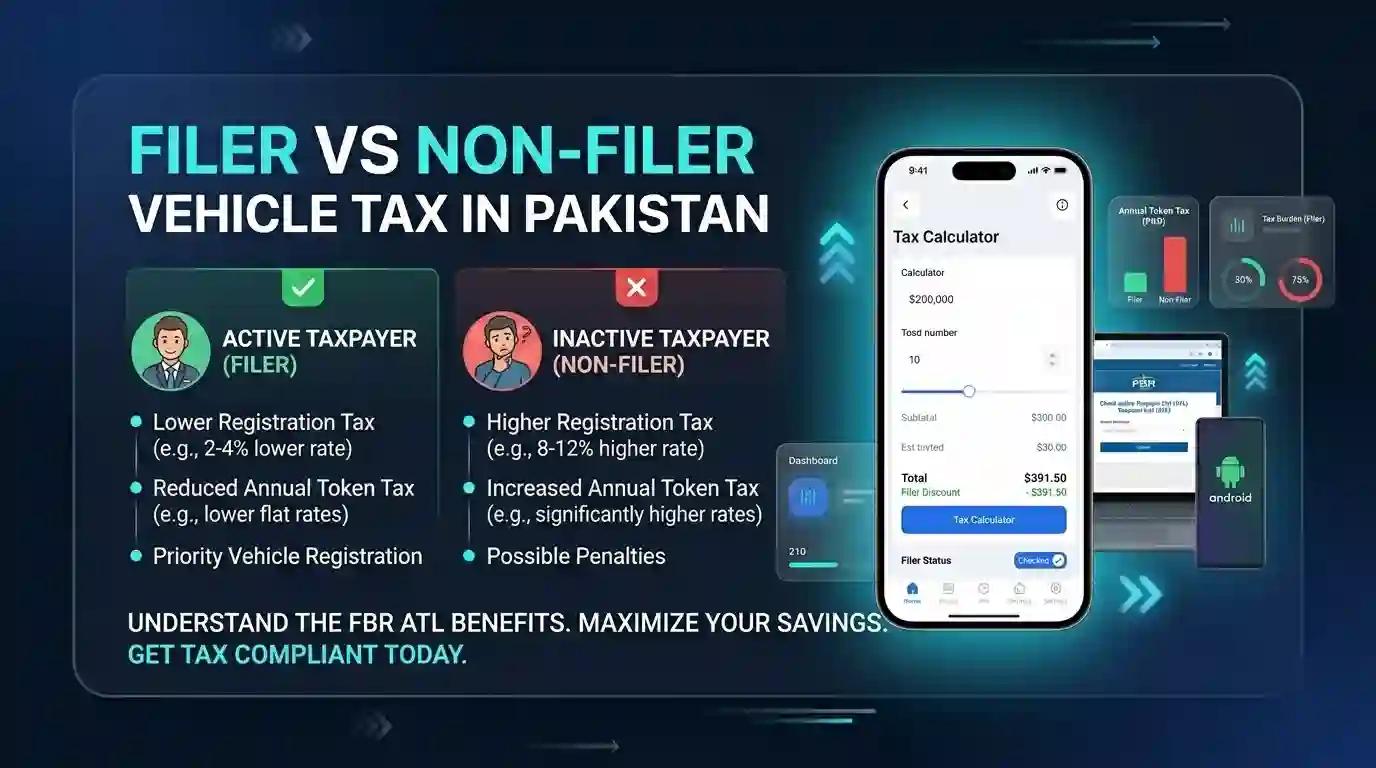
If you own a car in Pakistan — or are planning to buy one — there is one question that can save you thousands of rupees every single year: Are you a tax filer or a non-filer?
Most people in Pakistan assume vehicle tax is the same for everyone. It is not. Your FBR filing status directly determines how much you pay when you register a new car, how much token tax you owe every year, and even how much you pay when transferring ownership of a used vehicle. The difference is not small — non-filers often pay double what filers pay on the same car, with the same engine size, on the same road.
This guide breaks down everything you need to know about the filer vs non-filer vehicle tax difference in Pakistan — from registration fees and withholding tax to token tax rates across Punjab, Sindh, KPK, and Islamabad — with real numbers, legal references, and practical steps you can take right now.
What Is a Tax Filer and Non-Filer in Pakistan?
Before jumping into the numbers, it is important to understand who exactly is a filer and who is a non-filer in Pakistan's tax system.
A tax filer (also called an ATL filer) is a person whose name appears on the FBR Active Taxpayer List (ATL). This means they have filed their annual income tax return with the Federal Board of Revenue and are considered compliant taxpayers.
A non-filer is anyone who does not appear on the ATL — either because they have never filed a tax return or because their most recent return was not accepted or processed by FBR.
You can check your ATL status at any time by visiting the official FBR website at fbr.gov.pk and searching your CNIC on the Active Taxpayer List. This one check can tell you immediately whether you are paying filer or non-filer rates on your vehicle.
The difference in rates is not a minor adjustment. Under the Income Tax Ordinance 2001, specifically through the Tenth Schedule, non-filers are subject to 100% increased withholding tax rates across almost every major transaction — and vehicle registration is one of the most significant.
What Is Vehicle Token Tax in Pakistan?
Vehicle token tax is the annual fee paid to your provincial Excise and Taxation Department that legally certifies your vehicle to operate on public roads for that financial year. Think of it as your vehicle's annual road licence.
The tax year in Pakistan runs from 1 July to 30 June. Every registered vehicle owner must pay their token tax within this period. If you pay the full annual amount on or before 31 August, you receive a 10% early payment rebate — a small but useful saving.
Token tax is governed under the Motor Vehicle Ordinance 1965 and is administered province-wise by:
- Punjab — Excise and Taxation Department Punjab (excise.punjab.gov.pk)
- Sindh — Excise, Taxation and Narcotics Control Department Sindh (excise.gos.pk)
- KPK — Excise and Taxation Department KPK (excise_taxation.kp.gov.pk)
- Islamabad / Federal — ICT Excise and Taxation (follows Federal WHT schedule under Section 231B)
Token tax rates are determined by engine capacity in CC and your filer or non-filer status. This is where the big difference lies.
For a detailed, province-specific calculation, you can use the free Vehicle Token Tax Calculator at Free Calculators to get exact figures instantly.
What Is Vehicle Registration Fee in Pakistan?
When you buy a brand-new car and register it for the first time, you pay a one-time registration fee. This is separate from your annual token tax and is calculated as a percentage of your vehicle's invoice value.
Registration also involves withholding tax under Section 231B of the Income Tax Ordinance 2001, which is where the filer vs non-filer difference is most dramatic. This withholding tax is collected at the time of first registration and is adjustable against your final income tax liability at year-end — but only if you are a filer.
Section 231B — Advance Tax on Vehicle Registration (Filer vs Non-Filer)
Section 231B of the Income Tax Ordinance 2001 governs advance tax collected at the time of motor vehicle registration. It applies when:
- A new vehicle is registered for the first time by the Excise and Taxation Department
- Ownership of a vehicle is transferred (second-hand sale)
- A locally manufactured vehicle is sold by the manufacturer
The rates under Section 231B vary by engine capacity and whether you are a filer or non-filer. Here is the practical reality: non-filers pay exactly double what filers pay at registration.
The tax collected at registration is adjustable — meaning if you are a filer, you can claim it back or offset it against your total income tax liability when you file your annual return. For a non-filer, it is simply gone.
One important rule: under Section 231B, no advance tax is collected after five years from the first registration date of a vehicle in Pakistan. Additionally, vehicles that are 10 years or older are fully exempt from withholding tax under both Section 231B and Section 234. However, these older vehicles still pay 75% of the regular annual token tax.
Section 234 — Annual Token Tax Withholding (Filer vs Non-Filer)
Section 234 of the Income Tax Ordinance 2001 governs withholding tax collected annually at the time of token tax payment. This is the recurring charge that affects every vehicle owner every year.
KPK, for example, applies its token tax withholding under Section 234. The filer advantage here is substantial and is clearly felt at every annual renewal.
Filer vs Non-Filer Token Tax Rate Comparison — Province by Province
Here is a clear comparison of how much filers and non-filers pay in annual token tax across Pakistan's major provinces. These are FY 2025–26 rates:
Token Tax in Islamabad (ICT) — Section 231B Rates
Islamabad follows the Federal Withholding Tax schedule, which is among the most progressive:
Token Tax in KPK — Section 234 Rates
KPK applies withholding tax under Section 234. The filer advantage is identical in percentage terms — filers pay exactly half:
Token Tax in Punjab
Punjab's token tax rates for private motor cars follow engine capacity brackets under Excise Punjab regulations. Non-filers across all brackets pay significantly more than ATL-registered filers. You can calculate your exact Punjab token tax using the Punjab Token Tax Calculator at Free Calculators.
Token Tax in Sindh / Karachi
Sindh administers its vehicle tax through the excise.gos.pk portal. For new cars up to 1000cc, a one-time lifetime token tax of Rs. 20,000 applies. Motorcycles up to 149cc pay just Rs. 80 per year. For 2000cc and above vehicles: Rs. 12,000 for filers and Rs. 24,000 for non-filers annually. Use the Sindh Car Token Tax Calculator for accurate Sindh-specific figures.
Real-World Example: How Much Can You Save by Being a Filer?
Let's take a concrete example that most Pakistani car owners can relate to.
Scenario: You own a 1300cc private car registered in Islamabad.
- If you are a filer: Annual withholding tax = Rs. 2,500
- If you are a non-filer: Annual withholding tax = Rs. 5,000
- Annual saving by being a filer: Rs. 2,500
Over 10 years, that is Rs. 25,000 saved on this one vehicle alone — just by filing your income tax return.
Now scale that to a 1800cc car in KPK:
- Filer pays: Rs. 6,000 per year
- Non-filer pays: Rs. 12,000 per year
- Annual saving: Rs. 6,000
And for a higher-capacity vehicle at registration time, the savings at the Section 231B stage can run into tens of thousands of rupees in a single transaction.
How Does Becoming a Filer Reduce Vehicle Token Tax?
This is the most important practical question. The answer is straightforward.
When your name appears on the FBR Active Taxpayer List (ATL), every provincial Excise and Taxation Department — whether you are in Lahore, Rawalpindi, Faisalabad, Multan, Karachi, Peshawar, or Islamabad — applies the lower filer rate to your vehicle's annual token tax.
The Excise Department checks your CNIC against the ATL database when you generate your PSID (Payment Slip ID) for token tax payment. If your CNIC is on the ATL, you get the filer rate. If not, you automatically get the non-filer rate — which is double in almost every bracket.
To become a filer, you need to:
- Register with FBR and obtain your NTN (National Tax Number)
- File your annual income tax return through the FBR IRIS portal
- Your name appears on the ATL within 24–48 hours of successful filing
For a complete, step-by-step guide on this process, read our detailed article on how to become a tax filer in Pakistan.
What Is Withholding Tax on Vehicles and Is It Refundable?
Vehicle withholding tax — collected under Section 231B at registration and Section 234 at annual token renewal — is technically an advance tax. For filers, it is adjustable against your final income tax liability at the end of the year.
This means if you are a filer and your total income tax liability for the year is, say, Rs. 50,000 — and Rs. 10,000 was deducted as vehicle withholding tax throughout the year — your net payable to FBR is only Rs. 40,000. If more was deducted than you owe, FBR will refund the difference after you file your return.
For non-filers, there is no such offset or refund. The withholding tax collected is a final cost — and it is double the rate to begin with.
This is one of the most financially meaningful benefits of being a registered taxpayer in Pakistan, and it is one of the strongest reasons to file your tax return even if your income is modest.
Vehicle Tax Exemptions in Pakistan
Not all vehicles and vehicle owners are treated the same. Here are the key exemptions you should know:
Vehicles 10 Years or Older: Fully exempt from withholding tax under both Section 231B and Section 234. However, they still pay 75% of the standard annual token tax.
Motorcycles: Exempt from withholding tax (income tax component). In KPK, motorcycles pay a one-time lifetime token tax. In Sindh, the annual rate is just Rs. 80 for bikes up to 149cc.
Government Vehicles: Exempt from withholding tax.
Vehicles Acquired from the Armed Forces: Special provisions apply regarding the date of first registration.
5-Year Rule: Under Section 231B, no advance tax is collected on vehicle registration or transfer after five years from the date of first registration in Pakistan. This means used cars older than five years do not attract the Section 231B withholding tax at time of transfer.
For commercial vehicle tax, rates are determined by seating capacity rather than engine size. Goods transport vehicles and passenger transport vehicles follow different schedules under FBR rules.
Capital Value Tax (CVT) on Vehicles in Pakistan
The Capital Value Tax (CVT) is a federal tax applied during the transfer of ownership of certain vehicles. Under recent Finance Act amendments, CVT has been adjusted and currently applies to vehicles above a certain value threshold.
CVT under Section 231B also benefits from a 10% annual reduction following the first year of registration in Pakistan — meaning the CVT component decreases each year you hold the vehicle.
How to Pay Vehicle Token Tax Online in Pakistan
Paying your vehicle token tax online is now straightforward across all provinces:
- Generate your PSID (Payment Slip ID) through your provincial Excise portal or app — ePay Punjab, excise.gos.pk for Sindh, or the ICT app for Islamabad
- Pay via any of these methods:
- Mobile banking apps (HBL, Meezan, UBL, etc.)
- 1Link ATM
- JazzCash or Easypaisa mobile wallet
- Bank counter using PSID
- Receive digital confirmation receipt as proof of payment
Punjab vehicle owners can use the MTMIS Punjab system and ePay Punjab for registration, token tax calculation, and payment. The Punjab Token Tax Calculator at Free Calculators simplifies this — select your vehicle type, engine capacity, and filer status to get your exact amount before heading to the portal.
For Islamabad, the ICT vehicle token tax calculator is available through the official ICT Excise app, and also through the Islamabad Token Tax Calculator at Free Calculators.
What Happens If Token Tax Is Not Paid on Time?
Missing your token tax payment has real consequences. The tax year runs July to June. If you pay the full annual amount by 31 August, you get a 10% rebate. If you miss this window, you lose the rebate. If you delay further into the year, you may face:
- Late payment penalties as prescribed by the provincial Excise and Taxation Department
- Additional fees if your vehicle was not registered within the prescribed period after purchase or import
- Inability to transfer ownership — sellers must clear all outstanding token tax dues before ownership transfer can be processed. The buyer cannot complete a transfer without a clean token tax record.
Filer vs Non-Filer: A Quick Summary Comparison Table
Why Becoming a Filer Is the Smartest Financial Move for Every Car Owner
Filing your FBR income tax return is not just a legal obligation — it is a direct financial benefit for every vehicle owner in Pakistan. The savings are immediate, recurring, and compounding over the years.
Consider the total picture:
- You save on annual token tax every year
- You save on Section 231B withholding at registration and transfer
- You can claim back adjustable tax at year-end
- You avoid penalties and restrictions that non-filers face across banking, property, and vehicle transactions
Most people assume filing is complicated. It does not have to be. The FBR IRIS portal has made online return filing accessible to individuals with salaried or business income. If you need a step-by-step walkthrough, our FBR IRIS Income Tax Return Guide walks you through the entire process in plain language.
You can also understand the broader filer vs non-filer comparison — beyond just vehicles — in our in-depth guide at Filer vs Non-Filer Pakistan.
FAQs — Filer vs Non-Filer Vehicle Tax Pakistan
What is the difference between filer and non-filer in vehicle tax Pakistan? A filer is registered on FBR's Active Taxpayer List (ATL) and pays the standard withholding tax rate on their vehicle. A non-filer pays double that rate under the Tenth Schedule of the Income Tax Ordinance 2001. This applies to both first-time registration (Section 231B) and annual token tax renewal (Section 234).
How much do non-filers pay extra on vehicle token tax in Pakistan? Non-filers pay exactly 100% more — double the filer rate — on withholding tax for vehicle registration and token tax in Pakistan. For example, a 1300cc car owner in Islamabad who is a filer pays Rs. 2,500 annually, while a non-filer pays Rs. 5,000 for the same vehicle.
Is withholding tax on vehicles refundable for filers? Yes. Withholding tax on vehicles is an advance tax for filers and is fully adjustable against your final income tax liability. If excess tax was deducted, FBR refunds the difference upon filing your annual return. For non-filers, the tax is a final non-refundable cost.
Are vehicles older than 10 years exempt from withholding tax in Pakistan? Yes. Under the Income Tax Ordinance 2001, vehicles that are 10 years or older from their date of first registration in Pakistan are fully exempt from withholding tax under Section 231B and Section 234. However, they still pay 75% of the regular annual token tax amount.
What is the early payment rebate on token tax in Pakistan? If you pay the full annual token tax on or before 31 August of the financial year, you receive a 10% rebate on the total amount due. This applies across Punjab and other provinces.
Can a non-filer register a car in Pakistan? Yes, a non-filer can register a car in Pakistan. However, they will pay double the withholding tax rate at the time of registration under Section 231B compared to a filer. There is no restriction on registration — only a significant financial penalty in the form of higher tax rates.
What is PSID in vehicle tax payment? PSID stands for Payment Slip ID. It is a unique 6 to 8-digit number generated when you calculate your vehicle tax through your provincial Excise portal. You use this PSID to make payment through mobile banking, ATM, JazzCash, Easypaisa, or a bank counter.
Does filer status apply to commercial vehicle tax in Pakistan? Yes. Filer status affects commercial vehicle tax as well, though the rates for commercial and passenger transport vehicles are determined by seating capacity rather than engine size. Non-filers still pay significantly higher rates across commercial vehicle categories.
Conclusion — Your Vehicle Tax Is in Your Hands
The vehicle tax system in Pakistan rewards compliance. Becoming a tax filer on FBR's Active Taxpayer List is not complicated, and it does not require a high income. What it does require is filing your annual income tax return — and the financial return on that action is immediate and real.
Every year you remain a non-filer, you are paying double on your vehicle's token tax. Every time you register or transfer a vehicle as a non-filer, you are paying double in withholding tax — with no ability to claim it back.
The good news is that fixing this is entirely in your control.
Ready to stop overpaying on your vehicle tax? Start by calculating exactly how much you owe — and how much you can save — using the free tools at Free Calculators. The Vehicle Token Tax Calculator, Punjab Token Tax Calculator, Islamabad Token Tax Calculator, and Pakistan Withholding Tax Calculator are all free, instant, and built on the latest FY 2025–26 official rates.
Then take the next step: file your return, get on the ATL, and start paying what you should — not double.