
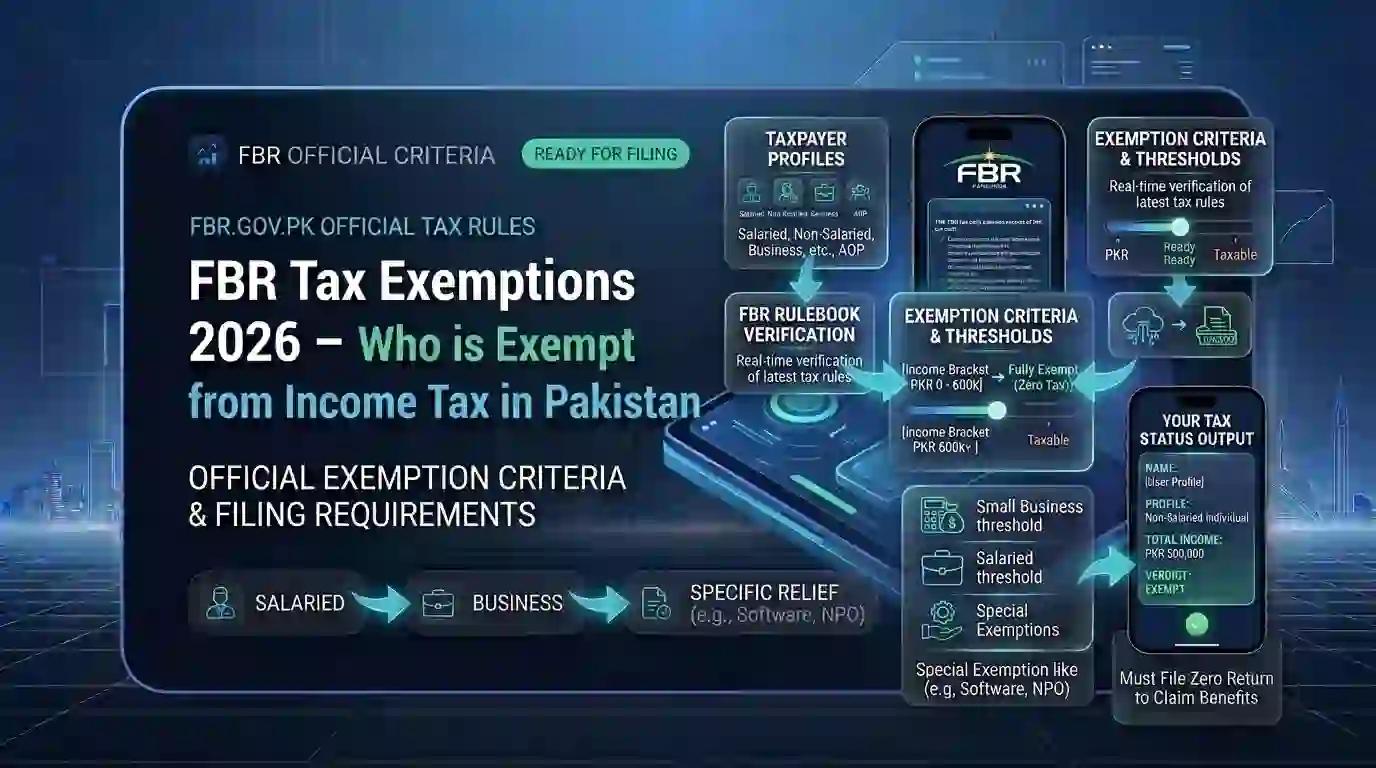
If you've ever looked at your payslip and wondered why so much of it disappears before you even see it, you're not alone. Millions of salaried and self-employed Pakistanis pay more income tax than they legally need to — simply because they don't know which exemptions actually apply to them.
As of the 2025-26 tax year, individuals earning up to Rs. 600,000 annually pay zero income tax, and several categories of people — including pensioners, certain freelancers, widows, senior citizens, and non-profit organizations — qualify for additional exemptions under the Income Tax Ordinance, 2001. This guide breaks down exactly who qualifies, how much you can legally save, and how to apply for exemption where required.
Note: Tax rules change through annual Finance Acts and FBR notifications (SROs), so always confirm current figures on the official FBR website before filing.
What Does "Tax Exempt" Actually Mean?
Before diving into categories, it helps to understand the terminology. A tax exemption means a specific portion of your income — or your income entirely, in some cases — isn't included when calculating how much tax you owe. This is different from a tax credit, which reduces the actual tax bill after it's been calculated, and different from zero-rating, which still requires reporting even though no tax is charged.
A tax exemption certificate in Pakistan is a formal recognition from tax authorities that grants specific individuals, entities, or transactions freedom from certain tax liabilities as permitted by law. Some exemptions apply automatically based on your income level or source of earnings, while others require you to actively apply for a certificate through the FBR IRIS portal.
Who Is Exempt from Income Tax in Pakistan in 2025?
Here's a breakdown of the major categories currently recognized under FBR rules.
1. Individuals Earning Below the Tax-Free Threshold
The exemption limit for salaried persons remains at Rs. 600,000 per year for the 2025-26 tax year. If your total annual income falls at or below this amount, you owe no income tax at all — no filing tricks or special applications needed, just straightforward compliance with the basic threshold.
For income above this limit, tax is calculated progressively, meaning you only pay higher rates on the portion of income that exceeds each bracket, not your entire salary.
2. Salaried Employees With Specific Allowances
Even if your gross salary exceeds Rs. 600,000, several components of your compensation package may be partially or fully exempt from tax:
- Medical Allowance — up to 10% of basic salary is exempt
- Conveyance Allowance — partially exempt when used specifically for official transport purposes
- Provident Fund Contributions — employer contributions to a recognized provident fund are generally exempt within prescribed limits
- Gratuity — exempt up to specified limits under the Income Tax Ordinance 2001
- Zakat Deduction — Zakat deducted at source under the Zakat and Ushr Ordinance is fully deductible from taxable income
This means your gross salary and your actual taxable salary can differ significantly once these deductions are applied. If you want to see exactly how these exemptions affect your take-home pay, our free Income Tax Calculator factors in these allowances automatically, and our Salary Tax Calculator gives a month-by-month breakdown.
3. Pensioners and Retirees
Retirement income enjoys strong protection under Pakistani tax law. Pensions from government or approved private schemes are generally exempt from income tax, meaning retirees relying on a standard pension typically don't owe tax on that income at all.
Additionally, pensions received by Pakistani citizens formerly employed by the UN or its specialized agencies are exempt, provided certain salary conditions during employment were met.
4. Senior Citizens
Senior citizens aged 60 and above, with retirement proof, may qualify for tax exemption in Pakistan. This category often overlaps with pension exemptions but can also apply to other income sources depending on documentation and eligibility criteria set by FBR.
5. Widows and Individuals Below Income Thresholds
Widows with verified status and income below the applicable threshold are among the categories eligible for tax exemption certificates in Pakistan. This exemption recognizes financial vulnerability and requires supporting documentation when applying through the IRIS portal.
6. Freelancers and IT Exporters
Pakistan's booming freelance and IT export sector receives meaningful tax relief. Income from exports of computer software, IT services, or IT-enabled services was exempt up to June 30, 2025, provided 80% of export proceeds are brought into Pakistan through banking channels.
For individual freelancers specifically, those with export income and proper Bank Realization Certificate (BRC) proof are eligible for exemption consideration. If you're earning through platforms like Upwork or Fiverr, understanding this exemption category could meaningfully reduce your tax burden — our detailed guide on freelancer income tax in Pakistan under FBR rules covers this in depth.
7. Non-Profit Organizations (NGOs and Trusts)
Registered non-profits don't automatically qualify for tax exemption just by existing — nonprofits must apply to FBR for approval under Section 2(36) and Clause 66 of the Second Schedule. Once approved, NGOs and trusts that are SECP registered with audited accounts become eligible for exemption certificates.
8. Teachers and Researchers
Teachers and researchers working in eligible institutions are recognized as a distinct category qualifying for tax exemption in Pakistan. This reflects a broader policy goal of supporting education and research sectors through favorable tax treatment.
9. Residents of Special Regions (Malakand, Swat, Gilgit-Baltistan)
Residents of Swat, Malakand, and Gilgit-Baltistan with local registration qualify for regional tax exemptions, reflecting Pakistan's policy of supporting economic development in specific geographic areas.
10. Foreign Remittances
If you're receiving money from relatives or income sources abroad, there's good news. Remittances sent through official banking channels up to PKR 5 million annually are exempt from income tax, and FBR typically does not require proof of source for these transfers. However, amounts exceeding this limit may be added to taxable income unless documentation proves it isn't income — such as gifts or loans.
11. Diplomats and International Organization Employees
Income earned by individuals entitled to privileges under the Diplomatic and Consular Privileges Act, 1972, or the United Nations Privileges and Immunities Act, 1948, is exempt to the extent provided by these specific acts.
12. Non-Residents Under International Tax Treaties
Any Pakistan-source income which Pakistan is not permitted to tax under a tax treaty is exempt from tax under the Ordinance. This typically applies to foreign contractors, consultants, or experts working on specific internationally-funded projects in Pakistan.
FBR Tax Slabs 2025-26: Where Exemptions Fit In
Understanding exemptions makes more sense once you see the full slab structure. Here's the current breakdown for salaried individuals:
Here's a quick breakdown of FBR income tax slabs for 2025-26 in Pakistan — Up to Rs. 600,000: 0% (tax-free), Rs. 600,001–1,200,000: 2.5%, Rs. 1,200,001–2,200,000: 11%, Rs. 2,200,001–3,200,000: 23%, Rs. 3,200,001–4,100,000: 30%, Above Rs. 4,100,000: 35%. Know your bracket, plan your savings.
The rate on the Rs. 600,000–Rs. 1,200,000 bracket dropped from 5% to 2.5%, and the Rs. 1,200,000–Rs. 2,200,000 bracket dropped from 15% to 11% under the Finance Act 2025, offering meaningful relief to middle-income earners.
To see exactly where your income falls and how much tax relief applies to you, use our FBR Tax Calculator Pakistan — it factors in the latest 2025-26 slabs automatically.
Real-World Example: How Exemptions Reduce Your Tax Bill
Consider someone earning Rs. 1,800,000 annually who claims Rs. 690,000 in total legitimate exemptions and deductions — including medical allowance, provident fund contributions, and Zakat. Their taxable income drops to Rs. 1,110,000 instead of Rs. 1,800,000, saving approximately Rs. 100,000 to Rs. 150,000 in annual taxes depending on exact slab calculations.
This example illustrates why understanding exemptions isn't just a compliance exercise — it directly affects how much money stays in your pocket every year.
How to Apply for an FBR Tax Exemption Certificate
If your exemption doesn't apply automatically (unlike the basic Rs. 600,000 threshold), you'll typically need to apply through official channels:
- Register or log in to the FBR IRIS Portal using your NTN (National Tax Number).
- Select the relevant exemption category — whether it's for withholding tax relief, NGO status, or individual exemption based on age, income, or profession.
- Submit supporting documentation — this may include proof of age, income statements, export proceeds records, or registration certificates depending on your category.
- Wait for verification — FBR reviews applications and issues certificates once eligibility is confirmed.
- Renew as required — most exemption certificates aren't permanent and need periodic renewal or reverification.
You must have an active NTN and filed tax return to qualify for most exemptions — so staying compliant with basic filing requirements is a prerequisite, not an alternative, to claiming exemptions.
If you're new to the filing process entirely, our step-by-step guide on how to become a tax filer in Pakistan walks through registration from scratch, and our breakdown of the FBR IRIS portal for tax filing explains how the system works in practice.
Filer vs Non-Filer: Why It Affects Your Exemption Eligibility
One critical detail people overlook: most exemptions require you to be an active filer — meaning you've filed your tax return and appear on FBR's Active Taxpayer List (ATL). Non-filers not only miss out on exemption eligibility but also face significantly higher withholding tax rates on banking transactions, property purchases, and vehicle registration.
If you're unsure about the practical difference this makes, our detailed comparison of filer vs non-filer status in Pakistan breaks down the real financial impact side by side.
Agricultural Income: A Special Case
Agricultural income occupies a unique position in Pakistan's tax system. Agriculture tax laws give broad exemptions to income derived from farming activities, with agricultural income tax governed by provincial authorities rather than the federal FBR. This means agricultural income is generally exempt from federal income tax, though provincial agricultural income tax may still apply depending on the province and income level.
Common Mistakes That Cause People to Miss Exemptions
- Not filing a tax return at all — even if you owe zero tax, filing keeps you on the Active Taxpayer List and preserves exemption eligibility for future years.
- Assuming gross salary equals taxable salary — many allowances and deductions reduce your actual taxable amount significantly.
- Missing documentation deadlines — exemption certificates often require proof (BRC for freelancers, retirement documents for pensioners) submitted within specific windows.
- Not renewing certificates — most exemption certificates aren't permanent and lapse without renewal.
- Overlooking Zakat and provident fund deductions — these are automatic exemptions many salaried employees forget to claim properly during filing.
FAQs About FBR Tax Exemptions in 2025
Who is exempt from income tax in Pakistan? Individuals earning up to Rs. 600,000 annually pay no income tax. Additional exemptions apply to pensioners, senior citizens, widows, certain freelancers with export income, registered NGOs, teachers, and diplomats, among other categories defined under the Income Tax Ordinance 2001.
What is the minimum taxable income in Pakistan for 2025? The tax-free threshold for salaried individuals in the 2025-26 tax year is Rs. 600,000 annually. Income above this amount is taxed progressively, starting at 2.5% for the next bracket.
Is agricultural income taxable in Pakistan? Agricultural income is generally exempt from federal income tax and falls under provincial jurisdiction instead. Provincial agricultural income tax rules vary and may apply depending on income level and province.
How do I apply for an FBR tax exemption certificate? Log in to the FBR IRIS portal with your NTN, select the relevant exemption category, submit required documentation, and wait for verification. Most exemptions also require you to be an active tax filer.
Is freelance income tax exempt in Pakistan? Freelancers earning through IT and software exports may qualify for exemption if they bring at least 80% of export proceeds into Pakistan through official banking channels, supported by valid Bank Realization Certificates.
Do non-profit organizations pay income tax in Pakistan? Not automatically. NGOs and trusts must apply to FBR for approval under Section 2(36) and Clause 66 of the Second Schedule before qualifying for tax-exempt status.
Final Thoughts
Understanding FBR tax exemptions isn't just about compliance — it's about making sure you're not overpaying on income that Pakistani law never intended to tax in the first place. From the basic Rs. 600,000 threshold to specialized categories like pensioners, freelancers, and NGOs, exemptions exist across nearly every type of income source.
The key is knowing which category applies to you, keeping proper documentation, and staying on the Active Taxpayer List through consistent filing — since most exemptions simply aren't available to non-filers.
Ready to see exactly how much tax you owe — or don't? Try our free Income Tax Calculator or FBR Tax Calculator Pakistan to get an accurate, up-to-date estimate based on the 2025-26 slabs and exemption rules.
For the complete legal text on exemptions, the Federal Board of Revenue's official Income Tax Ordinance 2001 documentation remains the authoritative source, and should always be checked directly before making final tax decisions.