
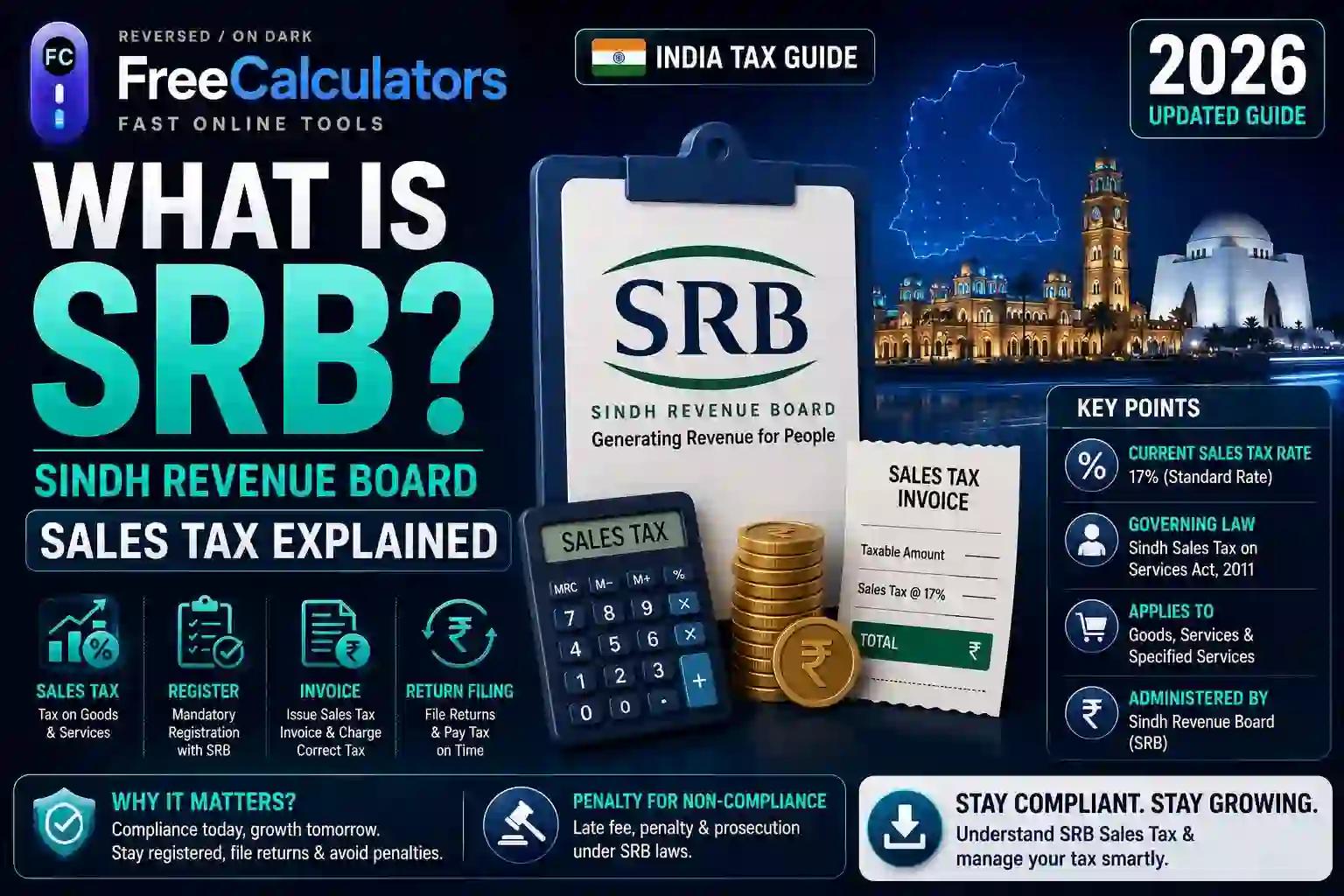
SRB stands for the Sindh Revenue Board — the provincial authority responsible for collecting sales tax on services rendered or provided within Sindh, Pakistan. It operates entirely separately from FBR, which handles sales tax on goods and federal income tax. For FY 2026-27, the standard SRB sales tax rate on services is 15%, with telecommunication services taxed higher at 19.5% and several sectors carrying their own reduced or specific rates. If you provide any kind of service within Sindh — consulting, IT, restaurants, freight, advertising, or dozens of other categories — understanding when SRB registration becomes mandatory is essential to avoid penalties. Here's exactly how the system works.
SRB vs FBR: The Distinction That Confuses Almost Everyone
This is genuinely the single most common point of confusion for new business owners in Pakistan, so it's worth resolving immediately. FBR (Federal Board of Revenue) collects sales tax on goods nationally, along with federal income tax. SRB, by contrast, is a provincial authority that collects sales tax specifically on services — and only for services rendered or provided within Sindh.
This split happened because, under Pakistan's constitutional structure, sales tax on services falls under provincial jurisdiction, not federal. Each province set up its own revenue authority to collect it, which is why Pakistan doesn't have a single unified sales tax on services — it has several, run independently.
The practical consequence: if you're a service provider based in Sindh, or providing services to a client in Sindh, you may need to register and file with SRB separately from any FBR sales tax obligations your business has for goods. These are two different registrations, two different filing systems, and two different sets of deadlines. If you want the full breakdown of how these two systems compare more broadly, our guide on income tax vs sales tax in Pakistan covers the federal-level distinction that this provincial layer sits on top of.
Pakistan's Provincial Sales Tax Landscape: SRB Isn't Alone
Sindh isn't unique in having its own revenue authority — every province runs one, and rates genuinely differ between them.
| Authority | Jurisdiction | Standard Rate on Services |
|---|---|---|
| SRB (Sindh Revenue Board) | Sindh | 15% (19.5% for telecom) |
| PRA (Punjab Revenue Authority) | Punjab | 16% |
| KPRA (Khyber Pakhtunkhwa Revenue Authority) | Khyber Pakhtunkhwa | 15% |
| BRA (Balochistan Revenue Authority) | Balochistan | 15% |
| ICT (Islamabad Capital Territory) | Islamabad | 15–16% |
The general principle governing which authority's rate applies: it's typically based on where the service is rendered, or where the recipient is located, rather than simply where your business is headquartered. A consulting firm based in Lahore serving a client in Karachi may need to register with SRB and apply Sindh's rate for that specific engagement, even though the firm itself is registered with PRA for its Punjab-based work. This place-of-provision logic is exactly where multi-province service businesses make invoicing errors — assuming their home province's rate applies universally, when it actually depends on where the service was actually delivered.
What Is the Current SRB Sales Tax Rate?
For FY 2026-27, following the Sindh Finance Act, 2026, the general standard rate for Sindh sales tax on services is 15%. A handful of sectors carry different rates:
- Telecommunication services (voice calls, SMS, internet, data): 19.5% — notably higher than the general rate
- Restaurants and cafes: 15% standard, reduced to 8% specifically for payments made via debit card, credit card, mobile wallet, or QR code scanning, as an incentive for digital payment documentation
- Hospitals and clinics: reduced rates apply in specific circumstances
- IT and IT-enabled services: often subject to reduced rates under specific notifications, distinct from the general services rate
These rates are revised periodically through the annual Sindh Finance Act or specific SRB notifications and circulars, so treating any rate as permanently fixed is a mistake — always confirm the current SRB tax rate directly against the latest Finance Act before finalizing invoices, particularly around the start of a new fiscal year when rate changes typically take effect.
Who Needs to Register With SRB?
SRB registration becomes mandatory once your business provides a taxable service within Sindh, as defined in the Second Schedule to the Sindh Sales Tax on Services Act, 2011. This schedule covers a genuinely broad range of service categories — consultants, advertising agencies, freight forwarders, IT companies, restaurants, marriage halls, beauty services, telecommunications, insurance, and many others.
A few practical scenarios that trigger registration:
- You operate a service-based business physically located in Sindh
- You provide services to clients located in Sindh, even if your business is headquartered elsewhere
- Your service category appears in SRB's Second Schedule list of taxable services
- You've crossed any sector-specific threshold that removes an otherwise-available exemption
If your specific service type isn't clearly listed, it's worth checking SRB's official taxable services page directly rather than assuming exemption — the schedule is detailed and periodically updated, and "I didn't think my service counted" is not a defense SRB accepts during an audit or penalty assessment.
Step-by-Step: How to Register With SRB
Step 1 — Determine if your service is taxable. Check your specific service category against SRB's Second Schedule. If you're unsure whether your exact service falls under a taxable category, this is worth confirming before proceeding, since misclassification creates compliance problems later.
Step 2 — E-register on the SRB portal. SRB registration is completed through their official e-registration system, requiring your business details, NTN (National Tax Number), and relevant business documentation. If you don't yet have an NTN, our guide on what is an NTN (National Tax Number) walks through that prerequisite step first.
Step 3 — Obtain your SRN (SRB Registration Number). Once approved, you're issued a registration number that identifies your business within the SRB system — this is what appears on your tax invoices and returns going forward.
Step 4 — File monthly returns. SRB-registered businesses file sales tax returns on a monthly basis, reporting taxable services provided and the sales tax collected, along with any applicable input tax adjustments.
Step 5 — Maintain proper records. Keep detailed records of invoices, service transactions, and tax collected — these need to be readily available in case of an SRB audit or verification request.
Filing SRB Sales Tax Returns
Registered businesses are required to file monthly returns reflecting their taxable service transactions for that period, along with the corresponding sales tax collected from clients. Filing is done through SRB's online portal, and the return needs to reconcile with the tax invoices issued during the period.
A few practical points worth understanding about the filing process:
- Input tax adjustment may be claimed in certain cases, similar in concept to how input tax works under federal sales tax — though the specific rules and eligibility depend on your service category and whether you've opted for reduced-rate schemes that restrict input tax claims.
- Withholding tax rules apply in specific situations under the Sindh Sales Tax Special Procedure (Withholding) Rules, meaning certain clients — particularly government entities or large withholding agents — deduct a portion of the tax directly at source rather than the service provider collecting the full amount themselves.
- Monthly deadlines are strict, and missing them triggers penalties that compound the longer a return goes unfiled — similar in principle to how missed deadlines work under FBR's own filing deadline system, just administered by a separate authority.
What Happens If You Don't Register or File With SRB?
Skipping SRB registration when you're legally required to register doesn't make the obligation disappear — it just means the tax, along with penalties and default surcharge, accumulates in the background until SRB catches up with your business, often during an audit, a tender application, or when a client's own compliance checks flag your business as unregistered.
Common consequences of non-compliance include:
- Monetary penalties for late or non-registration, calculated based on the duration of non-compliance
- Default surcharge accruing on unpaid tax amounts, similar to how interest accrues on unpaid federal tax
- Exclusion from SRB's Active Taxpayer List, which can disqualify your business from certain government tenders or contracts requiring active taxpayer status
- Audit exposure, since unregistered businesses providing clearly taxable services are a natural audit target once identified
If you're already behind on registration or filing, addressing it proactively — rather than waiting for SRB to identify the gap — generally results in a more favorable outcome than being caught during an audit.
SRB Exemptions: Are Any Services Excluded?
Yes — SRB does maintain a list of services that are conditionally or entirely exempt from sales tax, notified separately from the general taxable services schedule. Exemptions typically depend on specific conditions being met (such as being below a certain threshold, operating in a specific sub-category, or meeting particular documentation requirements), rather than blanket exemptions for entire service categories.
Because these exemption conditions change periodically and depend heavily on your exact service classification, it's worth verifying your specific situation against SRB's current notifications rather than assuming a general exemption applies. Businesses that assumed exemption without confirming the specific conditions are a recurring source of penalty cases.
SRB for Freelancers and Small Service Providers
A common question among freelancers and small service providers in Sindh: does SRB apply to me if I'm working independently rather than through a formal company? The answer depends on whether your specific service falls within the Second Schedule's taxable categories and whether you meet any applicable registration thresholds — freelance status alone doesn't automatically exempt you if your service type is listed as taxable.
Many freelancers providing services like IT consulting, design, or digital marketing to Sindh-based clients do fall within scope, and treating SRB registration as something that "only applies to big companies" is a genuinely risky assumption. If you're a freelancer navigating broader Pakistani tax obligations alongside this provincial layer, our guide on freelancer income tax and FBR rules in Pakistan covers the federal side of your compliance picture, which typically runs alongside — not instead of — any SRB obligation.
Checking Your SRB Registration Status
If you're unsure whether your business is currently SRB-registered, or want to verify a vendor's registration status before doing business with them, SRB provides online verification tools through their portal — checking by registration number, NTN, or CNIC depending on the entity type. This verification step is worth doing before finalizing contracts with new vendors, since dealing with an unregistered service provider who should be charging SRB tax can create complications on your own compliance side too.
Frequently Asked Questions
What is SRB in Pakistan? SRB (Sindh Revenue Board) is the provincial authority responsible for collecting sales tax on services rendered or provided within Sindh. It operates under the Sindh Sales Tax on Services Act, 2011, separately from FBR, which handles federal taxes and sales tax on goods.
What is the difference between SRB and FBR? FBR is the federal authority handling sales tax on goods and federal income tax nationwide. SRB is a provincial authority handling sales tax specifically on services rendered within Sindh. A business may need to register with both, depending on whether it deals in goods, services, or both.
Who needs to register with SRB? Any business or individual providing a taxable service within Sindh, as listed in the Second Schedule to the Sindh Sales Tax on Services Act, 2011, generally needs to register. This includes consultants, IT companies, restaurants, advertising agencies, and many other service categories.
What is the current SRB sales tax rate? For FY 2026-27, the general standard rate is 15%, with telecommunication services taxed at 19.5%. Some sectors, like restaurants using digital payment methods, qualify for reduced rates. Rates are revised periodically through the Sindh Finance Act, so current figures should always be confirmed against the latest notification.
Is SRB applicable to freelancers and service providers? Yes, if the specific service they provide falls within SRB's taxable services schedule and they meet applicable registration thresholds. Freelance or independent status doesn't automatically exempt a service provider if their service category is listed as taxable.
What happens if I don't register with SRB? Penalties, default surcharge on unpaid tax, and exclusion from the Active Taxpayer List can all result from failing to register or file when required. Addressing non-compliance proactively generally produces a better outcome than waiting to be identified during an SRB audit.
Bottom Line
SRB is a genuinely separate system from FBR, and treating it as an afterthought — or assuming your federal tax compliance automatically covers your provincial obligations — is one of the most common and costly mistakes service-based businesses in Sindh make. If you provide any kind of service within Sindh, checking your specific category against SRB's taxable services schedule and registering promptly if required will save you from penalties that compound the longer they go unaddressed.
To calculate exactly how sales tax affects your business income alongside your federal filing obligations, our Pakistan sales tax calculator and FBR tax calculator can help you model both layers together before you finalize pricing or invoices.
For the official, current SRB taxable services list, registration process, and rate notifications, the Sindh Revenue Board's official website remains the authoritative source to confirm before registering or filing.