If you've started a business in Pakistan or you're preparing to issue your first sales tax invoice, you've probably run into the term STRN and wondered what it actually means beyond "some tax number I need." It's one of those acronyms that gets thrown around constantly in FBR paperwork, yet rarely gets explained in plain language.
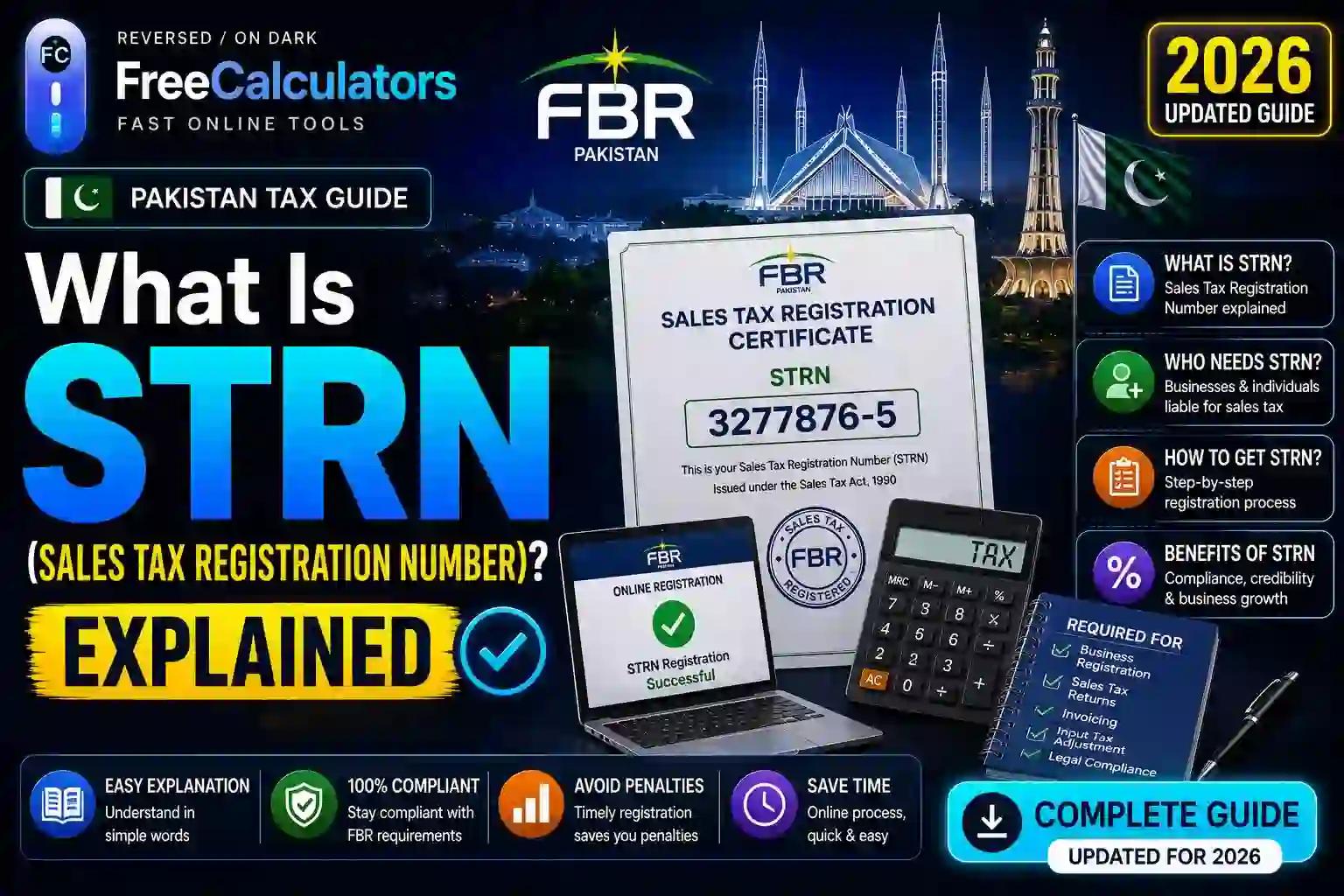
STRN stands for Sales Tax Registration Number. It's a unique identifier issued by Pakistan's Federal Board of Revenue (FBR) to businesses and individuals registered to collect and pay sales tax. Once issued, your STRN must appear on every tax invoice you generate, and it confirms to customers, suppliers, and tax authorities that your business is legally authorized to charge sales tax.
This guide breaks down what STRN actually does, how it differs from an NTN, who's required to get one, and the exact registration process through FBR's IRIS portal, so you're not left guessing halfway through a form.
What Does STRN Stand For?
STRN is short for Sales Tax Registration Number. Some older documents and provincial systems also refer to a similar concept as a GST number or GSTIN, but in Pakistan's federal system, STRN is the standard, current terminology used by FBR.
Every STRN is unique to the business or individual it's issued to. It functions as proof that you're a registered sales tax filer under the Sales Tax Act, 1990, and it's tied directly to your business's tax records inside the FBR system.
What Is STRN Used For?
An STRN isn't just a formality sitting in a file somewhere. It has real, practical functions in day-to-day business operations:
- Issuing valid tax invoices. A sales tax invoice without a valid STRN printed on it isn't considered compliant, and customers (especially other registered businesses) may refuse to accept it.
- Filing monthly sales tax returns. Your STRN is the login and reference identifier tied to your sales tax filings on the IRIS portal.
- Claiming input tax credit. Registered businesses can offset the sales tax they paid on purchases against the sales tax they collected from customers, but only if properly registered.
- Participating in government and corporate procurement. Many tenders and B2B contracts require a valid, verifiable STRN before a vendor is even considered.
- Avoiding penalties. Operating a taxable business without registering when required can trigger fines and legal notices from FBR.
STRN vs. NTN: What's the Difference?
This is genuinely one of the most confused pairs of terms in Pakistan's tax system, and it trips up a lot of new business owners.
In practice, your NTN comes first. You can't apply for an STRN without an existing NTN, since the IRIS system uses your NTN credentials to initiate the sales tax registration process. Think of NTN as your general tax identity and STRN as an additional registration layered on top, specific to businesses dealing in taxable supplies.
If this distinction is still fuzzy, our glossary on essential tax terms for beginners walks through NTN, STRN, and several other terms side by side in simpler language.
Who Needs to Register for an STRN?
Not every business or individual is required to get an STRN. Registration becomes mandatory under specific conditions:
- Manufacturers producing taxable goods.
- Importers, regardless of their annual turnover.
- Exporters, particularly those who intend to claim sales tax refunds.
- Wholesalers, dealers, and distributors of taxable goods.
- Businesses whose annual turnover exceeds FBR's registration threshold, which is periodically revised through Finance Act updates.
- Service providers registered under a provincial revenue authority (PRA in Punjab, SRB in Sindh, KPRA in Khyber Pakhtunkhwa, or BRA in Balochistan), where a similar but provincially administered registration applies.
Freelancers and salaried individuals typically don't need an STRN unless they're supplying taxable goods or services that push them into one of the categories above. If you're unsure whether your income falls into sales tax territory versus income tax alone, our comparison of income tax vs. sales tax in Pakistan explains how the two systems actually interact.
How to Register for an STRN: Step-by-Step Through the IRIS Portal
FBR has moved sales tax registration entirely online, which makes the process considerably faster than it used to be. Here's the full workflow.
1. Confirm you already have an NTN. If you don't, you'll need to register for one first. The FBR IRIS system won't let you begin STRN registration without an active NTN attached to your profile.
2. Log into the IRIS portal. Go to iris.fbr.gov.pk and sign in using your existing NTN credentials.
3. Navigate to the registration section. From your dashboard, select "Registration," then choose "Sales Tax Registration" from the available options.
4. Fill in your business details. This includes your business type (sole proprietor, partnership, or company), the nature of your supply (goods, services, or both), your estimated annual turnover, and your business bank account information.
5. Upload the required documents. Typically this includes your CNIC, proof of business address (utility bill or rental agreement), bank account maintenance certificate, and, depending on your business type, incorporation documents or partnership deeds.
6. Submit your application. Once submitted, FBR may reach out for verification, additional documents, or a biometric confirmation, depending on your business category and risk profile.
7. Wait for approval. Processing generally takes anywhere from a few days to about a week if your documentation is complete and accurate.
8. Download your STRN certificate. Once approved, your Sales Tax Registration Number becomes visible in your IRIS dashboard, and you can download or print the official certificate directly from the portal.
If you'd rather see the IRIS interface itself explained in more depth before diving in, our full walkthrough on what the FBR IRIS portal is and how tax filing works covers the dashboard layout and common navigation issues new users run into.
Documents Typically Required for STRN Registration
While exact requirements can vary slightly by business type, most applicants need to prepare:
- Valid CNIC (for individuals or business owners)
- NTN certificate
- Business bank account details and a bank maintenance certificate
- Proof of business premises (utility bill, rent agreement, or ownership documents)
- Partnership deed or incorporation certificate, if applicable
- Details of business activity and estimated turnover
Having these ready before you start the IRIS application significantly reduces back-and-forth delays with FBR's verification team.
How to Verify an STRN Number
Verification matters both for your own registration status and for checking whether a supplier's STRN is genuinely active before you accept their invoice. A supplier quoting a fake or inactive STRN can create real problems when you try to claim input tax credit later.
To verify an STRN:
- Visit the FBR verification portal or log into IRIS.
- Enter the STRN or the associated CNIC/NTN.
- Check the returned status, active, inactive, or suspended.
- Cross-check the registered business name against the invoice you received.
If you're dealing with a supplier whose STRN doesn't verify cleanly, it's worth pausing the transaction until it's resolved, since claiming input tax against an invalid registration can create compliance headaches during an audit.
What Happens After You Get an STRN?
Registration isn't the finish line, it's the starting point of an ongoing compliance obligation. Once your STRN is active, you're expected to:
- Charge sales tax on your taxable supplies at the applicable rate, generally 18% on most goods and services in Pakistan, though reduced rates and exemptions apply to specific categories.
- File monthly sales tax returns, typically due by the 15th of the following month.
- Maintain proper invoicing records, since every invoice you issue must display your STRN clearly.
- Track input and output tax, so you can accurately calculate what you owe versus what you can claim back.
For a closer look at which goods and categories fall outside the standard rate, our guide to FBR tax exemptions in Pakistan breaks down what's currently exempt under the Sixth Schedule.
Penalties for Not Registering When Required
Skipping STRN registration when your business meets the mandatory criteria isn't a minor oversight in FBR's eyes. Consequences can include:
- Monetary penalties calculated based on the unpaid or unregistered period
- Restrictions on business operations, including potential blocking from certain government or corporate transactions
- Legal notices requiring immediate registration and back-payment of applicable sales tax
- Difficulty claiming input tax credit retroactively, since unregistered periods generally can't be used to offset earlier purchases
Many freelancers and small business owners genuinely don't realize they've crossed into taxable territory until FBR flags it, particularly once turnover grows or a business shifts from pure services into supplying goods as well.
STRN and Provincial Sales Tax: A Common Point of Confusion
Pakistan's sales tax system isn't entirely centralized. While FBR handles sales tax on goods at the federal level, sales tax on services is generally administered provincially, through PRA (Punjab), SRB (Sindh), KPRA (Khyber Pakhtunkhwa), or BRA (Balochistan).
This means a business providing services in, say, Lahore may need to register with PRA rather than (or in addition to) FBR, depending on the nature of its supply. If your business deals in both goods and services across different provinces, it's entirely possible to need more than one registration simultaneously. This is one of the more common mistakes new business owners make, assuming a single FBR STRN covers every type of tax obligation nationwide.
A Practical Example: When a Freelancer Actually Needs an STRN
Consider a freelance graphic designer working purely on a service basis for overseas clients. In most cases, this person needs an NTN to file income tax, but not necessarily an STRN, since freelance services billed abroad often fall outside standard sales tax registration requirements.
Now imagine that same freelancer starts selling physical merchandise, printed posters, branded merchandise, or design templates sold as downloadable products bundled with physical media, within Pakistan. At that point, they've shifted into supplying taxable goods domestically, which can trigger the requirement to register for an STRN, depending on turnover and the nature of the supply.
This kind of gradual shift is exactly why so many small business owners get caught off guard. Registration obligations aren't always obvious the moment a business model evolves. If you're a freelancer trying to figure out where your specific situation lands, our guide on freelancer income tax rules under FBR covers this distinction in more detail.
STRN vs. Filer Status: Two Different Things
It's worth clarifying that having an STRN doesn't automatically make you an income tax "filer," and being a filer doesn't automatically mean you have an STRN. These are two separate registrations tracking two separate tax obligations, income tax and sales tax, and businesses often need both simultaneously without one substituting for the other.
If you're still working out your general filer status separately from sales tax registration, our guide on filer vs. non-filer status in Pakistan explains how that classification affects your broader tax obligations.
Estimating Your Sales Tax Liability Before You Register
Before diving into registration paperwork, it helps to get a realistic sense of what your sales tax obligations will actually look like once you're registered, particularly if you're deciding whether your turnover justifies voluntary registration versus waiting until it becomes mandatory.
Our Pakistan Sales Tax Calculator lets you estimate output tax on your sales instantly, and if you're managing both income and sales tax obligations together, the FBR Tax Calculator for Pakistan gives a broader picture of your combined tax position. For businesses that also handle deductions on payments to vendors or contractors, the Pakistan Withholding Tax Calculator is worth checking too, since withholding obligations often run alongside sales tax compliance for registered businesses.
STRN Registration: Common Mistakes to Avoid
- Applying without having documentation ready, which slows down FBR's verification process and can result in application rejection.
- Confusing STRN with provincial service tax registration, leading to businesses assuming they're fully compliant when they're only registered federally.
- Under-declaring turnover during registration, which can trigger closer scrutiny later during audits.
- Not updating business bank account details when they change, since mismatched banking information is a common cause of delayed approvals.
- Ignoring monthly filing obligations after registration, assuming registration itself is the only requirement.
Frequently Asked Questions
What does STRN stand for? STRN stands for Sales Tax Registration Number, a unique identifier issued by Pakistan's Federal Board of Revenue to businesses registered to collect and remit sales tax.
What is the difference between STRN and NTN? NTN identifies you for income tax purposes and is required by nearly all taxpayers, while STRN is specific to businesses supplying taxable goods or services and is required in addition to, not instead of, an NTN.
Who needs to register for an STRN in Pakistan? Manufacturers, importers, exporters, wholesalers, distributors, and businesses exceeding FBR's turnover threshold generally need to register. Freelancers and salaried individuals typically don't, unless they supply taxable goods or services.
How do I verify my STRN number online? You can verify an STRN through the FBR verification portal or your IRIS dashboard by entering the STRN, CNIC, or NTN and checking the returned registration status.
Is there a fee to get an STRN? There is generally no official government fee for basic FBR sales tax registration, though businesses often engage tax consultants for assistance, which involves a separate service fee.
How long does STRN registration take? If documentation is complete and accurate, the process typically takes between three and seven working days, though FBR may request additional verification that extends this timeline.
Can I check STRN status without logging into IRIS? Basic verification is possible through FBR's public verification tools without a full IRIS login, though managing your own registration details still requires signing into your account.
What happens if I don't register for STRN when required? Operating without a required STRN can result in penalties, legal notices, restrictions on certain business transactions, and difficulty claiming input tax credit retroactively.
Final Thoughts
An STRN isn't just another bureaucratic number, it's the foundation of legal sales tax compliance for any business supplying taxable goods or services in Pakistan. Understanding when you're required to register, how it differs from your NTN, and what ongoing obligations follow registration puts you in a much stronger position than scrambling to figure it out after FBR sends a notice.
If you're still assessing your tax position before registering, or you want to see exactly what your monthly sales tax obligations would look like once you're STRN-registered, try our Pakistan Sales Tax Calculator to run the numbers, or explore the full tools directory at FreeCalculaters for income tax, withholding tax, and vehicle token tax calculations relevant to your business.
For official guidance directly from the source, FBR's sales tax registration page outlines the current registration requirements and portal access.