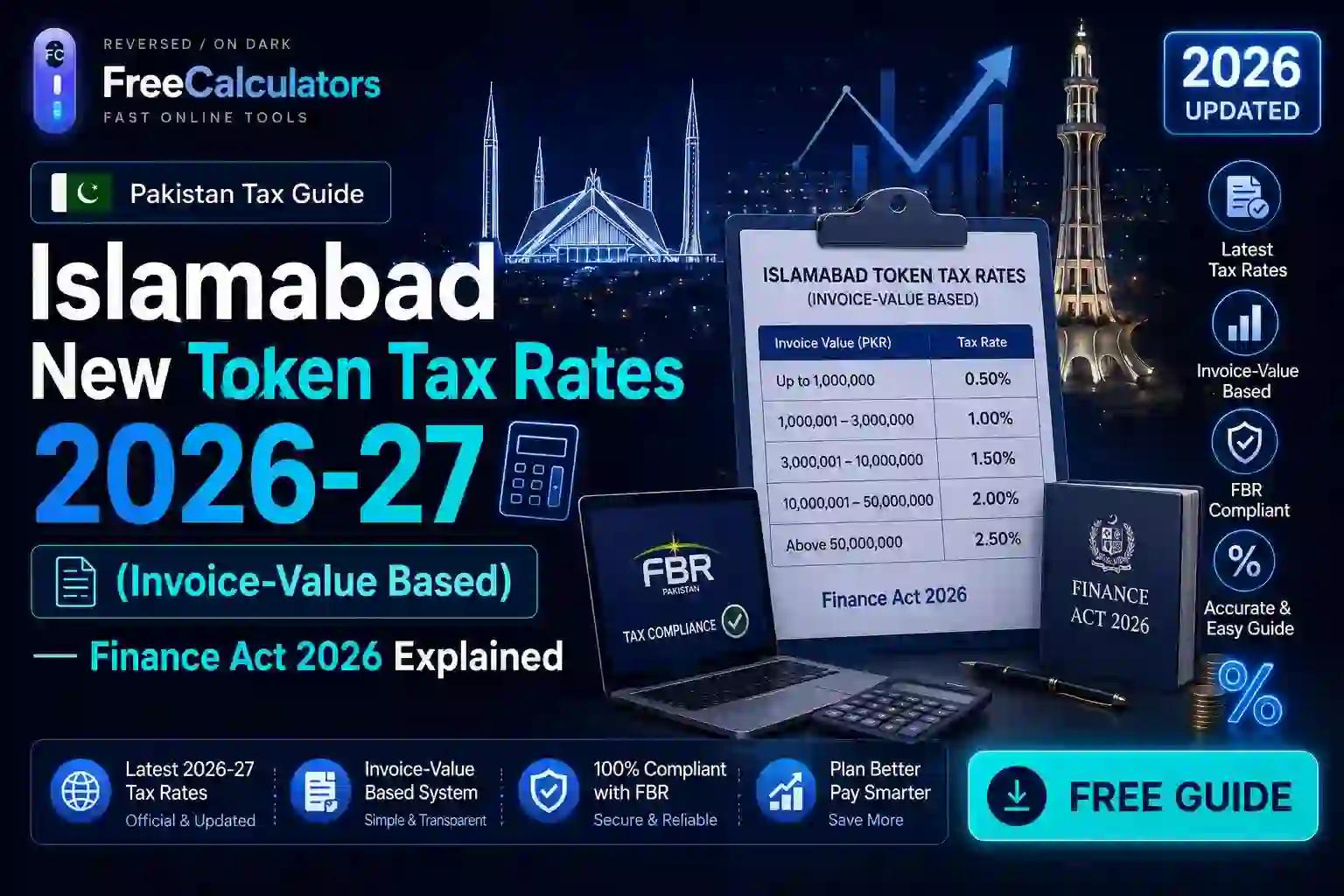
If you own a vehicle registered in Islamabad, your annual token tax bill just changed in a big way. Starting July 1, 2026, the Finance Act 2026 replaced the old flat, engine-capacity-based token tax system with a new invoice-value model for most vehicle categories. Whether you drive a compact hatchback or a full-size SUV, this shift affects how much you pay every year to keep your car legally on the road.
In this guide, we'll break down the complete new rate structure, show you how the invoice-value formula actually works with real numbers, compare it to the old system, and answer the questions vehicle owners across Islamabad are asking right now.
What Is Token Tax, and Why Did Islamabad Change the System?
Token tax is the annual fee every vehicle owner pays to the Excise and Taxation Department to keep their car's registration valid. Skip it, and you risk fines, delays at vehicle verification, or complications when transferring ownership.
For decades, Islamabad Capital Territory (ICT) calculated this tax using a simple engine-capacity formula: every car in a given cc bracket paid the same flat rupee amount, regardless of whether it was a stripped-down base model or a fully loaded top variant. A basic 1800cc sedan and a heavily optioned 1800cc SUV paid identical token tax, even though one might cost twice as much as the other.
The federal government decided this was no longer fair or realistic. Under the Finance Act 2026, which amended the West Pakistan Motor Vehicles Taxation Act, 1958 as applied to the Islamabad Capital Territory, token tax for most categories is now tied to a vehicle's original invoice value rather than just its engine size. The idea is straightforward: owners of higher-value vehicles should contribute proportionately more to public revenue.
Islamabad Token Tax Rates 2026-27: Complete Rate Chart
Here's the full breakdown of the new token tax structure under the Finance Act 2026, based on engine capacity and invoice value:
- Up to 1000cc — Rs. 20,000 (fixed flat rate)
- 1001cc to 1300cc — 0.25% of invoice value
- 1301cc to 1500cc — 0.25% of invoice value
- 1501cc to 2000cc — 0.25% of invoice value
- 2001cc to 2500cc — 0.35% of invoice value
- 2501cc and above — 0.35% of invoice value
A couple of things stand out immediately. First, small cars up to 1000cc — the Suzuki Alto, Suzuki Mehran, and similar entry-level hatchbacks — now pay a flat Rs. 20,000 every year, with no invoice calculation involved. Second, every category above 1000cc is taxed as a percentage of the vehicle's original invoice value, not its current resale price. That distinction matters a lot, because invoice value refers to what the manufacturer originally listed the car for, not what you could sell it for today.
This rate structure was first introduced through the Finance Bill 2026-27, examined by the National Assembly Standing Committee on Finance, and was formally passed into law as the Finance Act 2026, taking effect from July 1, 2026.
How the Invoice-Value Formula Actually Works
The math behind the new system is simple once you see it applied. Take your vehicle's original invoice value and multiply it by the applicable percentage for your engine-capacity bracket.
Example 1: A 1300cc sedan with an invoice value of Rs. 4,500,000 falls in the 0.25% bracket. Rs. 4,500,000 × 0.25% = Rs. 11,250 annual token tax.
Example 2: A 1800cc crossover with an invoice value of Rs. 6,800,000 also falls in the 0.25% bracket (since it's under 2000cc). Rs. 6,800,000 × 0.25% = Rs. 17,000 annual token tax.
Example 3: A 2500cc SUV with an invoice value of Rs. 12,000,000 falls in the 0.35% bracket. Rs. 12,000,000 × 0.35% = Rs. 42,000 annual token tax.
Example 4: A 660cc hatchback, regardless of its invoice value, simply pays the flat Rs. 20,000 rate since it's under 1000cc.
Notice how two cars in the same cc bracket can end up paying very different token tax amounts, simply because one has a higher invoice value than the other. That's the whole point of the reform — it shifts the burden toward higher-value vehicles instead of treating every car in a bracket identically.
If you'd rather not do this math by hand every time, plugging your engine capacity and invoice value into an online Islamabad Token Tax Calculator gives you an instant, accurate figure without any guesswork.
Old vs New Token Tax System: What Actually Changed
The shift can be summed up in one line: engine size alone used to decide your tax bracket and your final bill — now it only decides your bracket, while invoice value decides the actual amount you pay.
Under the old system:
- Token tax was a fixed rupee amount per engine-capacity slab
- The vehicle's price had zero effect on the tax owed
- A basic trim and a premium trim in the same cc range paid identically
Under the new Finance Act 2026 system:
- Vehicles up to 1000cc still get a flat rate (Rs. 20,000)
- Everything from 1001cc to 2000cc pays 0.25% of invoice value
- Everything above 2000cc pays 0.35% of invoice value
- Higher-value vehicles pay more, even within the same engine-capacity bracket
For a side-by-side look at exactly how much more (or less) you'd pay under each system for specific cc brackets, our detailed old vs new token tax Islamabad comparison guide walks through the numbers bracket by bracket.
Token Tax for Motor Cabs and Commercial Vehicles
The Finance Act 2026 doesn't only apply to private passenger cars — it also sets revised rates for motor cabs operating in Islamabad. Based on the finalized structure:
- Up to 1000cc motor cabs — Rs. 600 annually
- 1001cc to 1300cc motor cabs — Rs. 1,000 annually
- 1301cc to 1500cc motor cabs — Rs. 1,700 annually
- Above 2500cc motor cabs — Rs. 4,200 annually
Public transport vehicles and larger commercial transport operators fall under a separate schedule within the same legislation, with rates structured around vehicle category and seating or load capacity rather than the private-vehicle invoice-value model. If you operate a cab or commercial fleet in Islamabad, it's worth confirming your exact bracket directly with the Excise and Taxation Department, since commercial classifications can vary based on registration type.
Real Vehicle Examples: What Islamabad Owners Can Expect to Pay
To make this more concrete, here's roughly what owners of some commonly driven vehicles in Islamabad might expect under the new structure, based on typical invoice values for their category:
- Suzuki Alto (660cc–1000cc): Flat Rs. 20,000 per year, unaffected by invoice value.
- Compact sedans in the 1300cc range (invoice value roughly Rs. 4–5 million): Approximately Rs. 10,000–12,500 annually at the 0.25% rate.
- Mid-size sedans in the 1500cc–1800cc range (invoice value roughly Rs. 5.5–7 million): Approximately Rs. 13,750–17,500 annually.
- Larger SUVs and crossovers above 2000cc (invoice value often Rs. 8 million and up): Roughly Rs. 28,000 or more annually at the 0.35% rate, scaling higher with the vehicle's actual invoice price.
Keep in mind these are illustrative estimates. Your exact figure depends entirely on your vehicle's documented invoice value, which you can find on your original sale receipt or registration paperwork. When in doubt, an online Vehicle Token Tax Calculator removes the guesswork and gives you a precise number in seconds.
How to Pay Token Tax in Islamabad
Paying your token tax doesn't have to mean spending your morning in a queue. Here's the general process:
- Gather your vehicle documents — you'll need your registration book and the original invoice showing your car's engine capacity and purchase price.
- Calculate the amount owed — use an online calculator or confirm the figure directly with the excise office.
- Generate your challan — this can typically be done online through the relevant e-payment portal, or in person at an Excise and Taxation office.
- Make the payment — through your bank, a mobile banking app, or an in-person counter, depending on what your local office supports.
- Save your payment receipt — you'll likely need it later for vehicle verification, resale, or renewal.
For office locations, required documents, and current timings, our Excise and Taxation Islamabad guide and Islamabad Excise Office timings page cover everything you need before heading out, so you don't arrive to find the office closed or on shortened hours.
Islamabad vs Punjab vs Sindh: How Does the New Rate Compare?
Token tax isn't standardized across Pakistan — each province and territory sets its own structure. Islamabad Capital Territory now runs on this new invoice-value model under the Finance Act 2026, while Punjab and Sindh continue to apply their own separate engine-capacity-based schedules, at least for now.
This matters if you're relocating, deciding where to register a newly purchased vehicle, or simply curious how your token tax bill would differ across the border into Rawalpindi. You can compare figures directly using our Punjab Token Tax Calculator and Sindh Car Token Tax Calculator, or get a full side-by-side breakdown in our province-wise token tax guide for Pakistan.
Who Might Be Exempt or Treated Differently?
While the new rates apply broadly across Islamabad, a handful of categories typically receive different treatment under vehicle tax law in Pakistan:
- Government-owned and official vehicles
- Diplomatic vehicles registered under diplomatic status
- Certain older or vintage vehicles falling under legacy or transitional provisions
- Electric vehicles, which are generally taxed through separate customs and excise duty frameworks tied to import value rather than the standard token tax brackets
If you think your vehicle might qualify for different treatment, confirm directly with your local Excise and Taxation office, since exemption rules can be updated administratively even after the main legislation takes effect.
Does Filer vs Non-Filer Status Affect Your Token Tax?
Token tax itself applies the same way regardless of whether you're an active FBR filer. However, your filer status still matters at other stages of vehicle ownership — particularly through higher advance and withholding tax rates charged at the time of registration or when transferring ownership. If you're unsure how this affects your total cost of vehicle ownership, our filer vs non-filer vehicle tax in Pakistan breakdown explains exactly where the differences show up.
Becoming an active tax filer is generally the smarter long-term move for anyone who owns or plans to buy a vehicle, since it reduces costs across multiple touchpoints beyond just annual token tax.
Frequently Asked Questions
What are the new token tax rates in Islamabad for 2026-27? Vehicles up to 1000cc pay a flat Rs. 20,000 annually. Vehicles from 1001cc to 2000cc pay 0.25% of their invoice value, and vehicles above 2000cc pay 0.35% of invoice value, under the Finance Act 2026.
When did the new Islamabad token tax rates take effect? The revised rates became effective from July 1, 2026, following passage and official notification of the Finance Act 2026.
Is token tax now based on invoice value instead of engine capacity? Partly. Engine capacity still determines which tax bracket a vehicle falls into, but within brackets above 1000cc, the actual amount owed is calculated as a percentage of the vehicle's original invoice value rather than a flat fee.
What is the token tax rate for motor cabs in Islamabad? Motor cabs up to 1000cc pay Rs. 600 annually, 1001cc–1300cc pay Rs. 1,000, 1301cc–1500cc pay Rs. 1,700, and cabs above 2500cc pay Rs. 4,200, based on the finalized commercial vehicle schedule.
How can I calculate my token tax under the new invoice-value system? Multiply your vehicle's original invoice value by the percentage rate for your engine-capacity bracket (0.25% or 0.35%), or use an online Islamabad Token Tax Calculator for an instant result.
Are Islamabad's token tax rates the same as Punjab or Sindh? No. Each province and territory sets its own token tax structure. Islamabad now uses the invoice-value model under the Finance Act 2026, while Punjab and Sindh continue to apply their own separate rate schedules.
Final Thoughts
The Finance Act 2026 represents one of the most significant changes to vehicle taxation in Islamabad in years. Moving from a flat, engine-based system to an invoice-value model means owners of higher-value vehicles will pay noticeably more, while budget-friendly small cars remain largely unaffected. If you're planning to buy, sell, or simply budget for your next payment, knowing exactly where your vehicle falls under this new structure is essential.
Rather than estimating on your own, plug your vehicle's engine capacity and invoice value into our free Islamabad Token Tax Calculator for an instant, accurate figure based on the current 2026-27 rates. For the official legislative text, you can also refer to the Finance Bill 2026 document published by Pakistan's National Assembly.
Vehicle tax rules change fast — bookmark this guide, share it with fellow car owners in Islamabad, and check back as further clarifications roll out for the 2026-27 fiscal year.