
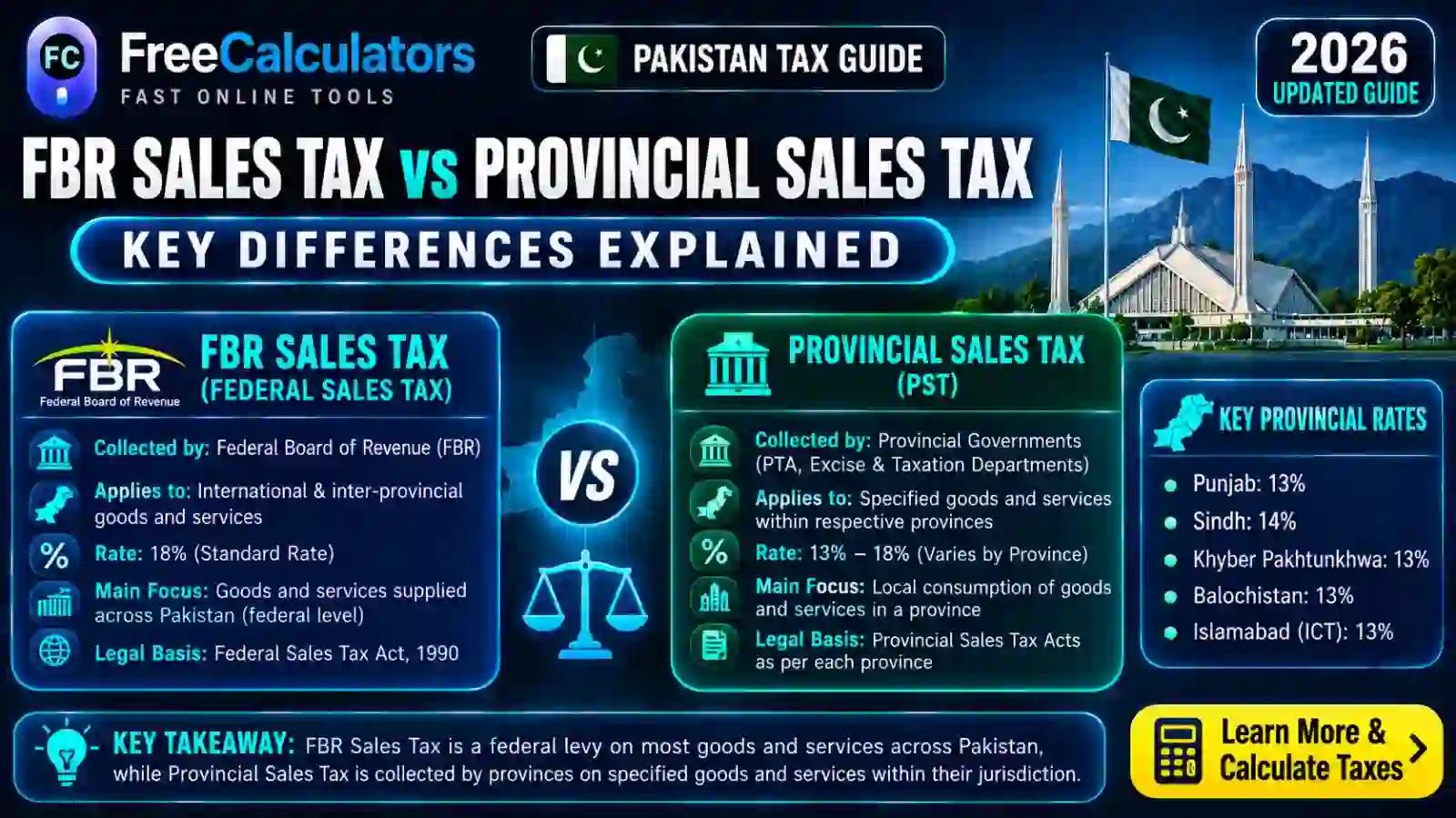
If you're running a business in Pakistan, the short answer is this: the Federal Board of Revenue (FBR) collects sales tax on goods at a standard rate of 18%, while sales tax on services is a provincial matter, handled separately by the Sindh Revenue Board (SRB), Punjab Revenue Authority (PRA), Khyber Pakhtunkhwa Revenue Authority (KPRA), and Balochistan Revenue Authority (BRA), each charging somewhere between 15% and 16% depending on the service and province. Islamabad is the one exception — FBR handles both goods and services tax there under a separate ordinance.
That single distinction — goods go to FBR, services go to the provinces — trips up more business owners than almost any other tax question in Pakistan. A restaurant owner registers with FBR thinking sales tax is sales tax, only to get a notice from SRB months later. A freelance developer in Lahore assumes their invoice needs an FBR sales tax number, when actually PRA is who they should be registering with. This guide breaks down exactly why this split exists, who collects what, and how to figure out which authority actually applies to your business.
Why Pakistan Has Two Separate Sales Tax Systems
This split isn't an accident or a bureaucratic quirk — it goes back to a specific constitutional change. Sales tax was originally a purely federal subject in Pakistan, formalized through the General Sales Tax Act of 1948 and later folded into the Sales Tax Act, 1990, which remains the governing law for goods-based sales tax today.
Everything changed with the 18th Constitutional Amendment, passed in 2010, which devolved the constitutional right to tax services from the federal government to the provinces. This was part of a broader push toward provincial autonomy following Pakistan's 7th NFC Award. In practical terms, it meant provinces could now legislate and collect their own sales tax on services rather than relying on FBR to do it on their behalf.
Sindh moved first, establishing the Sindh Revenue Board (SRB) in 2011. Punjab followed by creating the Punjab Revenue Authority (PRA) and passing the Punjab Sales Tax on Services Act, 2012. Khyber Pakhtunkhwa and Balochistan set up their own equivalents — KPRA and BRA — soon after. Islamabad Capital Territory (ICT) is the outlier here: since it isn't a province, it doesn't have its own revenue authority, so FBR continues to collect sales tax on services rendered within ICT under the separate Islamabad Capital Territory (Tax on Services) Ordinance, 2001.
FBR Sales Tax vs Provincial Sales Tax: The Core Comparison
Here's the distinction laid out directly, since this is the part most people actually search for.
| Aspect | FBR Sales Tax | Provincial Sales Tax |
|---|---|---|
| What's taxed | Goods (manufactured, imported, sold) | Services |
| Collecting authority | Federal Board of Revenue | SRB, PRA, KPRA, BRA (province-specific) |
| Governing law | Sales Tax Act, 1990 | Provincial Sales Tax on Services Acts (2011–2013) |
| Standard rate | 18% | 15–16% (varies by province and service type) |
| Registration portal | IRIS (iris.fbr.gov.pk) | Province-specific portals (e.g., PRA's eSST) |
The rule of thumb that actually holds up in practice: if you're selling a physical product, FBR is almost certainly your authority. If you're providing a service — consulting, IT development, restaurant service, freelance work, transportation, marketing — you're looking at a provincial revenue authority based on where that service is rendered or consumed, not FBR.
FBR Sales Tax: What It Covers and How It Works
FBR administers the General Sales Tax (GST) on goods under the Sales Tax Act, 1990, functioning much like a VAT system — tax is charged at each stage of the supply chain, but registered businesses reclaim what they paid on inputs, so the actual burden lands on the final consumer.
Standard FBR Rates
The standard sales tax rate on most taxable goods remains 18%. Certain categories carry reduced rates, zero-rating (for exports, primarily), or full exemption under the Sixth Schedule of the Sales Tax Act — this includes specific food items, agricultural inputs, and some pharmaceutical products. There's an important distinction worth understanding here: zero-rated supplies let you charge 0% while still reclaiming input tax on your purchases, whereas exempt supplies mean you charge no tax but also can't reclaim input tax paid — a difference that has real financial consequences for how a business structures its supply chain.
Who Needs to Register with FBR
If you manufacture, import, or wholesale taxable goods above the registration threshold, FBR registration and a Sales Tax Registration Number (STRN) are mandatory. You'll need an active National Tax Number (NTN) first — if you don't have one yet, this guide on what an NTN is and how to get one walks through the prerequisite step before sales tax registration becomes possible.
Registration happens entirely online through FBR's IRIS portal. Once registered, you're expected to file monthly returns reconciling your output tax (charged on sales) against admissible input tax (paid on purchases), with the difference remitted to FBR. Missing your Active Taxpayer List (ATL) status has real consequences — non-filers face significantly higher withholding tax rates across banking, property, and vehicle transactions, so staying compliant isn't just about avoiding penalties on the sales tax return itself. This breakdown of the FBR Active Taxpayer List explains what ATL status actually affects.
FBR's Role in Islamabad
Because ICT isn't a province, it has no independent revenue authority. FBR fills that gap, collecting sales tax on services rendered within Islamabad under the ICT (Tax on Services) Ordinance, 2001, generally at 15%, with a reduced 5% rate applying to specific service categories. This makes Islamabad a genuine exception to the "FBR does goods, provinces do services" rule — inside ICT, FBR does both.
Provincial Sales Tax: The Four Authorities Explained
This is where most of the confusion happens, because businesses assume "sales tax" means one single system. It doesn't — each province runs its own independent authority, own legislation, own registration portal, and its own rate structure.
Sindh Revenue Board (SRB)
SRB was the first provincial revenue authority established after the 18th Amendment, launched in 2011. It collects sales tax on services rendered in or from Sindh, covering categories like restaurants, telecommunications, professional services, advertising, and insurance. The standard SRB rate currently sits around 15%, with telecom services taxed higher at 19.5%, and reduced rates (as low as 3%) applying to hospitals and clinics. For a deeper walkthrough of SRB-specific registration and compliance, see this SRB sales tax guide.
Punjab Revenue Authority (PRA)
PRA was established under the Punjab Sales Tax on Services Act, 2012, and administers sales tax on services rendered in or from Punjab. Its standard rate is 16%, again with telecom services taxed at the higher 19.5% rate. PRA's registration and filing system runs through its own online portal, separate entirely from FBR's IRIS. This guide on PRA tax registration in Pakistan covers the practical registration steps in more detail.
Khyber Pakhtunkhwa Revenue Authority (KPRA)
KPRA handles the same function for services rendered in KP province, operating under its own provincial sales tax on services legislation. Rate structures broadly mirror the pattern seen in Punjab and Sindh — a standard rate in the 15–16% range, with sector-specific variations.
Balochistan Revenue Authority (BRA)
BRA is the newest and least digitally developed of the four provincial authorities, administering sales tax on services within Balochistan. The underlying framework — provincial jurisdiction over services, separate registration, separate filing — follows the same pattern established by the other three.
Why Rates Differ Slightly Between Provinces
Because each province legislates independently, rates aren't identical even though they're close. A marketing agency charging Rs. 500,000 for services delivered to a client in Punjab applies PRA's 16% rate (Rs. 80,000), while the same agency serving a client in Sindh applies SRB's 15% rate (Rs. 75,000) instead. This "place of provision" principle — where the service is rendered or where the recipient is located — is exactly where multi-province businesses most often get their compliance wrong.
Goods vs. Services: How to Tell Which Applies to You
This is genuinely the most practical question in this entire topic, so it's worth a dedicated breakdown.
You likely fall under FBR (goods) if you:
- Manufacture physical products
- Import goods for resale
- Operate as a wholesaler or retailer of tangible items
- Sell through e-commerce platforms shipping physical products
You likely fall under a provincial authority (services) if you:
- Run a restaurant, salon, or hospitality business
- Provide IT, software development, or consulting services
- Operate a courier, logistics, or transportation business
- Work as a freelancer providing digital services
- Provide advertising, marketing, or professional (legal, accounting) services
You might need both if your business involves a mix — a manufacturer that also offers installation or maintenance services, for example, may need FBR registration for the goods component and a provincial registration for the service component. Companies operating in multiple provinces (a Lahore-based agency serving clients in Karachi and Islamabad, say) may need multiple provincial registrations simultaneously, plus FBR involvement if any goods or ICT-based services are part of the mix.
Registration: What Comes First
Regardless of whether you end up registering with FBR, a provincial authority, or both, there's a fixed starting point: you need an active NTN before any sales tax registration — federal or provincial — can proceed. Provincial portals like PRA's system are explicitly built on top of your existing FBR NTN rather than functioning as a separate identity system.
Once your NTN is active, the next step is a Sales Tax Registration Number, commonly abbreviated STRN. This guide to what an STRN is explains how it's issued and why it matters for every invoice you generate going forward. From there, FBR registration happens through the IRIS portal, while provincial registration happens through each authority's own dedicated system — there's no single unified portal covering both federal and provincial sales tax.
Input Tax Adjustment Across Federal and Provincial Systems
Here's a nuance that catches even experienced business owners off guard: because FBR and the provincial authorities operate as legally separate tax systems, input tax paid under one system generally cannot be freely adjusted against output tax owed under the other. A business that pays FBR sales tax on goods purchased as raw materials, but then provides a taxable service billed under PRA, can't automatically net the two against each other the way you would within a single system.
There are specific adjustment mechanisms and exceptions that exist between some federal-provincial combinations, but they're narrower than most people assume, and getting this wrong is a common source of under- or over-payment. If your business regularly deals with both goods and services across jurisdictions, this is exactly the kind of situation where a session with a tax professional pays for itself — the interaction between systems is genuinely more complex than either system is on its own.
GST vs Sales Tax: Clearing Up the Terminology
One more source of confusion worth addressing directly: in everyday conversation, invoices, and even news coverage, "GST" and "sales tax" are used interchangeably in Pakistan, and that's technically correct — General Sales Tax is simply the formal name for the same tax administered under the Sales Tax Act, 1990. If you're searching for background on how this terminology works and where it applies, this explainer on what GST means in Pakistan covers the terminology in more depth. It's also worth understanding how sales tax differs conceptually from income tax, since the two are frequently confused despite taxing entirely different things — this comparison of income tax vs. sales tax in Pakistan lays out that distinction clearly.
Practical Compliance Tips for Businesses Operating Across Jurisdictions
If your business genuinely spans multiple categories or provinces, a few practical habits go a long way toward avoiding compliance headaches:
- Map your revenue streams first. Before registering anywhere, separate your income into "goods" and "services" categories, then further separate services by the province where they're rendered or consumed.
- Register proactively, not reactively. Waiting for a notice from SRB or PRA after FBR registration alone is a common and avoidable mistake — if you know you provide taxable services, register with the relevant provincial authority from the start.
- Track place-of-provision carefully. For service businesses working across provincial lines, the applicable rate and authority depend on where the service is delivered or the client is based, not just where your business is headquartered.
- File on both systems independently. Federal and provincial returns run on separate monthly cycles with separate portals — treat them as two distinct compliance obligations, not one combined task.
- Verify rates before every invoice cycle, since provincial rates and FBR schedules are revised through periodic Finance Acts and SROs. A Pakistan sales tax calculator can help you apply current rates quickly rather than working from a rate you remember from a previous fiscal year, and an FBR tax calculator is useful for the federal side specifically.
If you're still building out your understanding of how filer status affects your broader tax position, this guide on becoming a tax filer in Pakistan is a useful companion piece, since ATL status intersects with sales tax compliance in ways that go beyond just the sales tax return itself.
For authoritative reference and the most current notified rates, FBR's own Sales Tax section remains the primary federal source, while each provincial authority publishes its own current rate schedules directly.
Frequently Asked Questions
What is the difference between FBR sales tax and provincial sales tax? FBR sales tax applies to goods across all of Pakistan, currently at a standard rate of 18%, under the Sales Tax Act, 1990. Provincial sales tax applies to services and is collected separately by each province's own authority — SRB in Sindh, PRA in Punjab, KPRA in KP, and BRA in Balochistan — generally at rates between 15% and 16%.
Who collects sales tax on services in Pakistan? Sales tax on services is collected by the relevant provincial revenue authority based on where the service is rendered or consumed — SRB for Sindh, PRA for Punjab, KPRA for Khyber Pakhtunkhwa, and BRA for Balochistan. In Islamabad Capital Territory, since there's no provincial authority, FBR collects services tax under a separate ordinance.
Why does Pakistan have separate federal and provincial sales tax systems? This split traces back to the 18th Constitutional Amendment of 2010, which devolved the constitutional authority to tax services from the federal government to the provinces. Goods remained under federal jurisdiction, while each province subsequently created its own revenue authority to collect tax on services.
Can a business need to register with both FBR and a provincial revenue authority? Yes. Businesses that sell physical goods and also provide taxable services — or that operate across multiple provinces — often need both FBR registration for the goods component and one or more provincial registrations for services, since the two systems don't substitute for each other.
What is the current sales tax rate under FBR vs provinces? FBR's standard rate on goods is 18%. Provincial rates on services generally range between 15% and 16%, though specific categories like telecommunications are taxed higher (around 19.5%) and certain sectors, like healthcare, carry reduced rates.
How does input tax adjustment work across federal and provincial sales tax? Because FBR and provincial systems are legally distinct, input tax paid under one generally cannot be freely offset against output tax owed under the other, though limited adjustment mechanisms exist in specific circumstances. Businesses operating across both systems should confirm applicable rules with a tax professional rather than assuming automatic offset.
Is sales tax on restaurants collected by FBR or the province? Restaurants provide a service, so sales tax on restaurant bills is collected by the relevant provincial authority — SRB, PRA, KPRA, or BRA depending on location — not FBR, except within Islamabad Capital Territory, where FBR handles it directly.
What happens if a business registers with the wrong tax authority? Registering only with FBR when your business actually provides taxable services (or vice versa) typically results in non-compliance with the correct authority, which can lead to penalties, notices, and complications maintaining Active Taxpayer status once the provincial authority identifies the gap.
Final Takeaway
The FBR-versus-provincial sales tax split in Pakistan comes down to one core principle: goods are federal, services are provincial, and Islamabad is the exception where FBR handles both. Getting this right from the start — registering with the correct authority based on what you actually sell, not just registering with FBR by default — saves businesses from the compliance headaches and penalties that come from discovering the mismatch months or years later.
If your business spans goods and services, or operates across more than one province, take the time to map your revenue streams against the right authority before your next registration cycle. And whichever side of the goods-services line you fall on, verifying current rates against a live sales tax calculator before invoicing beats relying on last year's rate schedule — especially with how frequently these figures shift through Finance Act updates.