
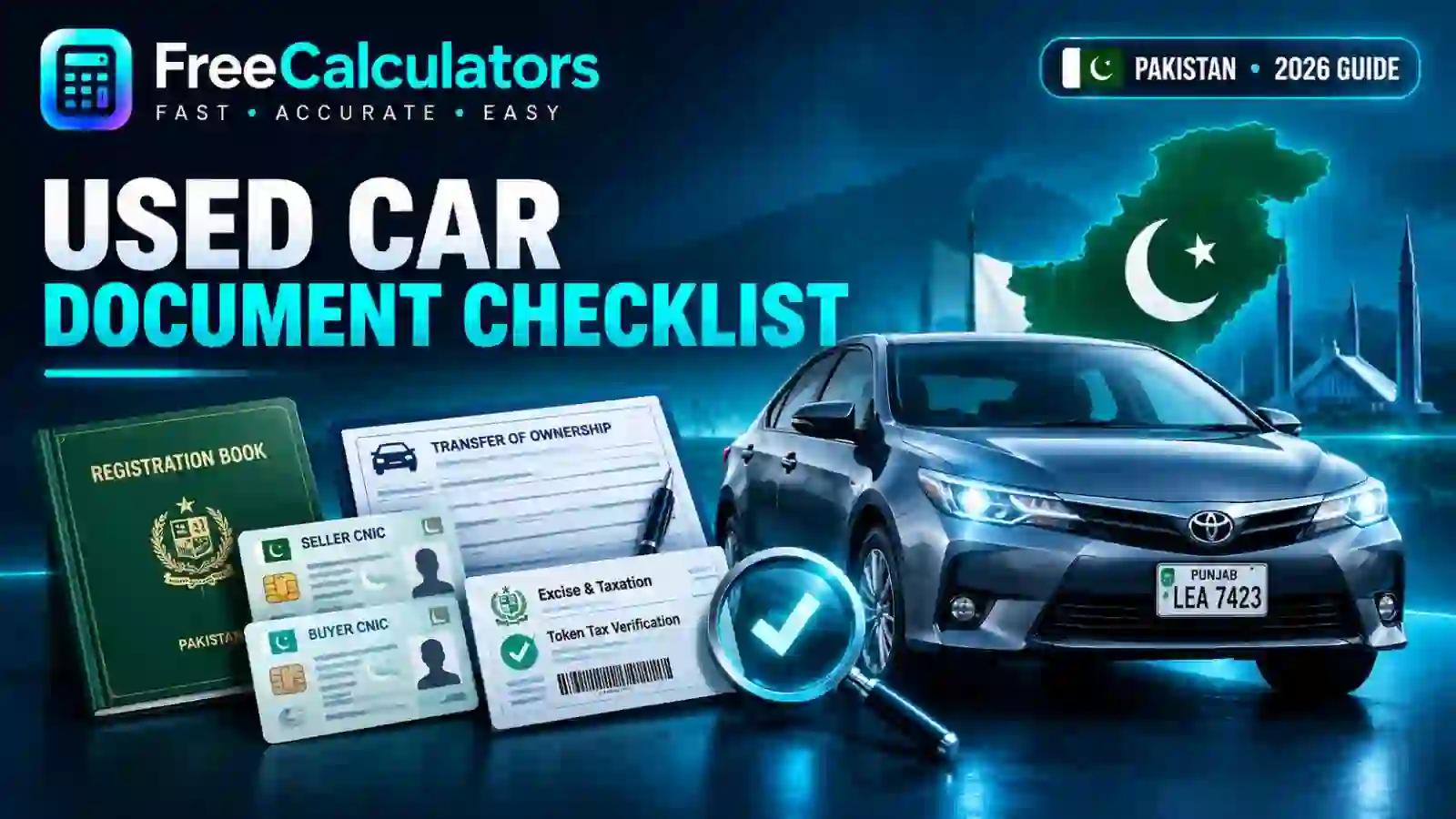
Every year, thousands of used car buyers in Pakistan hand over their money before realizing the seller wasn't even the registered owner, or that the vehicle still carries an unpaid bank loan. The car itself might run perfectly. The paperwork behind it is what actually decides whether you legally own it.
Buying a used car is usually treated like a mechanical decision — check the engine, test the brakes, negotiate the price. But the deal isn't safe until the paperwork checks out and the ownership transfer is completed correctly. This guide walks through exactly which documents to verify, what each one protects you from, and how the transfer process actually works province by province in 2026.
Why Documents Matter More Than the Test Drive
A car with a clean engine and a messy paper trail is still a bad purchase. Here's what's actually at stake if you skip document verification:
- Ownership disputes — if the seller isn't the registered owner, you may never get a clean transfer, no matter how much you paid.
- Hidden bank financing — a car under an active hire purchase agreement technically belongs partly to the bank, not the seller.
- Unpaid token tax and challans — these debts often follow the vehicle, not the previous owner, meaning you inherit them.
- Fraud and duplicate registration books — a surprisingly common scam involves selling the same vehicle to multiple buyers using forged documents.
None of this shows up on a test drive. It only shows up when you actually read the paperwork.
The Core Documents to Check Before Buying
1. Original Vehicle Registration Book (or Smart Card)
This is the single most important document in the entire transaction. It confirms who the vehicle is officially registered to, and in most provinces, it's now being replaced by a Smart Card version issued by the Excise Department.
What to actually verify:
- The registered owner's name matches the CNIC of the person selling the car to you
- The chassis number and engine number printed in the book match the numbers physically stamped on the vehicle
- The document isn't a photocopy — always insist on the original
- There's no visible tampering, overwriting, or mismatched printing style, which are common signs of a duplicate or forged book
Duplicate registration book fraud is a real and recurring problem in Pakistan's used car market. Buyers have lost money to sellers presenting a duplicate book for a vehicle that's already sold, financed, or even stolen. If anything about the book looks inconsistent, it's worth pausing the deal until you can verify it directly with the relevant excise office.
2. Seller's CNIC and Ownership Match
Before any money changes hands, confirm that the person sitting across from you is actually the person named on the registration document. This sounds obvious, but it's one of the most commonly skipped steps.
If the seller isn't the registered owner, ask directly:
- Who is the registered owner, and why are they not present?
- Is this a family member, an agent, or someone selling on commission?
- Will the actual registered owner be available to complete the biometric verification step?
- Will the local Excise authority even accept a transfer arranged this way?
Simply having possession of the car, the keys, or an unsigned transfer form doesn't prove legal ownership. If the registered owner can't personally complete their side of the transfer, the deal carries real risk regardless of how convincing the seller sounds.
3. Token Tax Payment Status
Token tax (also called vehicle tax) needs to be current before you take over the vehicle. An unpaid token tax balance doesn't disappear when ownership changes — it typically follows the vehicle's registration record, meaning you could inherit someone else's unpaid tax history.
Before finalizing the purchase, ask the seller for proof of the latest token tax payment, and independently verify it if possible. Our guide on how to check vehicle token tax online in Pakistan walks through how to confirm this yourself rather than relying on the seller's word. If you're unsure what the current rate should look like for the vehicle's category, the Vehicle Token Tax Calculator gives you a quick reference point.
Token tax rules also differ by province, so it helps to know which jurisdiction the vehicle is registered under. If it's a Punjab-registered vehicle, the Punjab Vehicle Tax Calculator and our province-wise car token tax guide cover the differences in detail.
4. Outstanding Challan and Traffic Violation Check
Traffic violations (challans) tied to a vehicle's registration number can sometimes complicate a transfer, and unpaid violations are a cost you don't want to discover after you've already paid. Where an official traffic police or e-challan verification system is available in your city, use it to check the vehicle's registration number before finalizing anything.
It's worth noting that different jurisdictions handle unpaid challans differently — not every outstanding violation automatically blocks a transfer, but it's still something to settle or account for in the negotiated price rather than discovering it afterward.
5. Hire Purchase NOC / Bank Clearance Certificate
If the vehicle was ever purchased on a car loan or leasing arrangement, it may still be listed as financed even if the seller tells you it's "already paid off." A vehicle can appear completely clean on the surface while a bank or leasing company technically still holds a financial claim against it.
If the seller says the financing has been cleared, ask for the actual clearance document — commonly an NOC (No Objection Certificate) from the bank or leasing company confirming the Hire Purchase Agreement has been terminated. Punjab Excise, for example, specifically lists this NOC as a required document when a vehicle was previously financed. Be cautious of any seller who suggests the bank clearance will be "arranged after payment" — that arrangement puts all the risk on you, not them.
6. Sale Agreement (Bill of Sale)
A signed sale agreement isn't a substitute for the official ownership transfer, but it's still an important protective document. It should clearly state:
- Full names and CNIC numbers of both buyer and seller
- Vehicle make, model, registration number, chassis, and engine number
- Agreed sale price and payment method
- Date of the agreement
- A clause confirming the vehicle is free of loans, liens, and legal disputes to the seller's knowledge
Keep this agreement even after the official transfer is complete — it's useful documentation if a dispute or discrepancy surfaces later.
7. Vehicle Verification Through Official Portals
Depending on your province, there are official digital tools that let you verify a vehicle's registration status before committing to a purchase. In Islamabad, for instance, MTMIS (Motor Transport and Information System) allows online verification of registration details. Sindh and Punjab have their own province-specific verification channels tied to their Excise departments.
Running a vehicle's registration number through these systems, where available, adds an independent layer of confirmation beyond whatever documents the seller physically hands you.
How the Ownership Transfer Process Actually Works in 2026
Getting the keys and driving the car home doesn't mean the transaction is complete. The car isn't legally yours until the ownership transfer is processed by the relevant provincial Excise and Taxation Department, and in 2026, that process increasingly includes a mandatory biometric verification step.
Here's the general flow, though specifics vary by province:
- Document preparation — original registration book/smart card, CNICs of both parties, signed sale agreement, and proof of paid transfer fee.
- Transfer fee payment — in Punjab, this is often done through the ePay Punjab app, which generates a challan for the transfer.
- Biometric verification — both buyer and seller typically need to complete facial and fingerprint verification, confirming the registered owner has actually authorized the transfer. This is usually done through NADRA's e-Sahulat network, an excise-linked biometric system, or an approved digital channel like the Pak Identity app.
- Excise office submission — the physical documents, along with biometric confirmation slips, are submitted to the local Excise office or an authorized agent.
- Smart Card / updated registration issuance — once approved, the Excise Department issues an updated registration certificate or Smart Card in the buyer's name.
One detail that trips up a lot of buyers: on some digital platforms, the biometric verification step cannot even be initiated until the official Excise transfer fee has been paid first. NADRA's system typically functions as an identity-verification bridge, not a starting point — it requires an active, paid transfer request already sitting in the Excise database before the biometric portal for that vehicle unlocks. Trying to do it in the wrong order is a common source of frustration and delay.
For a full walkthrough specific to Punjab's digital process, see our NADRA e-Sahulat biometric vehicle transfer guide. If your vehicle is registered in Sindh, the process and portal differ — our Sindh vehicle registration guide covers that separately, and our broader vehicle ownership transfer in Pakistan guide compares the overall structure across provinces.
Is Biometric Verification Mandatory Everywhere?
In most provinces, yes — biometric verification of the seller (and often the buyer) is now a required step to confirm the registered owner genuinely agrees to the transfer, rather than someone using stolen documents to sell a vehicle without the actual owner's knowledge.
That said, the exact mechanism isn't identical across the country. Punjab has been rolling out biometric verification through its Pak Identity app alongside ePay Punjab, with the digital rollout still being phased in through 2026. Sindh offers its own online verification and digital transfer-related services, though the extent of what can be completed fully online versus what still requires an in-person excise visit can vary by district.
Because this is a detail that shifts by province and, at times, by month as digital rollouts continue, it's worth confirming the current requirement directly with your provincial Excise & Taxation Department before assuming a transfer can be completed entirely online. According to PakWheels' 2026 guide on transferring motor vehicle ownership in Pakistan, the transfer process now generally requires document verification, biometric confirmation, and an official record update — but the digital maturity of that process still differs meaningfully between provinces.
Province-Wise Differences Worth Knowing
Pakistan doesn't run one unified national vehicle transfer system — each province's Excise and Taxation Department manages its own process, fee structure, and level of digital access.
Punjab: Has the most actively evolving digital process, combining ePay Punjab for fee payment with the Pak Identity app for biometric confirmation. Final approval, however, often still requires a visit to the excise office depending on the district.
Sindh: Offers online verification tools and some digital transfer services, though buyers should confirm locally how much of the process can be completed remotely versus in person.
Islamabad: Uses the MTMIS system for vehicle verification, alongside the local excise office for transfer processing. Our Excise and Taxation Islamabad guide and Islamabad excise office timings page cover practical details if you're transacting in the capital.
If token tax penalties are a concern in your specific province, our guide to vehicle token tax late penalties across Punjab, Sindh, and KPK breaks down what happens if payments have lapsed before you take over the vehicle.
Filer vs Non-Filer: Does It Affect a Used Car Purchase?
Yes, indirectly. While buying a used car privately doesn't automatically trigger a withholding tax the way a property transaction does, filer status affects ongoing vehicle-related tax obligations, including token tax rates in several provinces, where non-filers are often charged at a higher rate than active filers.
If you're planning to register the vehicle in your name and want to understand how your filer status affects your ongoing costs, our guide on filer vs non-filer vehicle tax in Pakistan lays out the practical difference, and the FBR Active Taxpayer List (ATL) guide explains how to check or update your own status before completing the purchase.
A Real-World Scenario: What Skipping Verification Actually Costs
Consider a common situation: a buyer finds a well-maintained sedan at a fair price, negotiates quickly, and pays the full amount in cash the same day, trusting the seller's word that "everything is clear." Two weeks later, the buyer discovers the vehicle was still listed under an active hire purchase agreement with a bank, because the seller had stopped paying the loan months earlier and simply wanted to offload the car before repossession.
Because no NOC or bank clearance was ever requested, the buyer now has to prove they weren't part of the loan default, delay the transfer indefinitely, and in some cases, negotiate directly with the bank to resolve the vehicle's status before any ownership transfer can proceed. A five-minute document request before payment — asking for a clearance certificate — would have avoided the entire situation.
This is exactly the kind of outcome the checklist above is designed to prevent. None of it requires legal expertise; it just requires asking for the right paperwork before the money changes hands, not after.
Quick Pre-Purchase Checklist
Before you release full payment on a used car, confirm you have:
- [ ] Original registration book or Smart Card, with matching chassis and engine numbers
- [ ] Seller's CNIC matching the registered owner's name
- [ ] Current token tax payment proof
- [ ] No unresolved challans tied to the registration number
- [ ] Bank/lessor NOC if the vehicle was ever financed
- [ ] Signed sale agreement with full vehicle and party details
- [ ] A clear plan for completing biometric verification and the official transfer
If even one of these is missing or the seller seems reluctant to provide it, treat that as a reason to slow down, not a reason to push forward faster.
Frequently Asked Questions
What documents are required before buying a used car in Pakistan? At minimum, you need the original vehicle registration book or Smart Card, the seller's CNIC matched to the registered owner, proof of current token tax payment, a signed sale agreement, and a bank/lessor NOC if the vehicle was previously financed.
Is biometric verification mandatory for vehicle transfer? Yes, in most provinces biometric verification of the seller (and often the buyer) is now a required step in the ownership transfer process, confirming the registered owner has authorized the sale.
How do I check if a used car has unpaid token tax? You can verify token tax status through your province's official online vehicle verification portal, or ask the seller for a recent payment receipt and cross-check it independently before finalizing the purchase.
What if the seller is not the registered owner of the car? This is a significant red flag. Ask why the registered owner isn't present, confirm whether they'll personally complete their side of the biometric verification, and avoid proceeding until the actual owner is directly involved in the transfer.
Can vehicle ownership transfer be done fully online in Pakistan? Partially, depending on the province. Fee payment and some document submission can often be done digitally, but final approval and biometric confirmation frequently still require an in-person visit to the local excise office or an authorized e-facilitation center.
What is a Hire Purchase NOC and when do I need it? It's a clearance certificate from a bank or leasing company confirming that a vehicle's financing agreement has been fully paid off and terminated. You need it whenever the seller mentions the car was previously purchased through a loan or lease.
The Bottom Line
A used car purchase in Pakistan is only as safe as the paperwork behind it. The mechanical condition matters, but it's the registration book, the seller's identity match, the token tax status, and the financing clearance that actually determine whether you'll walk away with clean, undisputed ownership. Given how much biometric and digital verification requirements are still evolving province by province in 2026, always confirm the current process with your local Excise and Taxation Department before assuming a transaction can move faster than it actually can.
If you're getting ready to complete a transfer and want to check your expected token tax cost before you finalize the deal, the Vehicle Token Tax Calculator and province-specific tools like the Sindh Car Token Tax Calculator and Islamabad Token Tax Calculator give you a clear number to work from, rather than relying on the seller's estimate.