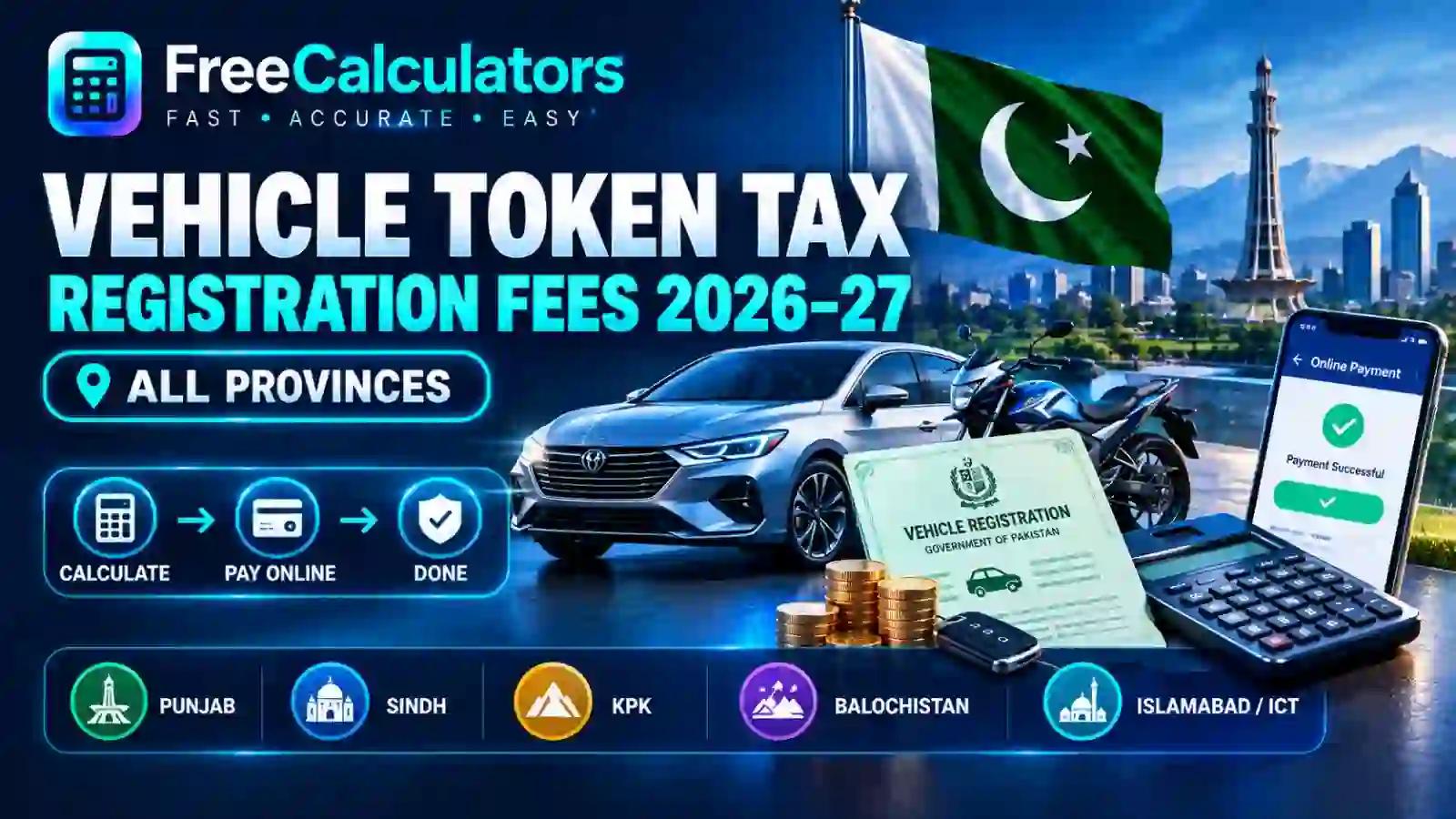
If you've ever tried to figure out exactly how much you owe on your car's token tax, you've probably noticed something frustrating: the answer isn't the same in Lahore as it is in Karachi, Peshawar, Quetta, or Islamabad. Pakistan doesn't run one national vehicle tax system — it runs five, each administered by a different Excise and Taxation Department, plus a separate federal layer collected by FBR on top of all of them.
This guide breaks down exactly how to calculate your vehicle token tax and registration fees for 2026-27, province by province, with real rupee examples for common engine sizes. We'll also cover the federal advance tax that gets added at the same counter, how filer status changes your final bill, and the fastest way to pay online without a trip to the excise office. Everything here reflects the framework as it stood after Finance Act 2026 — but because provincial schedules and federal withholding rates both get revised almost every year, we'll flag exactly where to double-check before you pay.
What Vehicle Token Tax Actually Is (And What It Isn't)
Vehicle token tax is an annual — or in some cases lifetime — provincial levy charged on every registered motor vehicle, collected by the relevant Excise and Taxation Department under provincial motor vehicle taxation laws. It's separate from three other charges people often lump together:
- Registration fee — a one-time charge paid when a vehicle is first registered, usually calculated as a percentage of the invoice value or a fixed amount by engine capacity
- Transfer fee — charged when ownership changes hands between buyer and seller
- Federal advance/withholding tax — a completely separate charge collected by FBR under the Income Tax Ordinance, 2001, alongside the provincial token or at registration
Confusing these four charges is the single biggest reason people underestimate what a new car or annual renewal will actually cost them. A full vehicle transaction can easily involve all four at once, and each one follows its own rulebook.
Why This Isn't One National Calculation
Motor vehicle taxation in Pakistan operates under the West Pakistan Motor Vehicles Taxation Act, 1958 and the West Pakistan Motor Vehicles Ordinance, 1965, but each province — and Islamabad Capital Territory separately — has amended and administers its own rate schedule. That means:
- Punjab and Islamabad now calculate token tax as a percentage of the vehicle's invoice value for most engine sizes
- Sindh, Khyber Pakhtunkhwa, and Balochistan still charge fixed rupee amounts based purely on engine capacity (cc)
- Each province sets its own registration fee structure, transfer charges, and rebate periods
- On top of all four provincial systems, FBR applies the same federal advance tax rules everywhere under Sections 231B and 234
This is exactly why a single flat formula doesn't work for this topic — and why a good vehicle token tax calculator needs separate inputs for province, vehicle type, engine capacity, invoice value, vehicle age, and filer status before it can give you an accurate number.
What You Need Before You Calculate
Gather these details first — vague inputs produce vague (and often wrong) results:
- Province or territory — Punjab, Sindh, KP, Balochistan, or Islamabad
- Vehicle type — motorcycle, car/jeep, commercial vehicle, or electric vehicle
- Engine capacity (cc) — printed on your registration book or vehicle manual
- Invoice or assessed value — required for Punjab and Islamabad's percentage-based bands
- Vehicle age — some federal charges phase out after five or ten years
- Taxpayer status — filer, late filer, or non-filer, since this can double or triple certain charges
- Transaction type — new registration, annual renewal, or ownership transfer, since each has a different fee structure
Step-by-Step: Using a Vehicle Token Tax & Registration Fee Calculator
Step 1: Select your province or ICT.
Choose Punjab, Sindh, Khyber Pakhtunkhwa, Balochistan, or Islamabad. This single choice determines which rate table applies — the calculator should never apply one universal formula across all five.
Step 2: Choose your vehicle category.
Motorcycles, cars/jeeps, and commercial vehicles are taxed under different schedules, and electric vehicles often qualify for exemptions or reduced rates depending on the province.
Step 3: Enter engine capacity and, where applicable, invoice value.
Sindh, KP, and Balochistan need only your engine cc. Punjab and Islamabad also need your invoice value, since both now charge a percentage of price for most engine bands above 1,000cc.
Step 4: Enter your vehicle's age.
This matters for two reasons: some provinces offer reduced lifetime tax rates for older vehicles, and the federal Section 231B advance tax stops applying once a vehicle passes five years from its first registration in Pakistan (Section 234 stops at ten years).
Step 5: Select filer, late filer, or non-filer status.
Confirm this against the Active Taxpayer List before assuming — non-filer rates on vehicles are among the steepest penalties in the entire tax code.
Step 6: Review the full breakdown.
A properly built calculator should separate the provincial token tax, the federal Section 234 charge, and (for a new purchase or transfer) the Section 231B advance tax, rather than bundling everything into one number you can't verify.
Step 7: Cross-check against the official department before paying.
Provincial schedules and federal rates both change through annual Finance Acts and notifications, so confirm the final figure against your province's Excise and Taxation Department or FBR's rate card before submitting payment.
Province-by-Province Token Tax Breakdown for 2026-27
Figures below reflect commonly reported schedules for 2026-27 following the provincial budgets and Finance Act 2026. Provincial notifications are issued and amended throughout the year, so treat these as a starting reference and confirm the exact figure through your province's official portal before paying.
Punjab: Percentage-Based System
Punjab has shifted most engine categories above 1,000cc to a value-based system, applying a percentage of the vehicle's invoice price rather than a flat rupee amount:
- Motorcycles: a fixed annual rate (commonly around Rs. 1,500)
- Vehicles up to 1,000cc: eligible for a one-time lifetime token tax, commonly cited around Rs. 20,000
- 1,001cc to 2,000cc: roughly 0.2%–0.3% of invoice value annually, depending on the specific value bracket
- Above 2,000cc: roughly 0.3%–0.4% of invoice value annually
Punjab also runs an early-payment rebate — commonly around 10% off if you pay by 31 August — so timing your annual payment matters more here than in most provinces. Full details are in our dedicated Punjab vehicle token tax calculator and Punjab vehicle tax guide for 2026.
Sindh: Fixed Engine-Capacity Bands
Sindh has kept a simpler, fixed-rate structure tied purely to engine size rather than invoice value:
| Engine Capacity | Approx. Annual Token Tax |
|---|---|
| Up to 1,000cc | Rs. 1,500 (or lifetime option) |
| 1,001–1,300cc | Rs. 2,000 |
| 1,301–1,600cc | Rs. 4,000 |
| 1,601–2,000cc | Rs. 4,500 |
| 2,001–2,500cc | Rs. 5,000 |
| Above 2,500cc | Rs. 7,000 |
Because Sindh's schedule is engine-based rather than price-based, a fully loaded 1,300cc sedan and a base-model 1,300cc hatchback pay exactly the same token tax — a real point of confusion for buyers used to Punjab's or Islamabad's value-linked system. Our Sindh vehicle token tax calculator applies these bands automatically, and our Sindh vehicle registration guide covers the registration side in detail.
Khyber Pakhtunkhwa: Fixed Rates, Digital Push
KP also charges fixed rupee amounts by engine capacity, broadly similar in structure to Sindh's bands, and the provincial government has been actively moving registration and token-tax payment into digital, cashless channels as part of a wider e-government push. Electric four-wheelers currently carry a full token-tax exemption in KP through a set future date, making EVs meaningfully cheaper to keep on the road here than in provinces without that concession.
Balochistan: Fixed Rates With Age-Based Discounts
Balochistan applies its own Schedule of Taxes and Fees, again structured around engine capacity, with lifetime tax options available for smaller vehicles and reduced rates as a vehicle ages past certain thresholds. Balochistan has also introduced a full motor vehicle tax waiver on electric vehicles through a multi-year window, one of the more generous EV incentives among the provinces.
Islamabad Capital Territory: The Big 2026 Change
Islamabad made the most significant shift of any jurisdiction in Tax Year 2027. Effective 1 July 2026, under Finance Act 2026, ICT moved away from its old flat, engine-capacity-based token table to an invoice-value system, echoing Punjab's model:
- Vehicles up to 1,000cc: a one-time lifetime token tax, commonly cited around Rs. 20,000
- 1,001cc to 2,000cc: roughly 0.25% of invoice value annually
- Above 2,000cc: roughly 0.35% of invoice value annually
This change hits higher-value vehicles hardest. A mid-range 1.8-liter sedan that previously paid a flat few thousand rupees a year can now owe considerably more once calculated against its actual invoice price, while smaller, cheaper cars under 1,000cc are unaffected. If you're registered in the federal capital, our detailed breakdown in Islamabad token tax rates for 2026-27 and the old-vs-new ICT comparison walk through real before-and-after examples, and you can run your own numbers through the Islamabad token tax calculator.
The Federal Layer: Section 231B and Section 234
No matter which province you're in, two federal charges under the Income Tax Ordinance, 2001 sit on top of your provincial token tax, and both are collected by the same excise counter on FBR's behalf.
Section 231B — Advance Tax on Registration or Transfer
This is a one-time advance tax charged when you register a new vehicle or transfer an existing one, calculated as a percentage of the vehicle's value that increases with engine capacity. It stops applying once a vehicle is more than five years past its first registration date in Pakistan. Filers pay the standard First Schedule rate; non-filers pay considerably more — commonly reported as three times the filer rate under the Tenth Schedule's specific proviso for this section, rather than the standard doubling that applies elsewhere.
Section 234 — Tax Collected With the Annual Token
This is a fixed annual amount collected alongside your provincial token tax, based purely on engine capacity, and it stops applying once a vehicle passes ten years old. Non-filers commonly pay double the filer amount here. Because it's collected in the same transaction as your token, it's easy to mistake this federal charge for part of the provincial tax — it isn't, and it's adjustable against your annual income tax liability if you keep the receipt.
Both charges are explained in more depth in our guide to how advance tax is calculated in Pakistan and our broader explainer on Pakistan withholding tax, since these vehicle charges are technically withholding/advance tax provisions rather than provincial excise duties.
Filer vs. Non-Filer: A Real Rupee Example
Here's where the numbers get personal. Say you're registering a new 1,500cc car with an invoice value of Rs. 4,000,000.
As a filer, Section 231B advance tax on a 1,500cc vehicle commonly sits in the range of 2% of value:
- Rs. 4,000,000 × 2% = Rs. 80,000
As a non-filer, the same section applies at roughly three times that rate — around 6%:
- Rs. 4,000,000 × 6% = Rs. 240,000
That's a Rs. 160,000 difference on registration alone, before you've even paid your first year's provincial token tax or the annual Section 234 charge — which is also commonly doubled for non-filers. Add in the fact that non-filers face steeper rates on property, banking, and services too, and the case for becoming an active filer before a major vehicle purchase becomes hard to ignore. See our comparison of filer vs. non-filer vehicle tax and the broader filer vs. non-filer guide for how this plays out across other transaction types.
New Registration vs. Annual Renewal vs. Ownership Transfer
These three transactions are often confused, but each carries a different combination of charges:
New vehicle registration typically bundles: registration fee (percentage of invoice value or fixed by category) + Section 231B advance tax + first year's token tax + any applicable smart card or number plate fee.
Annual token tax renewal is simpler — just the provincial token tax for that year, plus the Section 234 federal charge if the vehicle is under ten years old. Punjab's early-payment rebate (commonly through 31 August) and similar seasonal discounts elsewhere only apply at renewal, not at new registration.
Ownership transfer involves a transfer fee set by the province, plus Section 231B advance tax again (unless the vehicle is more than five years past first registration, in which case this federal portion is waived entirely). Biometric verification through NADRA e-Sahulat or similar systems is now standard for transfers in most provinces — our guide on biometric vehicle transfer and vehicle ownership transfer in Pakistan covers the documentation and process step by step.
How to Pay Vehicle Token Tax Online, Province by Province
Every province and ICT now offers a digital payment route, though the specific app or portal differs:
- Punjab — ePay Punjab app or the Excise and Taxation Department's online portal, generating a challan you can pay through mobile banking, ATM, or over-the-counter
- Sindh — the Excise, Taxation & Narcotics Control Department's online payment services and vehicle verification portal
- Khyber Pakhtunkhwa — increasingly shifted into KP's digital, cashless government-services initiative for both registration and token tax
- Islamabad — the PAK App (or City Islamabad App), where you sign in, check dues, generate a challan, and pay entirely from your phone
- Balochistan — payment through the provincial Excise and Taxation Department's designated channels; digital coverage here still lags behind Punjab, Sindh, and ICT
Whichever method you use, always download and save your payment receipt immediately — you'll need the reference number both to collect your physical token and to claim the federal Section 234/231B portion as adjustable tax on your annual return. For a full checklist, see our guide on checking and paying vehicle token tax online in Pakistan.
Common Mistakes People Make With Vehicle Tax Calculations
- Using an outdated rate table. Islamabad's entire calculation method changed on 1 July 2026 — anyone still using the old flat engine-based ICT chart will get a wrong number for Tax Year 2027.
- Confusing provincial token tax with federal advance tax. These are two different charges, collected by two different authorities, with two different rulebooks — treating them as one line item hides real cost.
- Forgetting invoice value matters in Punjab and Islamabad. Two identical-cc cars with different trim levels or import status can owe very different token tax in these two jurisdictions specifically, unlike Sindh, KP, or Balochistan.
- Ignoring the vehicle-age cutoffs. Section 231B stops at five years past first registration; Section 234 stops at ten years. Paying these on an older vehicle out of habit is a common overpayment.
- Not checking non-filer multipliers correctly. Most withholding sections double for non-filers, but Section 231B specifically triples — assuming a flat doubling across every vehicle charge will understate your actual bill.
- Skipping the early-payment rebate window. Provinces like Punjab offer a real percentage discount for paying by a set date each year; missing it is money left on the table for no reason.
- Not saving payment receipts. Without your challan reference, you can't claim the federal portion of your vehicle tax as adjustable against your annual income tax return.
Frequently Asked Questions
What is vehicle token tax in Pakistan?
It's an annual provincial tax charged on registered motor vehicles by the relevant Excise and Taxation Department, separate from the one-time registration fee, transfer fee, and federal advance tax collected by FBR at the same counter.
Is token tax the same in every province?
No. Punjab and Islamabad now calculate most token tax as a percentage of the vehicle's invoice value, while Sindh, Khyber Pakhtunkhwa, and Balochistan use fixed rupee amounts based purely on engine capacity.
Do filers and non-filers pay different vehicle taxes?
Yes, significantly. The federal Section 231B advance tax on registration or transfer is commonly triple the filer rate for non-filers, and the annual Section 234 charge is commonly double — on top of any provincial non-filer surcharge that may also apply.
How can I check my vehicle tax online?
Each province runs its own portal or app — ePay Punjab, Sindh's Excise online services, KP's digital government services, or the PAK App for Islamabad — where you can enter your registration number to view dues and generate a payment challan.
What happens if vehicle token tax goes unpaid?
Unpaid token tax typically blocks ownership transfer and vehicle resale, and most provinces apply escalating penalties the longer the payment is overdue.
Can I calculate vehicle tax before actually buying a car?
Yes — using a calculator with your intended province, engine capacity, expected invoice value, and filer status gives you a realistic total cost estimate, including federal advance tax, before you commit to a purchase.
Final Takeaway
Vehicle taxation in Pakistan isn't a single number you can memorize — it's five different provincial rate systems layered under one shared federal framework, and Islamabad just changed its entire method for Tax Year 2027. The only reliable way to know what you actually owe is to work through the calculation properly: pick your correct province, apply the right engine-capacity or invoice-value band, add the federal Section 231B or 234 charge where it applies, and confirm your filer status before you finalize the number.
Run your specific numbers through our Vehicle Token Tax Calculator — or jump straight to the Punjab, Sindh, or Islamabad tool for your specific jurisdiction — before you register, renew, or transfer a vehicle this year. For the full province-wise picture in one place, our province-by-province vehicle tax guide and late-payment penalty comparison are good next stops.