
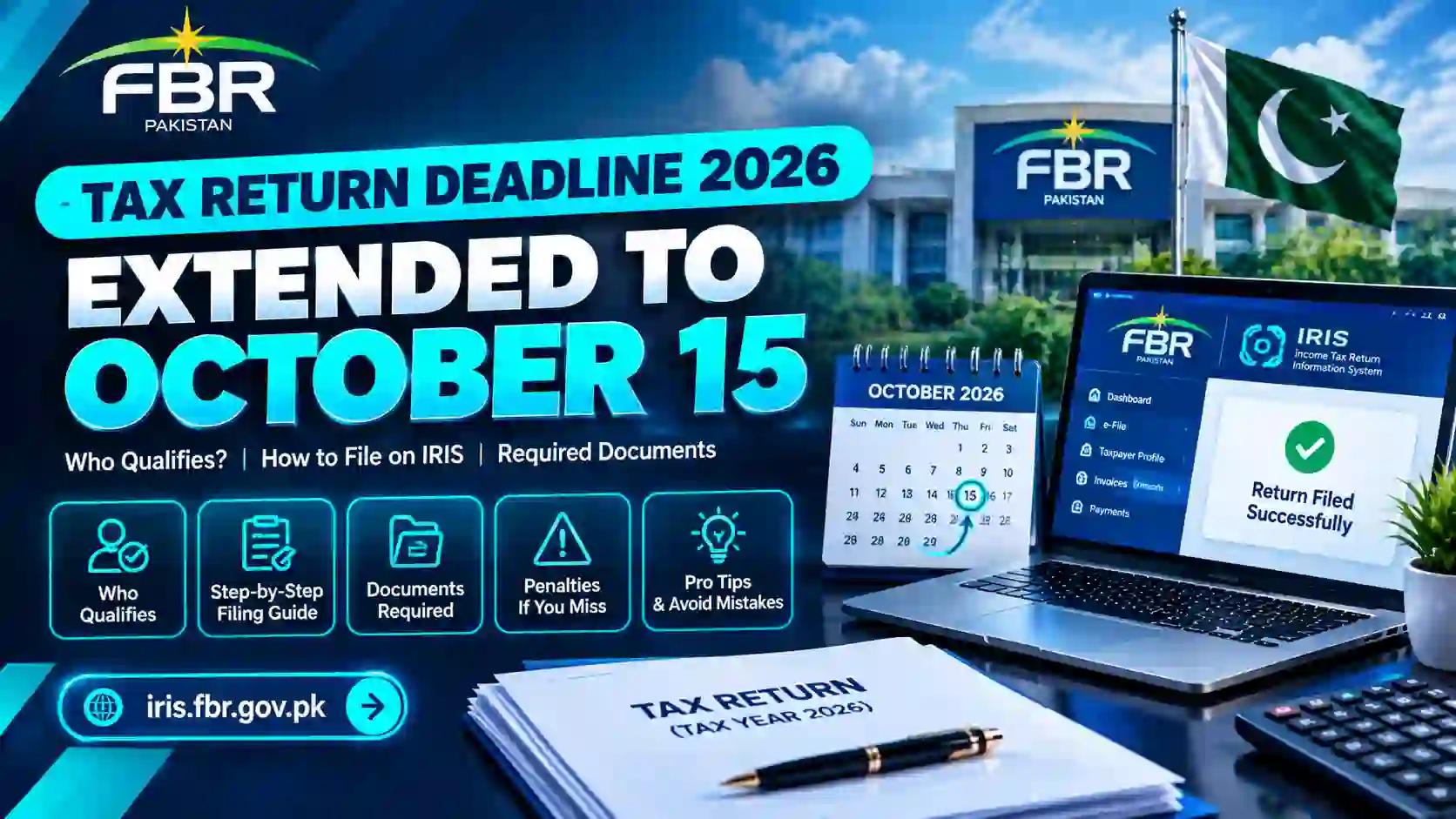
If you were still gathering salary slips or waiting on a bank statement on September 29, this extension is welcome news. You now have roughly two more weeks to file properly instead of rushing a return you might regret.
But a deadline extension is not a reason to relax. Every year, thousands of taxpayers lose the extra time to procrastination, then hit a crashed portal, a forgotten IRIS password or a wealth statement that won't reconcile on the final day.
This guide covers what the extension means, who it applies to, how to file step by step on IRIS, which documents to prepare, what happens if you miss the date, and how to avoid the mistakes that cause most filing headaches. If you want to see the earlier deadline context first, our FBR tax filing deadline 2026 article covers the standard framework.
The Official Announcement: What FBR Actually Said
FBR's circular extends the return filing date for Tax Year 2026 for persons who were originally required to file by September 30, 2026. The legal basis is Section 214A, which gives the Board power to extend the due date for filing returns.
A few facts anchor everything else in this guide:
- Original deadline: September 30, 2026
- Extended deadline: October 15, 2026
- Legal authority: Section 214A, Income Tax Ordinance, 2001
- Reference: FBR Circular No. 3 of 2026-27
- Tax year covered: Tax Year 2026 (income earned July 1, 2025 to June 30, 2026 for most individuals)
FBR also lists the extension among the current updates on its homepage. News outlets such as Dawn, Associated Press of Pakistan and The Express Tribune have reported it too. For legal certainty, though, rely on the FBR circular itself, not on a news summary or a social media screenshot.
Why Did FBR Extend the Deadline?
Extensions are usually granted when filing volumes are heavy and taxpayers or professional bodies ask for relief. Tax Year 2026 also coincided with the continued rollout of the IRIS 2.0 platform, which many taxpayers were still getting used to. We cover that in our FBR IRIS 2.0 tax filing guide.
FBR's circular is the authority on the extension itself. Treat any specific reason you read elsewhere as commentary, not an official finding.
Who Does the October 15 Extension Apply To?
The extension covers taxpayers whose Tax Year 2026 return was originally due on September 30, 2026. In practice, that includes most of these groups:
- Salaried individuals who must file annually
- Business individuals and sole proprietors
- Freelancers and self-employed professionals
- Associations of Persons (AOPs), such as partnerships, where their original due date was September 30
- Property owners earning rental income
- Individuals with taxable capital gains, dividends or other income
Quick Self-Check: Do You Need to File?
You should generally plan to file if any of these apply:
- Your taxable income crosses the threshold set for Tax Year 2026
- You were on the Active Taxpayer List (ATL) last year and want to stay there
- You own property, a vehicle above certain limits, or hold other assets that the law links to filing
- You hold an NTN or are registered as a business
- You earn income from freelancing, rent or investments
If you're unsure about your threshold, the income tax slabs for FY 2026-27 and our FBR tax slabs explained article break down the rates. You can also run your numbers through the income tax calculator before you open IRIS.
A Practical Warning About Companies
Companies and some other entities have different due dates depending on their financial year. The October 15 extension is specifically tied to those originally required to file by September 30. If you run a company, check the circular's wording against your own filing date, or ask your tax practitioner. Don't assume the extension automatically applies to you.
Original Deadline vs Extended Deadline: At a Glance
| Detail | Original | After Extension |
|---|---|---|
| Last date for Tax Year 2026 return | September 30, 2026 | October 15, 2026 |
| Legal basis | Standard due date under the Ordinance | Section 214A extension |
| Official reference | FBR due-date guidance | FBR Circular No. 3 of 2026-27 |
| Platform | IRIS | IRIS (IRIS 2.0 experience) |
| Extra days gained | None | Roughly 15 days |
Step-by-Step: How to File Your Tax Return on IRIS
You can file through the official FBR IRIS portal. If you want a deeper walkthrough with screenshots-style explanations, read our FBR IRIS income tax return guide alongside this section. New to the portal? Start with what the FBR IRIS portal is and how it works.
Step 1: Register or Log In to IRIS
If you already have an account, log in with your registered CNIC or NTN, your password and the PIN code FBR sent you. Make sure your mobile number and email are current, because IRIS sends verification codes to both.
If you don't have an NTN yet, you'll need to register first. Our explainer on what an NTN is shows what the number does and why you need it. Students and first-time filers can also look at student FBR registration. The broader process is in our guide to becoming a tax filer in Pakistan.
Practical tip: Do this on day one, not on October 14. Forgotten passwords and PIN problems are the most common reason people miss the final day.
Step 2: Gather Your Documents
Collect everything before you start entering numbers. A partly completed return that you abandon halfway is more stressful than a clean one done in one sitting.
Here's what most filers need:
- CNIC and NTN details
- Salary certificate or salary slips for the full year
- Bank statements and profit-on-debt certificates
- Details of tax already deducted (withholding certificates)
- Rental agreements and rent receipts, if you have rental income
- Property documents and purchase or sale records
- Vehicle registration details
- Business accounts, sales records and expense proof for business income
- Details of foreign remittances, for freelancers and overseas earners
- Opening and closing asset and liability details for your wealth statement
If your documents are scattered across several PDFs, our guide to combining tax documents into one PDF saves a lot of fumbling. For a broader checklist, see our tax season checklist for Pakistan 2026.
Step 3: Enter Income Under the Correct Heads
IRIS asks you to report income under separate heads. Putting income under the wrong head is a common source of notices later.
- Salary: Basic pay, allowances and perks. See FBR tax on salary 2026-27 for how salary is taxed, and the salary tax calculator to estimate it. Bonuses and gratuity have their own treatment, explained in bonus and gratuity tax in Pakistan 2026. Retirees can check pension tax rules.
- Business or profession: Gross receipts, allowable expenses and net profit. Our business income tax calculator guide helps with the math.
- Property: Rent received, less permitted deductions. Read rental income tax in Pakistan before you declare it.
- Capital gains: Profit from selling property or securities. See capital gains tax on property and stocks.
- Other sources: Profit on bank deposits, dividends, prizes and similar income.
- Agricultural income: Handled differently from other income. See agricultural income tax in Pakistan.
Step 4: Account for Tax Already Paid
Much of your tax may already have been deducted at source. Employers deduct tax from salary. Banks deduct tax on profit and certain transactions. Property and vehicle transactions carry advance tax.
Match these deductions against your withholding certificates and claim credit for them in the return. If you skip this, you may end up paying tax twice. To understand the types, see withholding tax in Pakistan and bank withholding tax, or check amounts with the withholding tax calculator. For taxes paid in advance, read how advance tax is calculated.
Step 5: Prepare and Reconcile Your Wealth Statement
This is where most people get stuck. The wealth statement lists your assets and liabilities, and the reconciliation must explain how your wealth changed during the year.
The logic is simple. Your opening net assets, plus your income and other inflows, minus your expenses and tax, should equal your closing net assets. If the numbers don't match, IRIS will flag it, or worse, FBR may query it later.
Common gaps that break the reconciliation:
- Forgotten bank accounts or small savings
- Gifts received from family that weren't recorded
- Personal expenses that were underestimated
- Foreign income brought in but not declared
- Gold, cash and vehicles omitted
If you're unsure how wealth tax concepts differ from income tax, our comparison of income tax vs wealth tax clears it up.
Step 6: Review, Submit and Download Your Return
Before you click submit, do three checks:
- Compare total income with your documents
- Confirm the tax paid and tax due figures
- Check that the wealth reconciliation shows no difference
Once submitted, download and save the return acknowledgment as a PDF. If tax is payable, pay it through the available payment channel and keep the payment confirmation, which includes the PSID and CPR reference.
A Realistic 14-Day Plan Before October 15
Having more time helps only if you use it well. Here's a simple schedule:
- Days 1 to 2: Log in, fix any password or PIN issues, update your mobile and email
- Days 3 to 5: Collect salary, bank and property documents
- Days 6 to 8: Estimate your tax with the FBR tax calculator
- Days 9 to 11: Draft the return and wealth statement
- Days 12 to 13: Reconcile, review and submit
- Day 14: Keep as your emergency buffer
Notice that submission happens two days before the deadline. That buffer is your protection against portal slowdowns.
Real-World Examples
Example 1: The Salaried Employee
Ayesha earns a fixed monthly salary from a private company in Islamabad. Her employer deducted tax every month. She assumed she didn't need to do anything.
She still needs to file, because filing is how she proves her income and maintains her filer status. Her return is simple: salary income, tax already deducted, and a wealth statement showing her savings and a small car loan. She can estimate her annual tax in minutes using the salary tax calculator and confirm her deductions against her salary certificate.
Example 2: The Freelancer
Bilal earns in dollars from overseas clients through a bank account in Pakistan. His income arrives irregularly, and he keeps poor records.
His biggest risk is under-reporting. He should compile bank credits, match them to invoices and report income and expenses properly. Our freelancer income tax guide for Pakistan and freelance tax checklist walk through this. If you work with foreign clients, cross-border tax compliance for freelancers is worth reading. Side-income earners may also find side hustle taxes 2026 helpful.
Example 3: The Landlord With a Vehicle
Imran rents out two shops and drives a car registered in his name. He pays advance tax on some transactions and receives rent monthly.
His return must show rental income with allowed deductions, his advance tax payments and his assets. Being on the ATL also affects what he pays when transferring property or a vehicle. See 236C and 236K tax rates for 2026-27 and FBR valuation vs DC rate for property for how property transactions are taxed.
Benefits of Filing Before October 15
Filing on time is not only about avoiding trouble. It affects what you pay in everyday transactions.
Staying on the Active Taxpayer List
The Active Taxpayer List (ATL) is FBR's list of taxpayers who have filed their returns. ATL status generally means lower withholding rates on many transactions. Our detailed article on the FBR Active Taxpayer List 2026 explains how to check your status and what it affects.
Lower Withholding Taxes
Filers typically pay lower rates than non-filers on bank transactions, property purchases, vehicle registration and similar activities. For a clear side-by-side, read filer vs non-filer in Pakistan and the vehicle-specific comparison, filer vs non-filer vehicle tax.
Credibility and Documentation
A filed return is proof of income. Banks, embassies, housing societies and business partners often ask for it. A clean filing history makes loans, visas and large purchases smoother.
Fewer Notices
Accurate, timely returns reduce the chance of queries. If you do receive a notice, see how to respond to an FBR tax notice.
What Happens If You Miss the October 15 Deadline?
Missing the deadline doesn't make filing impossible, but it does make it more expensive and complicated.
Late Filing Consequences
You may face:
- A default surcharge or penalty under the Income Tax Ordinance. Section 182 deals with penalties for failing to file a return, and the amount depends on your category and circumstances.
- Removal from or delay in joining the ATL. Late filers may face extra requirements or charges to be added to the list.
- Higher withholding rates on banking, property and vehicle transactions while you're off the list.
- Possible notices from the tax office asking you to explain the delay.
The exact penalty amounts and ATL-reinstatement rules depend on the current Ordinance and the Finance Act 2026. Verify them on the FBR site or with a tax professional, because we don't want you relying on a number that may have changed.
Can You File After the Deadline?
Yes, you can generally still file a late return. Do it as soon as possible, because the penalty exposure usually grows with delay. For more on getting back onto the list, see how to become a tax filer.
Common Filing Mistakes (and How to Avoid Them)
After years of watching tax seasons play out, a few errors keep repeating:
- Waiting for the last day. Portals slow down, and mistakes multiply under pressure.
- Ignoring small income sources. Profit on a savings account or occasional rent still counts.
- Wealth statement mismatches. Unrecorded gifts, cash and gold are the usual culprits.
- Wrong income head. Business income entered as "other sources" can trigger notices.
- Missing withholding credit. You lose money by not claiming tax already paid.
- Relying only on calculators. Calculators estimate, but IRIS is the legal record. Our guide on income tax calculator mistakes explains where estimates go wrong, and Pakistan tax calculator vs FBR IRIS shows how the two differ.
- Not saving proof. Always keep your return, payment receipt and supporting documents for several years.
If you want to reduce your legal tax burden, tax-saving tips for Pakistan 2026 covers lawful options.
IRIS Portal Problems: What to Do
Near a deadline, portal issues are common. Here's how to handle them.
If the portal won't load: Try a different browser, clear your cache and avoid peak hours. Early morning and late night are often smoother.
If you've forgotten your password: Use the password recovery option on the IRIS login page. This needs access to your registered mobile number or email, which is why updating contact details early matters.
If you get an error while submitting: Take a screenshot, note the time and try again later. Don't submit repeatedly. Save your draft where possible.
If nothing works: Contact FBR's taxpayer support through the official channels listed on the FBR website. For technical platform background, PRAL develops and supports many of FBR's IT systems. If you believe you've been treated unfairly by a tax office, the Federal Tax Ombudsman is the independent complaint forum.
For a plain-language overview of the platform's changes, revisit our IRIS 2.0 guide.
Special Cases Worth Knowing
First-Time Filers
If you've never filed, begin with NTN registration, then move to the return. The process is manageable once you understand the terms. Our essential tax terms glossary helps decode jargon like "taxable income," "tax credit" and "reconciliation."
Companies and High Earners
If you run a company, you may need a different compliance path, including SECP records. See how to register a company with SECP. High-income taxpayers should also read about super tax in Pakistan 2026 to see whether it applies to them.
Zakat and Income Tax
Many people confuse zakat with income tax. They are separate obligations with different purposes. See zakat vs income tax in Pakistan for the distinction.
Frequently Asked Questions
What is the FBR tax return deadline for 2026?
FBR extended the Tax Year 2026 income tax return deadline to October 15, 2026, from the original September 30, 2026, under Section 214A of the Income Tax Ordinance, 2001.
Has FBR extended the Tax Year 2026 filing date?
Yes. FBR Circular No. 3 of 2026-27 confirms the extension for taxpayers who were originally required to file by September 30, 2026. Check the FBR website for any later notification.
Is October 15, 2026 the final deadline?
October 15 is the current extended date. FBR has not stated that further extensions are impossible, but you shouldn't count on one. Plan to file well before the date.
How do I file my FBR return through IRIS?
Log in to the IRIS portal, gather your documents, enter income under the correct heads, claim tax already paid, complete your wealth statement and reconciliation, then review and submit. Our step-by-step IRIS return guide walks through each screen.
What happens if I miss the October 15 deadline?
You may face a penalty under Section 182, possible removal from or delay in joining the ATL, and higher withholding rates on certain transactions. You can still file late, and the sooner the better.
Do I need to submit a wealth statement?
Most individual filers must submit a wealth statement with their return, along with a reconciliation of wealth. Requirements can vary by taxpayer type, so confirm with FBR guidance or a tax practitioner.
Does filing a return automatically make me an active taxpayer?
Filing is the main step toward ATL status, but the list is updated on FBR's schedule, and certain conditions apply. Check your status on the FBR portal and read our ATL guide.
Can I revise a return after filing?
In many cases you can file a revised return within the time and conditions the law allows. If you spot an error, act quickly and confirm the current rules on IRIS or with a professional.
Final Takeaways and Next Steps
The October 15, 2026 extension gives you a genuine chance to file calmly. Use it wisely:
- Confirm the date on the official FBR website before you act.
- Fix your IRIS login today, not on deadline day.
- Collect documents first, then enter data.
- Reconcile your wealth statement until the difference reads zero.
- Estimate your tax with the income tax calculator or salary tax calculator.
- Submit by October 12 or 13, leaving a safety buffer.
- Save your acknowledgment and payment receipt for your records.
If you want to go deeper, browse all our Pakistan tax guides and explore the full range of free tax tools.